Knowledge base
1000 FAQs, 500 tutorials and instructional videos. Here, there are only solutions!
Infomaniak is an independent technology company based in Switzerland. It was founded in 1994 in Geneva and develops digital services for individuals, organizations, and businesses. The company is majority-owned by its employees and operates from Geneva and Zurich.
Infrastructure
Infomaniak designs, develops, and manages its own infrastructure entirely, including datacenters in Switzerland and all the servers installed there. The data entrusted to it is hosted and processed exclusively in Switzerland, which guarantees the sovereignty, confidentiality, and security of the information.
The company offers a wide range of services, including website hosting, domain name registration and management, cloud solutions, collaborative suites, email services, and audio/video broadcasting and streaming tools. These services are designed to be high-performing, scalable, and suitable for both beginners and professional users.
Infomaniak's data centers are renowned for their energy efficiency and eco-friendly design. Infomaniak has notably inaugurated a data center capable of recycling 100% of the energy it consumes to heat local homes, demonstrating a concrete commitment to ecology and sustainability.
Infomaniak emphasizes data protection and privacy. Services are designed and operated without advertising, without data analysis for commercial purposes, and in strict compliance with Swiss data protection laws as well as European standards such as the GDPR.
The services offered by Infomaniak include:
- web and online store hosting with CMS support and automated backups
- domain name registration and management
- high-performance cloud solutions for hosting applications, servers, and data
- the kSuite collaborative suite, including messaging, storage, calendar, video conferencing, AI assistant, and communication tools
- audio and video streaming solutions for media, radio stations, and events.
Infomaniak offers local, multilingual customer support, with a comprehensive knowledge base, guides, tutorials, and direct assistance to help users with the use and configuration of their services.
By choosing Infomaniak, users benefit from a sovereign, reliable infrastructure that complies with international standards, respects privacy, and is committed to an environmentally and socially responsible approach.
Certifications
Infomaniak is certified according to several international standards, which attest to the quality, security, energy management, and environmental impact of its operations. These certifications are regularly renewed and improved to ensure high performance standards.
The ISO 27001:2022 certification attests to the implementation of an information security management system covering data protection and defense against intrusions and data loss. The ISO 9001:2015 certification focuses on quality management, ensuring that the products and services provided meet customer needs and strict quality requirements. The ISO 14001:2015 certification concerns environmental management, with criteria for measuring and reducing the impact of activities on the environment. The ISO 50001:2018 certification aims to measure and continuously improve the energy efficiency of facilities and operations.
Infomaniak also offsets 200% of its CO₂ emissions through certified projects with high environmental and social value, demonstrating a proactive approach to reducing its ecological footprint.
Several Swiss labels reinforce this approach: the Swiss Made Software label, which certifies that the majority of software development is carried out in Switzerland; the Swiss Hosting label, which confirms that customer data and online services are physically hosted in Switzerland; and the Swiss Made label, which highlights the Swiss origin of the services and the maintenance of all jobs in the country, particularly in Geneva and Zurich.
In 2025, Infomaniak also obtained B Corp™ certification, an international label that recognizes companies that meet high standards in terms of social and environmental impact, governance, and transparency. This certification demonstrates a sustainable and ethical commitment that takes into account the needs of employees, customers, the community, and the planet.
Steps are being taken to obtain other certifications, which are required, among other things, for the PCI-DSS certification planned for the future; however, there are no plans to become a certified Health Data Host (HDS).
Link to this FAQ: https://faq.infomaniak.com/71
Has this FAQ been helpful?
This guide explains why you may receive an automatic security email regarding your Infomaniak account (i.e., your user account).
Introduction
- Warning: fake messages are circulating and imitate Infomaniak's security email.
- If you are unsure about the authenticity of the warning, access the Infomaniak Manager and check the recent activity instead of clicking on any potentially malicious link that may be present in the fake message.
Automated security alerts
1. Login from a new location
A security email is automatically sent when a new connection to your Infomaniak account occurs from a new location: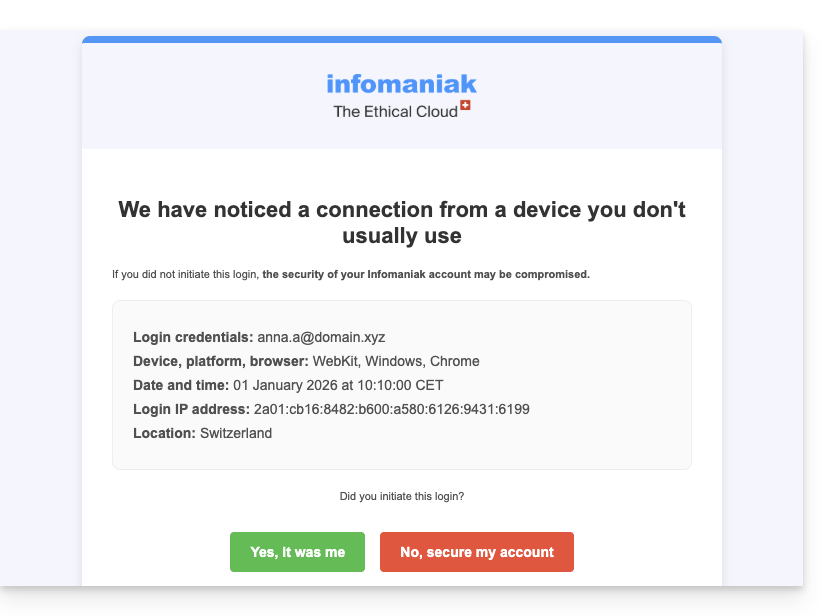
This can happen, for example, if you are using your browser's private browsing mode or if you are accessing your account from a new computer.
If you receive this email immediately after logging into your Infomaniak account, you can safely ignore the login alert!
2. Login attempt (incorrect password)
A security email is automatically sent when someone enters an incorrect password after entering the email address to log in to the Manager: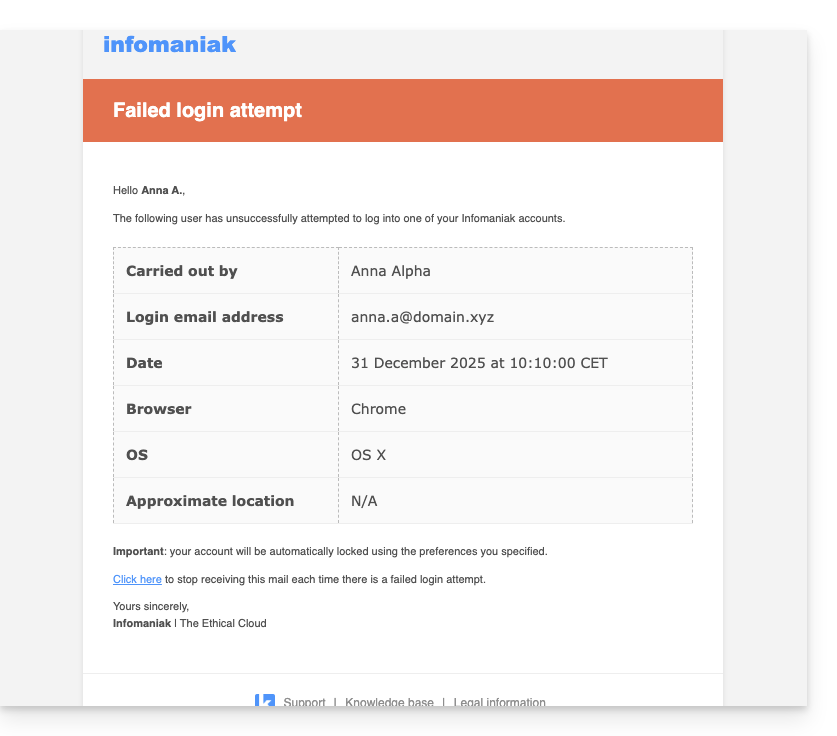
View recent activity in the Manager
You can view the recent activities of your account and those of your Infomaniak Organization:
If you notice any illegitimate actions that you don't believe you performed, and/or if you suspect an intrusion:
- Refer to this other guide to quickly secure your tools.
- Enable two-factor authentication on your account to improve its protection and ensure that only you receive a unique code authorizing login.
- Change the Manager password.
- Change the passwords for the email addresses associated with Mail Infomaniak.
Link to this FAQ: https://faq.infomaniak.com/88
Has this FAQ been helpful?
This guide explains how to change the first name and last name that Infomaniak displays when you are logged into your Infomaniak account (= user account) within an Organization in the Manager, as well as your account avatar.
Introduction
- To change your login ID, please refer to this other guide.
- To change your phone number, please refer to this other guide.
- To manage the details of the Organization you belong to, please refer to this other guide.
Modify your Infomaniak account details
To edit your personal details:
- Click here (or on the badge with your initials / avatar in the top right corner of the Infomaniak Manager) to "Manage my account":
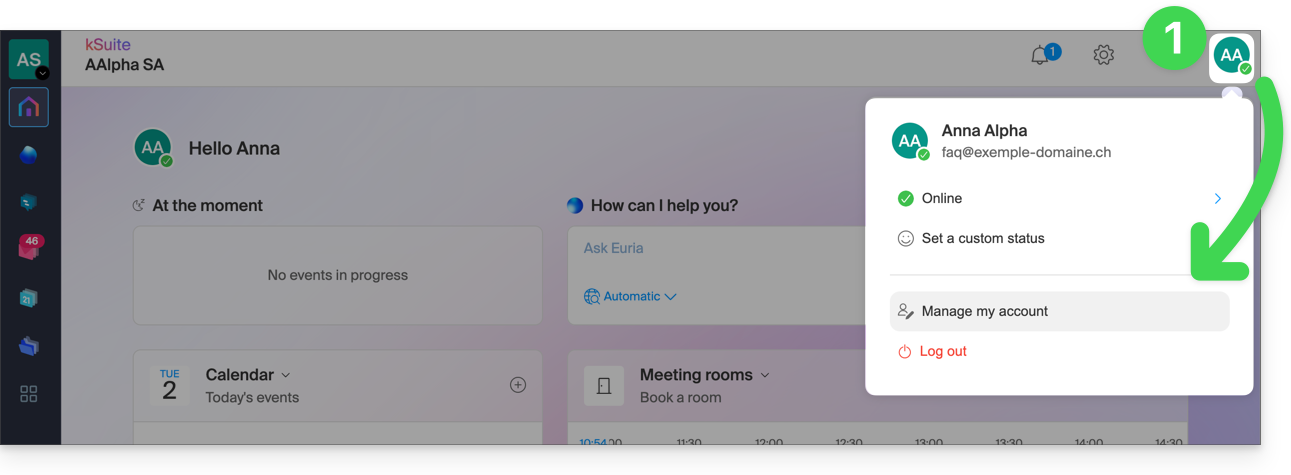
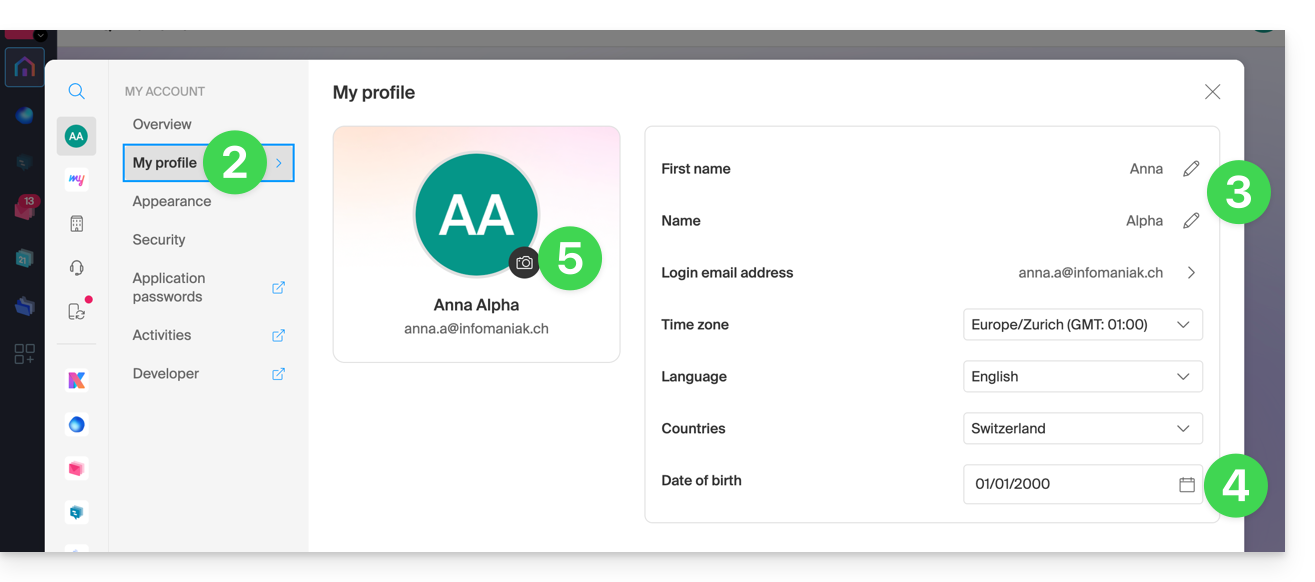
- Click on My profile in the left-hand menu.
- Edit your first name and last name on the right-hand side.
- You can also specify your date of birth.
- You can add a profile picture to your Infomaniak account, which will be displayed instead of your initials; it is recommended to import an image with a minimum size of 210 pixels on each side:
Link to this FAQ: https://faq.infomaniak.com/220
Has this FAQ been helpful?
This guide explains how to quickly secure your Infomaniak account if you suspect hacking, identity theft, password theft, etc., or after any type of security alert or suspicious activity.
Change all passwords
To follow the security assistant that allows you to change all user passwords and disable device logins, application passwords, and tokens (API):
- Click hereto access the security information management section in the Infomaniak Manager.
- Click on "Compromised password?" in the Security box:
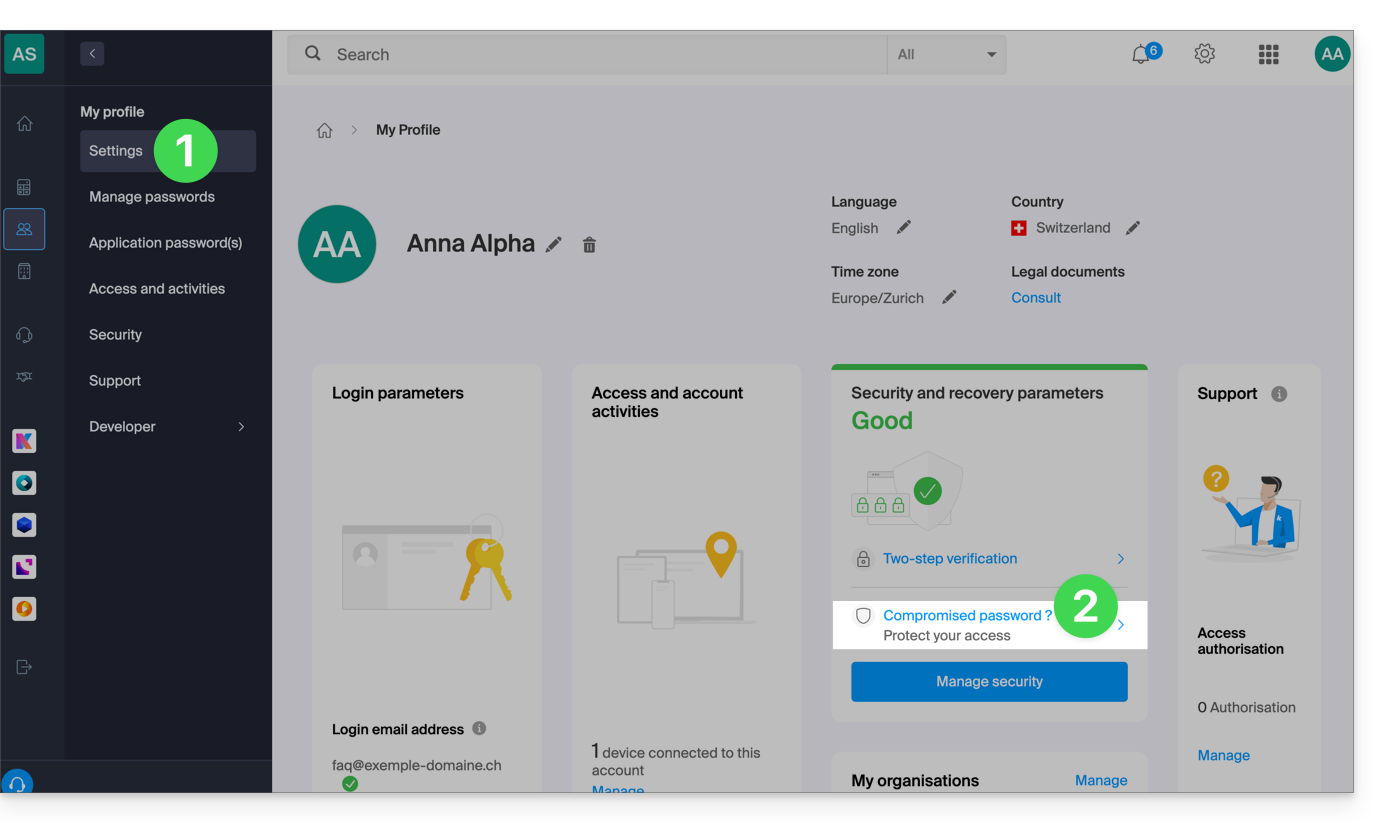
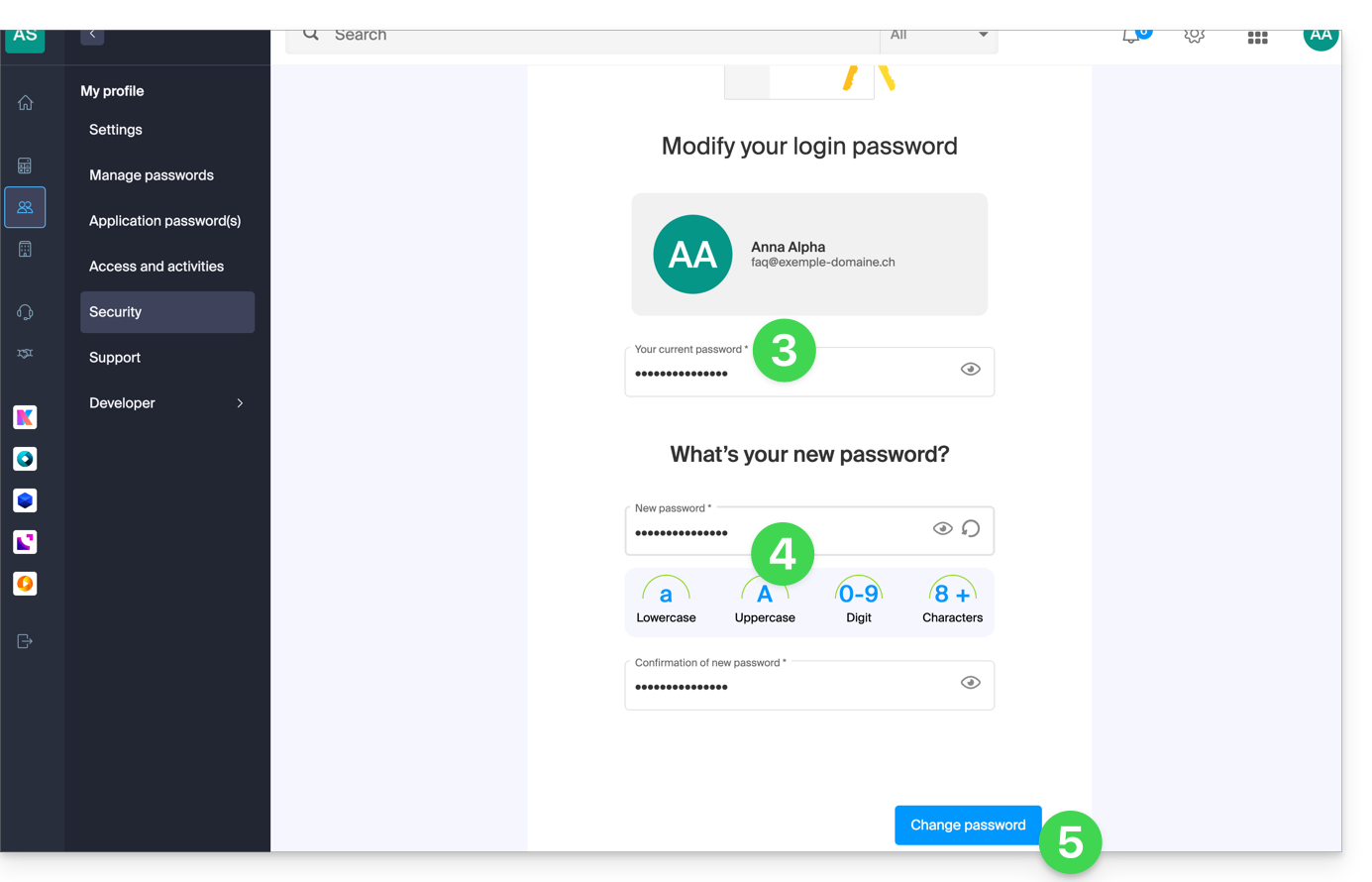
- Enter your current login password.
- Enter your new password and confirm it below.
- Click the blue button to apply the password change:
- Continue with the process to disconnect and delete connected devices, application passwords, and tokens (API), and then access the security settings verification.
Also, refer to this other guide to secure the access of the various users within the Organization.
Link to this FAQ: https://faq.infomaniak.com/229
Has this FAQ been helpful?
This guide explains how to change the current user with the highest status within your Organization, a status similar to that of an administrator, which includes an additional legal responsibility.
Requirements
- If you cannot find the expected list of users, first switch to the desired Organization using this link.
- Be the Legal Representative within the Organization.
- Learn about the different permissions (e.g., access rights to products) and administrative contact preferencesby a user within an Organization.
Modify the legal representative of an Organization
Please note that it is not possible to remove a legal representative if there is no other legal representative.
Therefore, you can:
- Add a new user with the legal representative role within the Organization.
- Assign the legal representative role to an existing user within the Organization.
- Remove an existing legal representative (if one already exists – this requires appointing a new legal representative beforehand, if necessary).
Link to this FAQ: https://faq.infomaniak.com/284
Has this FAQ been helpful?
This guide is for you if you have received a payment reminder for an Infomaniak invoice even though everything seems to be in order.
Payment reminder email from Infomaniak?
Make sure the reminder you received is not a phishing attempt (fake email / message not from Infomaniak / scam).
Standing order
If you have set up a standing order, the reference number will not match the invoice number.
Since each invoice has a unique reference number, please refer to the invoice for the relevant month or payment period.
Amount or currency difference
The amount of your payment does not match the invoice amount.
Please always pay the exact amount of the invoice, and in the invoice's currency.
Funds on your prepaid account
The payment you made has been received, but due to an issue that occurred while linking your payment to the pending invoice,this initial payment has been credited to your prepaid account.
Check your prepaid account balance and pay the invoice using this method. You can also consult this other guide.
Reminder sent before payment
A payment has been made, but if it was made by bank transfer, a reminder may have been sent before the invoice was settled.
You can modify how payments are processed:
Link to this FAQ: https://faq.infomaniak.com/353
Has this FAQ been helpful?
This guide explains what a support code and a VIP code are (not to be confused with the authorization code used for domain name transfers) at Infomaniak.
Support code and VIP code
The support code allows Infomaniak's Support department to identify you quickly and securely when you contact them and provide them with this sequence of numbers. It is displayed on your user profile page.
The VIP code is reserved for customers who have subscribed to Premium Support and allows for identification when you call the technical contact. It is displayed on the management page for this service.
On this management page, you will also find your various details for contacting Infomaniak as part of the subscribed Support plan.
The code is present on your technical document and is also displayed on the contact window that opens when you want to contact Infomaniak via the support button: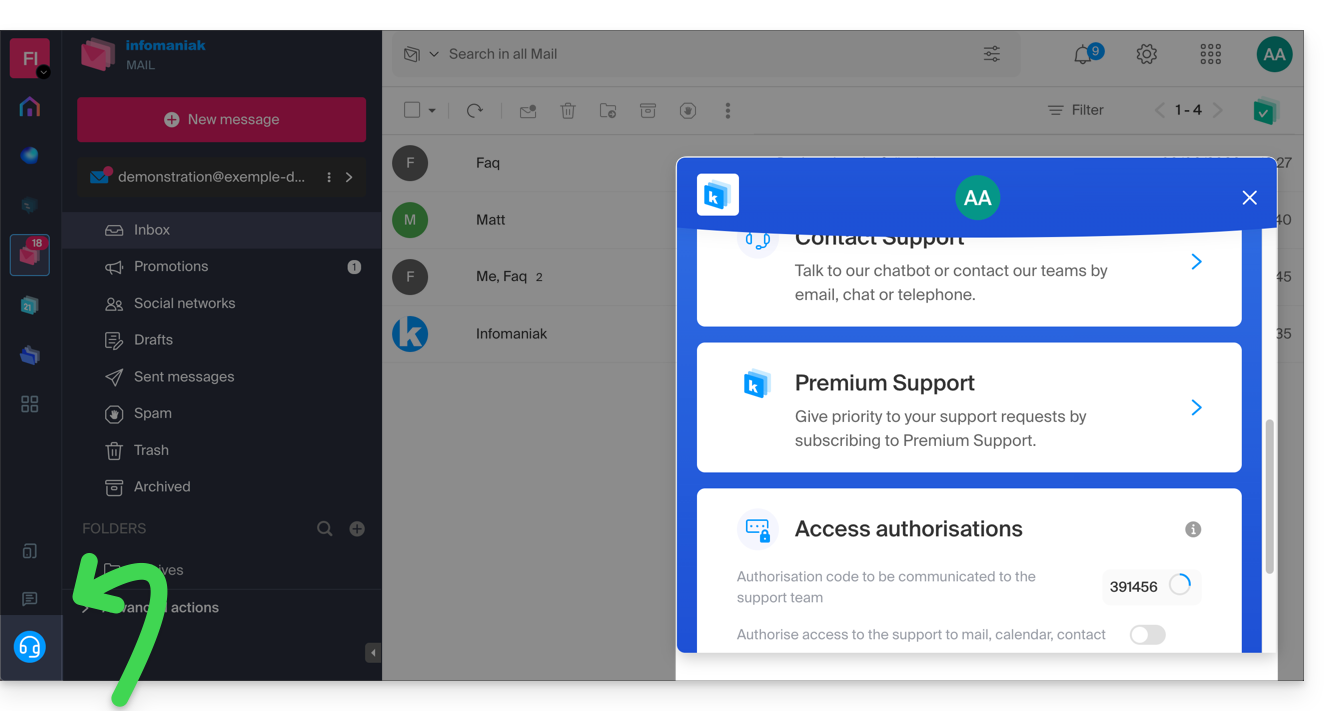
In the same place, you can grant temporary access to your services (for access only possible to Infomaniak Support staff).
Link to this FAQ: https://faq.infomaniak.com/766
Has this FAQ been helpful?
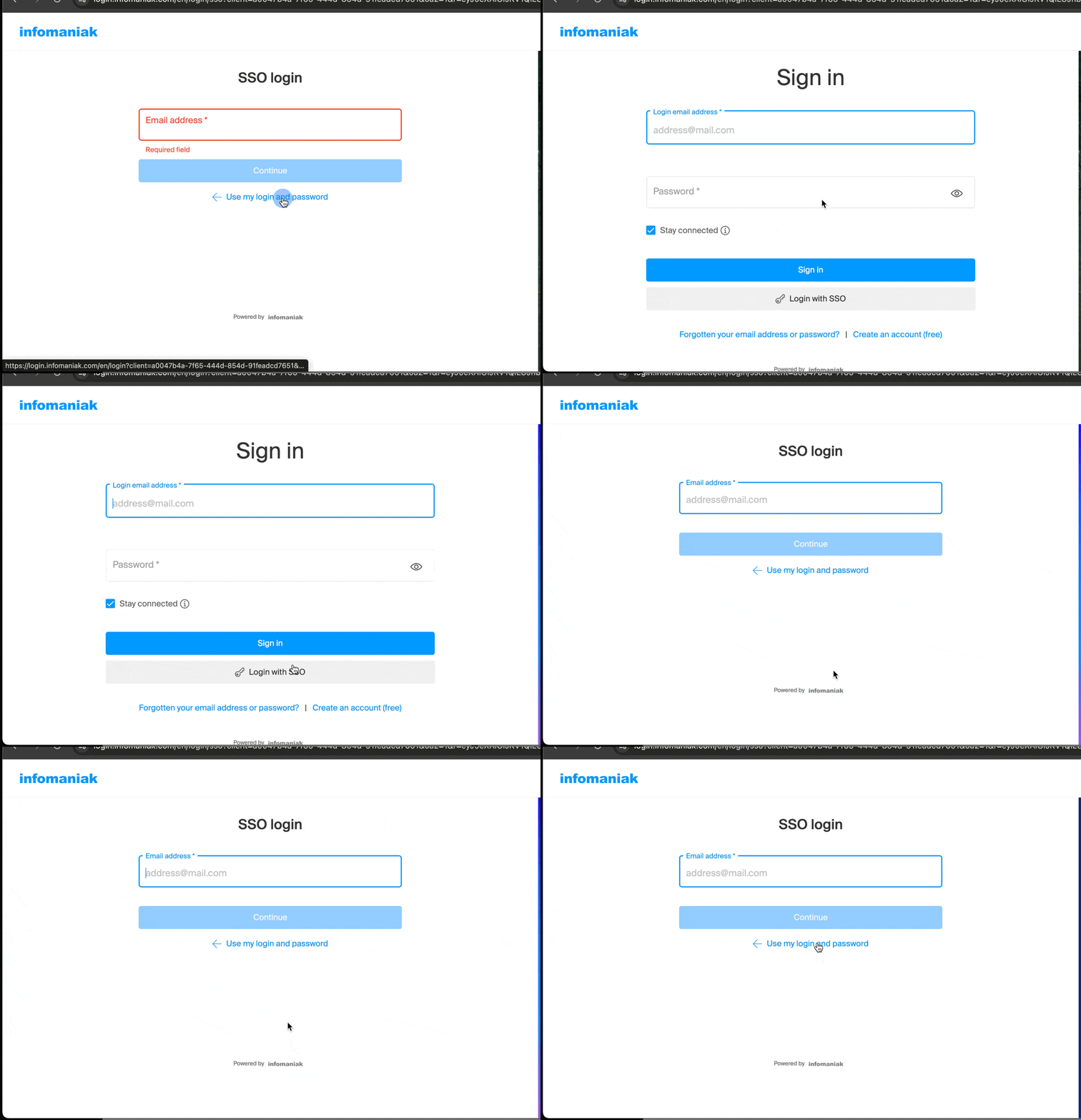
This guide explains what the login button for Single Sign-On (SSO) on Infomaniak login pages does and details the procedure for configuring this feature within your organization.
Introduction
- Single Sign-On (SSO) is an authentication mechanism that allows users to log in to multiple applications using a single set of credentials.
- SSO simplifies access to Infomaniak services and enhances their security, allowing you to:
- use your corporate credentials without an additional password;
- apply the organization's security rules, including multi-factor authentication (MFA);
- centralize account management, provisioning (SCIM), and permissions.
- If you are not aware of this feature or if you are a private Infomaniak customer, log in as usual using the standard blue button.
Configure SSO integration for your organization
Prerequisites
- Infomaniak offers this option on its various login pages, including in its mobile applications.for users whose organization has enabled this feature.
To request SSO activation for your organization, please review the information below and then contact Infomaniak support directly by submitting a request through support.infomaniak.com. Infomaniak will then provide the necessary information to connect its platform to your organization's identity provider.
Compatible identity providers
SSO login and automated user management (SCIM 2.0) are available on Infomaniak login pages and mobile applications with:
- Microsoft Entra ID (formerly Azure AD).
- Any other identity provider (IdP) that supports the standard SAML 2.0 and SCIM 2.0 protocols.
- Okta via the official pre-integrated application available in the Okta Integration Network (OIN) catalog.
Regarding Okta, the official pre-configured integration allows for simplified deployment in a few steps from their administration console:
- Log in to your Okta administration console.
- Go to Applications > Applications > Add Integration.
- Search for Infomaniak in the catalog and click on Add Integration.
- SSO (SAML 2.0) authentication configuration:
- In the Sign On tab, retrieve the Metadata URL or the metadata file generated by Okta.
- Assign the application to the users or groups authorized to access Infomaniak services.
- Automatic provisioning configuration (SCIM 2.0 - Optional):
- In the Provisioning tab, enable the API integration to allow for the automatic creation, updating, and deactivation of user accounts.
- Open a request from support.infomaniak.com and provide your Okta metadata URL to finalize the connection of your domain.
Link to this FAQ: https://faq.infomaniak.com/874
Has this FAQ been helpful?
This guide explains how to contact and authorize Infomaniak Support to access your online productsand especially regarding their content, and provide useful details when submitting a support request.
Contact Infomaniak Support
Certain email addresses, such as support@infomaniak.com, are not intended to receive direct support requests.
Messages sent to these addresses are not processed by our teams and do not allow us to track your request.
To ensure proper handling, each request must be submitted solely through the support center:
- This process generates a ticket, automatically routes the request to the relevant department, and ensures complete follow-up until it is resolved.
- Once the request is registered, communication can then continue directly via email with support.
Before contacting support, we also recommend consulting the knowledge base, which contains many guides and answers to frequently asked questions.
Allow Support to access a type of content
Infomaniak Support may ask you to grant temporary access to a portion of your content; this helps save time in the diagnosis by avoiding unnecessary back-and-forth communication:
- This access is strictly limited to the context of the analysis and is only used to identify the source of the problem:
- Only Infomaniak employees directly handling your support request will have access.
- Access is only granted from Infomaniak's controlled facilities.
- In accordance with Infomaniak's privacy policy, your data will never be used for other purposes:
- You can revoke this access at any time.
- Otherwise, it will automatically expire after 7 days.
To allow Infomaniak to access a specific part of your services (granting access to one piece of content never grants access to others; each authorization is specific and independent):
- Click here to access access management in the Infomaniak Manager.
- Click on the toggle switch to allow access to the content of…
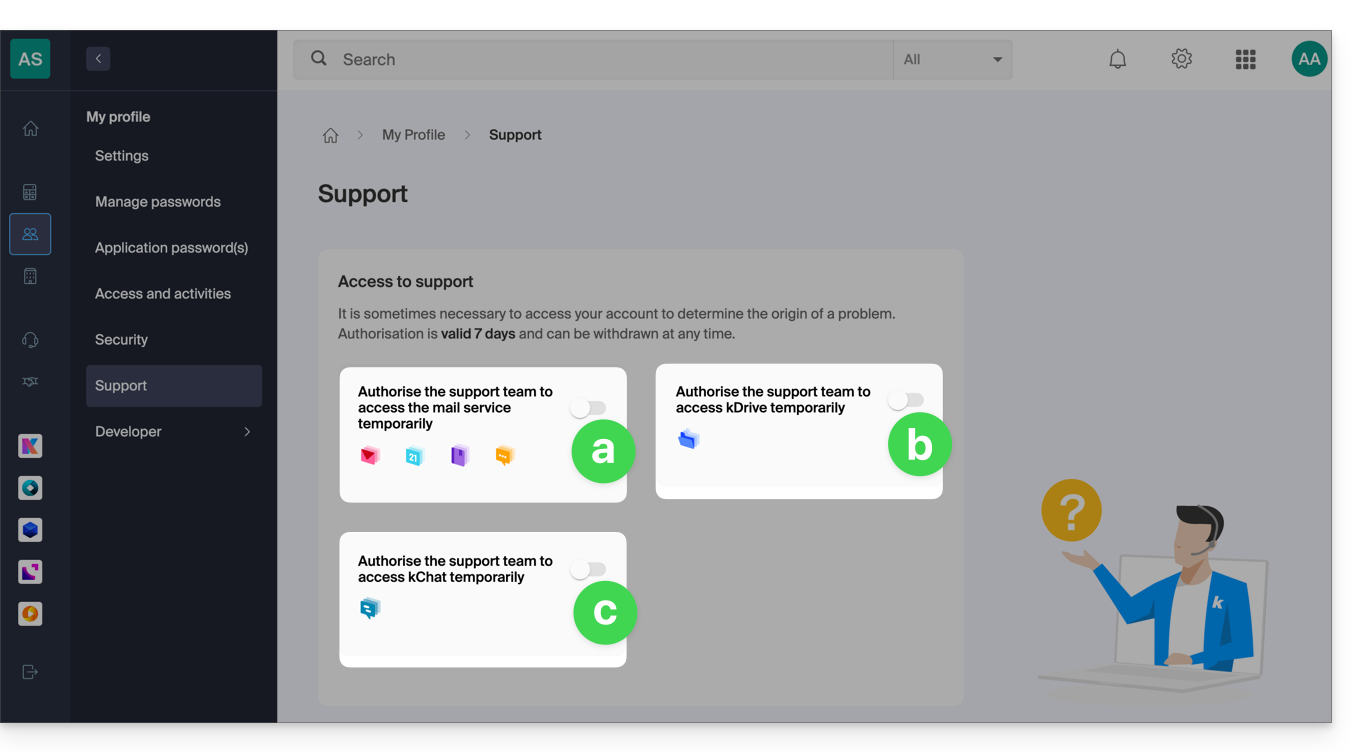
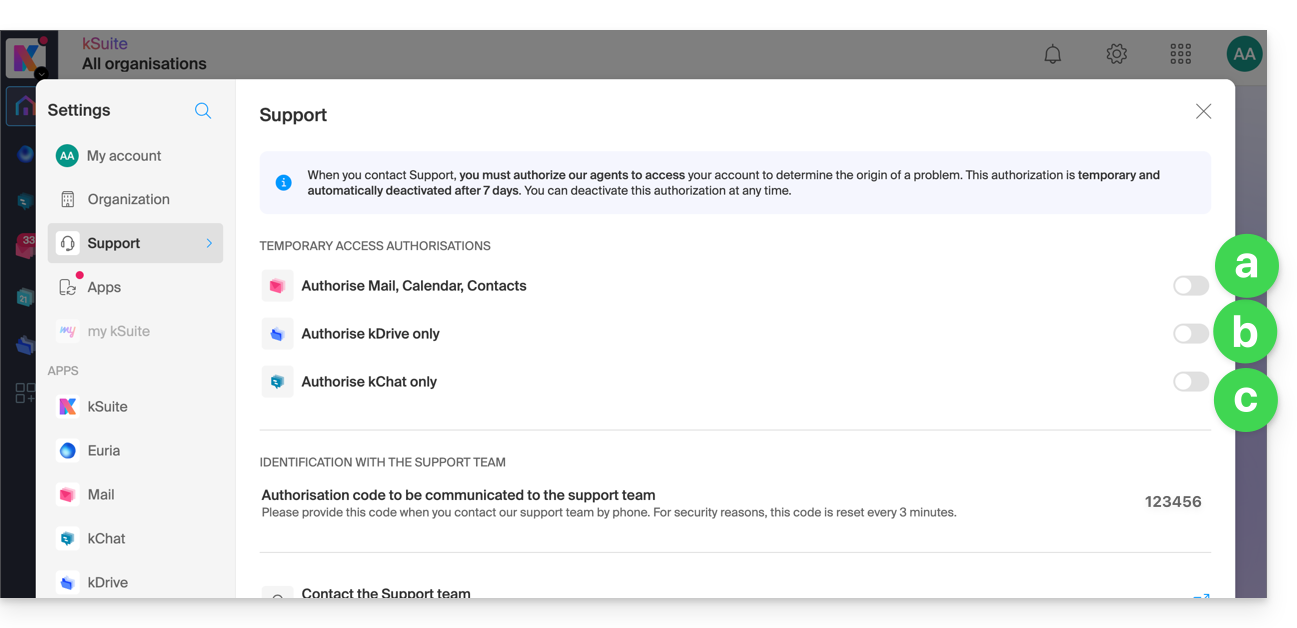
- … email addresses associated with the Mail web app from Infomaniak (online service ksuite.infomaniak.com/mail) + contacts & calendars,
- … folders from one or more existing kDrive accounts within the Organizations that the current user belongs to,
- … discussions from one or more existing kChat products within the Organizations that the current user belongs to.
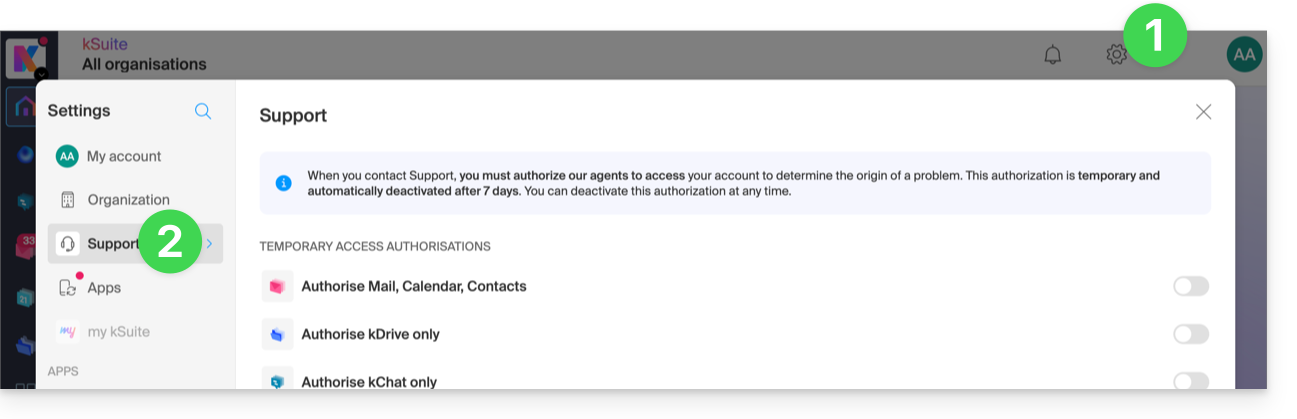
With kSuite, you can also do this by clicking here or proceed as follows to achieve this:
- Click on the Settings icon in the top right corner of your kSuite window.
- Click on Support in the left-hand menu:
- Click on the toggle switch to allow access to the content of…
You can also easily share a single, specific email.
Taking screenshots
… on Windows
Microsoft offers a software program pre-installed that is dedicated to taking screenshots. But to take them manually:
- Display what you want to show on the screen.
- Press the PRINTSCREEN key on your keyboard once (or
PRTSCR,IMPR. ECRAN, etc.). - In Microsoft Word (or similar), go to "Edit" -> "Paste" to place your image on the page.
- Save your file.
- Repeat steps 1 to 5 as many times as the number of screenshots you want.
… on macOS
- Press the "
CMD" + "shift" (the upward-pointing arrow — Shift) + "3" keys simultaneously. - Each time you press these keys, an image file is created on your computer's desktop.
… on iOS (iPhone, iPad...)
- Simultaneously press the "
Power" + "Home" buttons (the only two physical buttons). - Then, retrieve the screenshots in the "Photos" app on your device.
… on Android (e.g. Samsung, LG or Huawei)
- Simultaneously press the “Volume Down” button (on the side) and the lock button.
- The captured image is automatically saved in a Screenshots folder in the gallery.
Copy the content of an alert window
… on Windows
To copy and paste an error message displayed in a Windows “popup” window as text, simply press the CTRL + C key on your keyboard to copy the message to the clipboard. You can then paste it (CTRL + V) into the body of the message you are sending.
Accessing the browser's JavaScript console
… on Windows
Chrome, Firefox, and Safari: enter the key combination CTRL + SHIFT + i
Internet Explorer and Edge: press the F12 key
… on macOS
Chrome: enter the key combination ⌘ + ⌥ + J
Safari: enter the key combination ⌘ + ⌥ + C
- Then, click on the icon with a crossed circle or similar to reset the log.
- Display the page of your website that is experiencing the issue.
- The console tab displays JavaScript errors and online resources that could not be found.
Link to this FAQ: https://faq.infomaniak.com/913
Has this FAQ been helpful?
This guide addresses issues that may arise when using Infomaniak applications (such as kChat, kDrive, Infomaniak Authenticator, etc.) or tools (such as config.infomaniak.com, the Infomaniak Manager, etc.) with old / outdated / obsolete hardware (OS, browser, devices, etc.).
Introduction
- For example, it will not be possible to comfortably access Infomaniak services with an iPhone 5s or 6 on iOS 12.
- It is therefore recommended to regularly update browsers and operating systems to benefit from the best possible experience with the Infomaniak infrastructure.
- Also, please refer to this other guide which focuses specifically on browsers and their components.
- And are you using the latest version of the Infomaniak app in question?
Update the OS, browser, etc.
Old systems or browsers can cause slowdowns, errors, or incorrect display. It is therefore preferable to rely on components that are regularly updated, as Infomaniak apps work optimally on updated systems and with recent hardware.
Example for kChat:
| kChat | Minimum requirement |
|---|---|
| Web app (browser) | Chrome 134+, Firefox 128+, Safari 17.4+, Edge 134+ |
| Mobile app (iOS) | iOS 15.1+ (iPhone 6s or later) |
| Mobile app (Android) | Android 7.0+ with updated Chrome |
| Desktop app (macOS) | macOS 12 (Monterey) or later |
| Desktop app (Windows) | Windows 10 or later |
| Desktop app (Linux) | Ubuntu 22.04 LTS or an equivalent maintained distribution |
If you encounter issues with your web browser, try updating it or installing an alternative:
- Google Chrome
https://www.google.com/chrome/
(The site automatically detects the operating system and offers the latest version) - Mozilla Firefox
https://www.mozilla.org/firefox/new/
(Download and update page for Windows, macOS, and Linux) - Microsoft Edge
https://www.microsoft.com/edge
(The link offers automatic updates or downloads depending on the system) - Safari (macOS only)
https://support.apple.com/fr-fr/HT204416
(Safari updates are done through macOS system updates) - Opera
https://www.opera.com/fr/download
(Allows you to download the latest version for your system) - Brave
https://brave.com/download/
(Download page with automatic operating system detection)
Technologies used by Infomaniak
Many web tools developed by Infomaniak use Angular. The need for updated or recent hardware to run the applications is not specific to Angular itself but rather a general requirement for running any modern web application. Here are some reasons why updated hardware is often necessary:
- Angular relies on advanced features of modern browsers, which are often absent or poorly managed in older versions.
- Recent browsers optimize JavaScript execution and graphics rendering, which improves the responsiveness of Angular applications.
- Updated versions fix known vulnerabilities, reducing the risk of compromise.
- Modern browsers are more compliant with the latest HTML, CSS, and JavaScript specifications, ensuring better compatibility.
- Modern APIs (camera, geolocation, notifications, etc.) are only accessible via recent browsers, which are essential for interactive experiences.
Link to this FAQ: https://faq.infomaniak.com/1025
Has this FAQ been helpful?
This guide is intended for users who have chosen Infomaniak, a hosting provider committed to the planet: you will find below the details of the calculation method used to display CO2 on invoices, as well as some tips to reduce your own digital footprint.
Introduction
- For Web Hosting and Mail services, Infomaniak displays the amount of CO2 emitted annually, a figure based on a rigorous Life Cycle Assessment (LCA) method that combines two key factors:
- Material impact (Full life cycle)
- Using emission factors from the ResilioDB database, the calculation includes emissions generated during the manufacturing (BLD), transport (DIS), and end-of-life/recycling (EOL) of each piece of equipment (servers, RAM, disks, etc.).
- Energy impact (Actual consumption)
- The actual electricity consumption of the servers is measured via IPMI probes.
- This energy is then converted into CO2 equivalent using Infomaniak's specific energy mix, which is very low in carbon (11.77g CO2eq/kWh).
- Material impact (Full life cycle)
- The total impact is then distributed according to the customer's unit of usage (per hosted website or per mailbox).
What can you do?
If the hosting provider optimizes its infrastructure, the end-user also plays a key role. Here's how to reduce the environmental impact of your services.
For websites
The goal is to minimize the energy consumption of servers and visitors' devices:
- Technical optimization: Compress images, minify scripts, and use modern formats (WebP).
- Clean design: Limit autoplay videos, advertisements, and heavy scripts that consume bandwidth.
- Best practices: For WordPress in particular, it is recommended to consult the GreenIT guides.
For email
Email communication can also be optimized:
- Simplicity: Prefer plain text emails over HTML emails and limit the use of large, graphical signatures.
- Attachments: Prefer sending download links (via kDrive or SwissTransfer) instead of large attachments, or use compressed PDF format.
- Cleanup: Unsubscribe from unnecessary newsletters and use tracking tools to avoid sending emails that are not opened.
It is recommended to regularly monitor statistics to improve environmental performance. While waiting for Infomaniak's future integrated tools, it is possible to audit the impact of web pages via GreenFrame.io.
Link to this FAQ: https://faq.infomaniak.com/1160
Has this FAQ been helpful?
This guide explains how to configure a YubiKey (from Yubico) for Infomaniak accounts protected by two-factor authentication (or double authentication / 2FA). This is one of the methods that allows you to secure access to your Infomaniak user account.
Introduction
- Currently, Infomaniak only supports the Yubico OTP (One-Time Password) protocol for YubiKey keys.
Configure OTP on your YubiKey
To generate one-time passwords (OTP), you must first configure your key using the official Yubico utility:
- Download and install the YubiKey Manager application from the official Yubico website.
- Insert your YubiKey into the USB port of your computer and launch YubiKey Manager.
- In the top menu, click on Applications and then select OTP.
- Choose the location you want to configure:
- Short Touch (Slot 1) (short press) or Long Touch (Slot 2) (long press)
- Click the Configure button.
- Select Yubico OTP as the credential type and click Next.
- On the Yubico OTP configuration screen:
- Check the Use serial box to fill in the Public ID field.
- Click Generate to create the Private ID and the Secret key.
- Be sure to check the Upload box located in the bottom right corner of the window, then click Finish.
The utility will save your configuration to Yubico's servers (a browser window will open to confirm the operation).
In case of a problem
OTP configuration is complete, but validation fails on Infomaniak
If you have already configured the OTP protocol on your YubiKey but the code is not recognized when logging in, this generally means that the configuration has not been synchronized with the Yubico cloud.
To resolve this issue, you have two options:
- Open the YubiKey Manager and repeat the tutorial above to regenerate a configuration, this time making sure to check the Upload box before clicking Finish.
- Alternatively, if you copied and saved your credentials (Public ID, Private ID, and Secret key) during your first configuration, you can upload them manually by going to the official Yubico OTP key upload page.
Save your backup codes
If you have just enabled two-factor authentication, the app will automatically display your 10 personal backup codes.
In all cases, carefully note the recovery codes offered for download after each configuration: download and keep a copy of these codes in a safe place, as they will be the only way to access your account if you lose your credentials or to access your account without access to your phone.
Link to this FAQ: https://faq.infomaniak.com/1218
Has this FAQ been helpful?
This guide concerns potential additional bank charges that may be incurred for your Infomaniak payment or renewal if made using dual-logo (co-branded) cards or cards issued abroad.
How co-branded cards work
The CB (Groupement des Cartes Bancaires) manages the French national interbank network. Infomaniak accepts cards bearing the CB logo for payment of services.
The majority of cards issued in France are so-called co-branded cards: they bear the CB logo (for the national network) and a second international logo, usually Visa or Mastercard.
Risk of additional bank charges
When making online transactions, if your card is a CB/Visa or CB/Mastercard co-branded card and the payment is processed via the international network:
- Your issuing bank may interpret the transaction as an international transaction, even if the amount is in euros (€).
- This interpretation may result in the application of transaction fees or non-euro fees.
These fees result in fixed fees or an additional percentage charged by your bank on the transaction amount.
Infomaniak recommends that you consult your bank's fee schedule to find out about these potential fees.
The term "Carte Bleue"
The term "Carte Bleue" was a former trademark historically used by some banks in the CB network. This trademark has been gradually replaced by the generic term "CB (Cartes Bancaires)", which designates the current French payment network.
Link to this FAQ: https://faq.infomaniak.com/1254
Has this FAQ been helpful?
This guide presents the security model that allows you to assign users to an email address or dedicate a different password to it for each device or software that needs to access it.
Introduction
- No password is set when creating a mail address.
- If you remain within the Infomaniak ecosystem, i.e., you only use the Infomaniak Mail web app (online service ksuite.infomaniak.com/mail) and/or the Infomaniak Mail mobile app (application for iOS/Android smartphones or tablets), you do not need to manage a password because everything is configured using the concept of a user, i.e., an Infomaniak account (which has a password):
- A mail address can be viewed/used on these Infomaniak Mail apps without a password other than the one that already allows access to your Infomaniak account, simply after you have been invited.
- You only need to authorize your own account or invite an acquaintance to be a user of the mail address.
- Otherwise, outside of this ecosystem, you simply create a password (or several) for your devices (Outlook, iPhone, CRM, etc.) according to your needs:
- Each password can be revoked individually, without affecting other users or devices linked to this address.
- It is not possible to display a previously created password; simply create a new one!
Add a user
= Allow a person to view the email address in the Infomaniak Mail interface
To allow a user (including yourself) to view the email address in Infomaniak without needing a password other than their own (the password for their Infomaniak account):
- From the Mail Service dashboard:
- add the email address to your Infomaniak Mail apps so you can use the address,
- or decide which other external user should have access to the address in their Infomaniak Mail apps,
- or remove a user's access: the other accesses to the email address will remain active.
- You can manage authorized users directly from the Mail web app (any user of an email address on Infomaniak can view the list of other users who have access).
Add a device
= Add a password to allow someone to access the address on a device (Outlook, iPhone, CRM, etc.)
To allow a user (including yourself) to view the email address in IMAP and send messages via SMTP (both protocols require a password):
- From the Mail Service dashboard:
- You can manage connected devices directly from the Mail web app.
Link to this FAQ: https://faq.infomaniak.com/1344
Has this FAQ been helpful?
This guide explains how to remove an user's access to an email address within the Infomaniak ecosystem, from within a Mail service. This means that the user will only be able to access the email address using the Mail Infomaniak web app (online service ksuite.infomaniak.com/mail) and/or the Infomaniak Mail mobile app (application for iOS/Android smartphones or tablets).
Other methods for managing access (e.g., using a password) are described in the main guide; also, refer to this other guide if necessary.Block an entire Mail service for all users.
Prerequisites
- You must have at least the right to manage the Mail Service in question (or be an Administrator / Legal Representative within the Organization).
Managing and removing a user from the Mail Service
The current mail access management model allows each user within an Organization to connect independently and securely to the same mail address, without sharing a global password.
If a user should no longer have access to a mail address and its content, simply remove it from the interface:
- Click here to access the management of your Mail Service in the Infomaniak Manager (need help?).
- Click directly on the name assigned to the product in question:
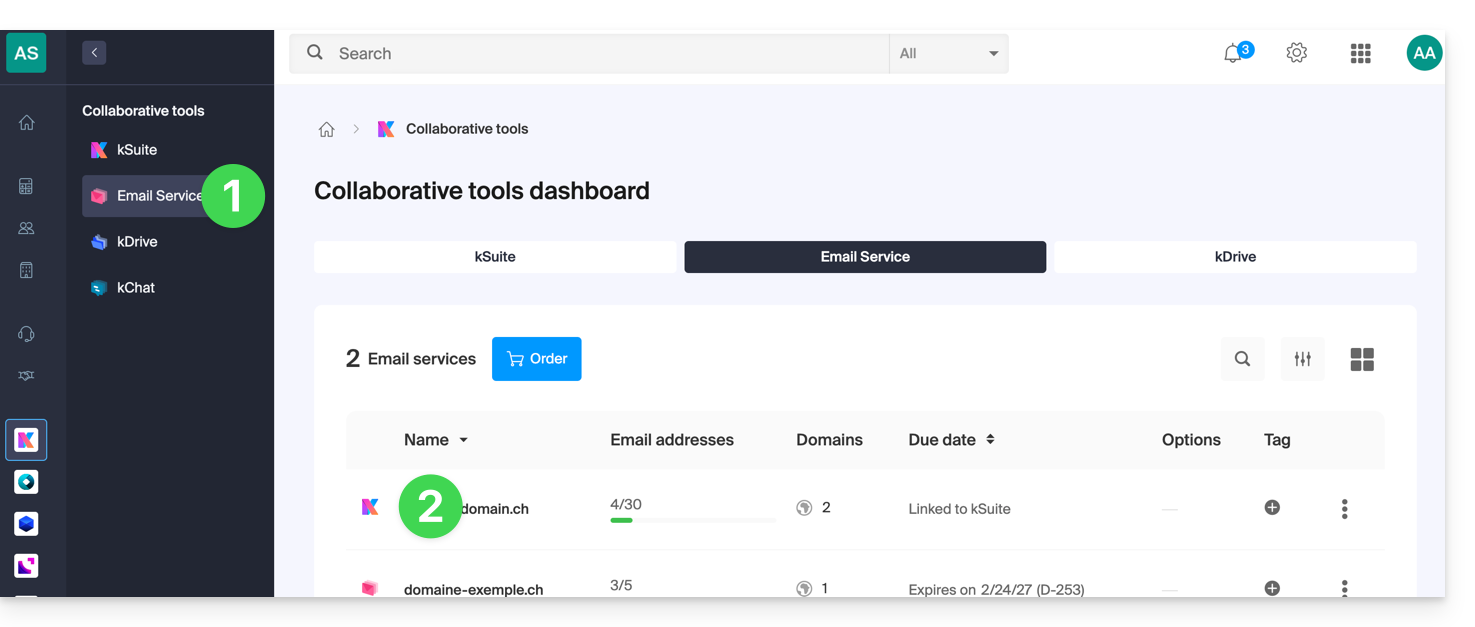
- Click on the email address in question in the table that appears:
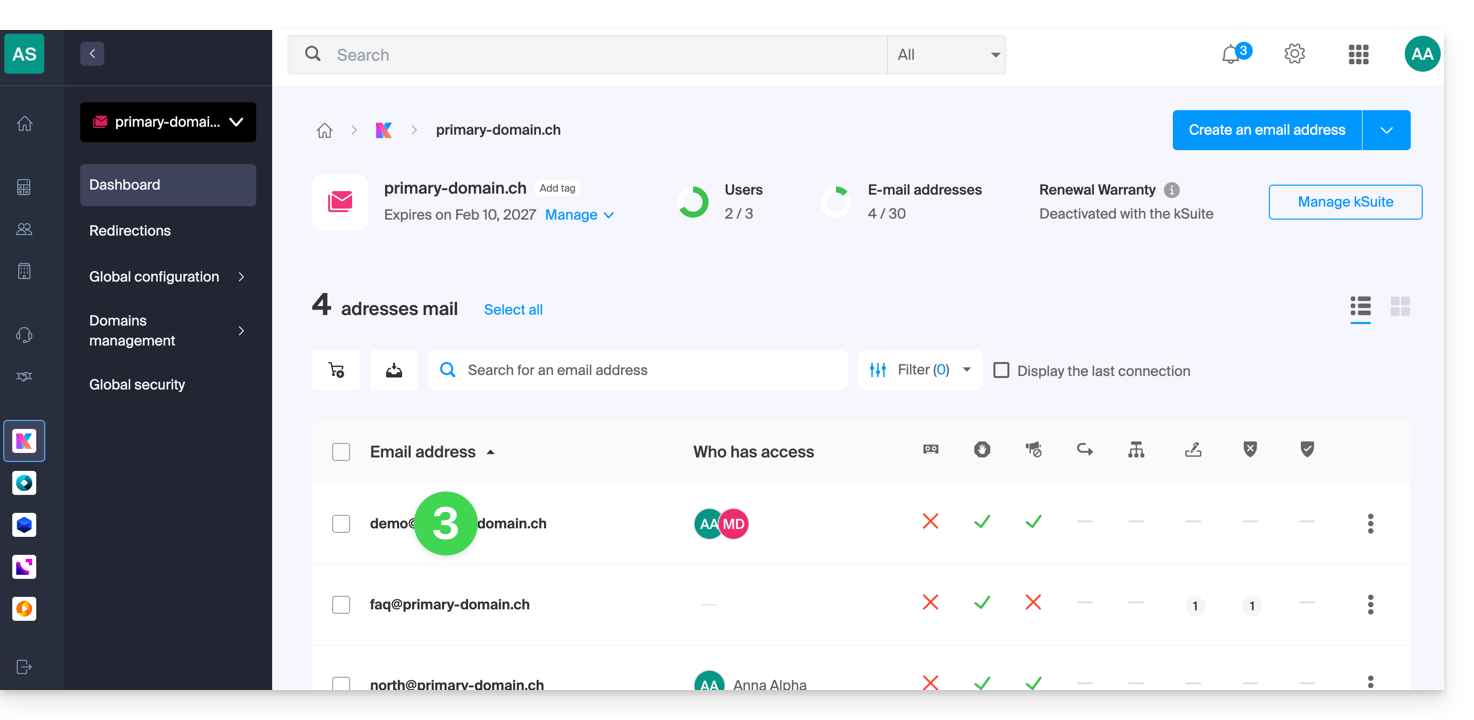
- On the list of users who currently have access to the address in question, click on the action menu ⋮ to the right of the user in question.
- Choose to remove their access to the email address:
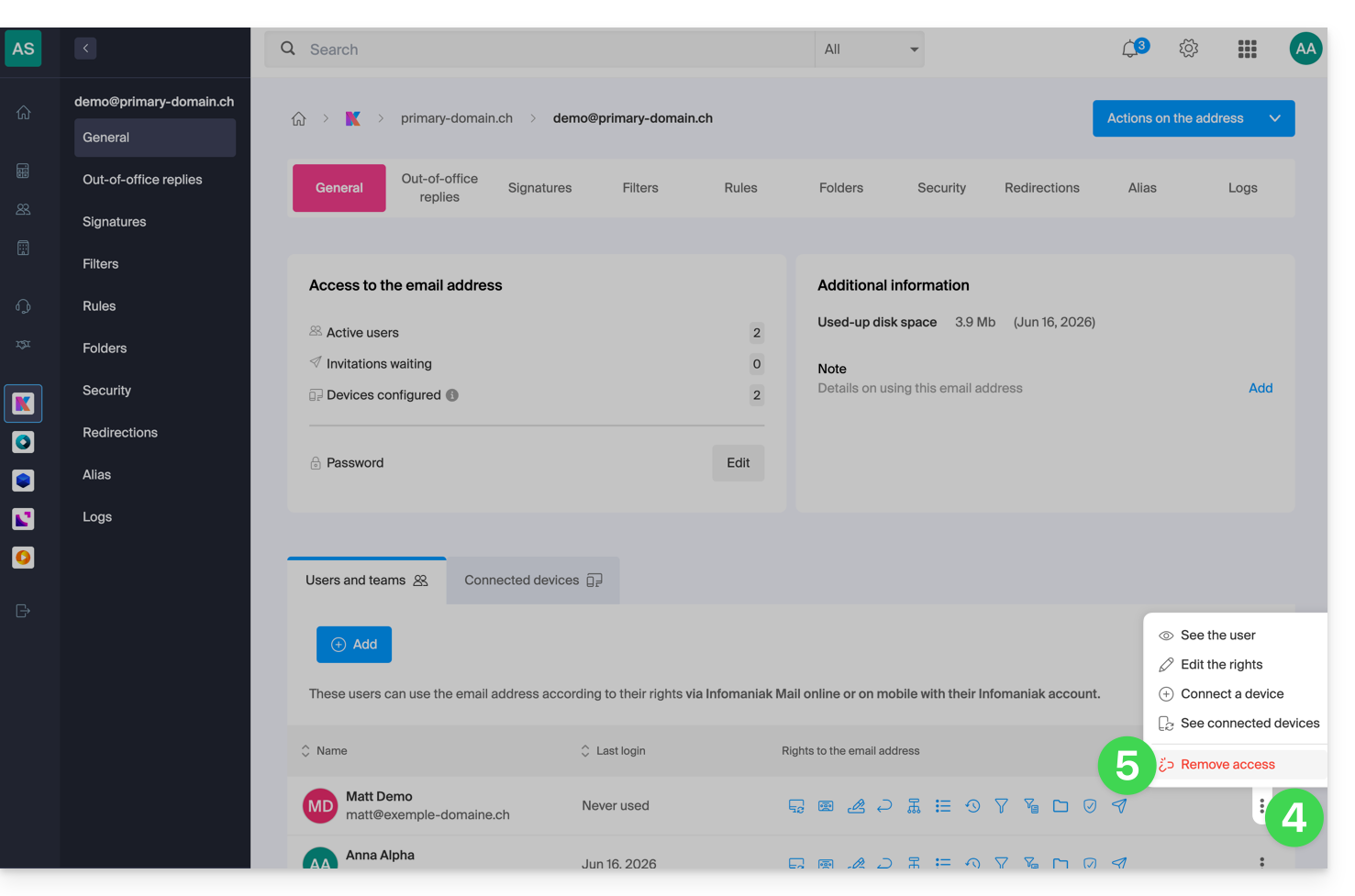
- Confirm the action: all access to the email address will be terminated, and it will no longer be possible to view it.
Link to this FAQ: https://faq.infomaniak.com/1371
Has this FAQ been helpful?
This guide explains how to manually pay your Infomaniak invoices and what payment methods are accepted. Please refer to this other guide if you would like to automatically renew certain products.
Introduction
- If invoices are not paid within the specified timeframe, the relevant services will be blocked and then terminated.
- In case of a problem, it is therefore important to react quickly.
- To be notified by email when a product is due,check the billing message settings in your Manager.
Pay for or renew a product
To renew a product before or at its expiration date:
- Click here to access the payment management section in the Infomaniak Manager.
- Access requires authentication with a user who has sufficient rights.
- If necessary, click on the date filter (next 2 months) to Show All.
- Select the products to pay for:
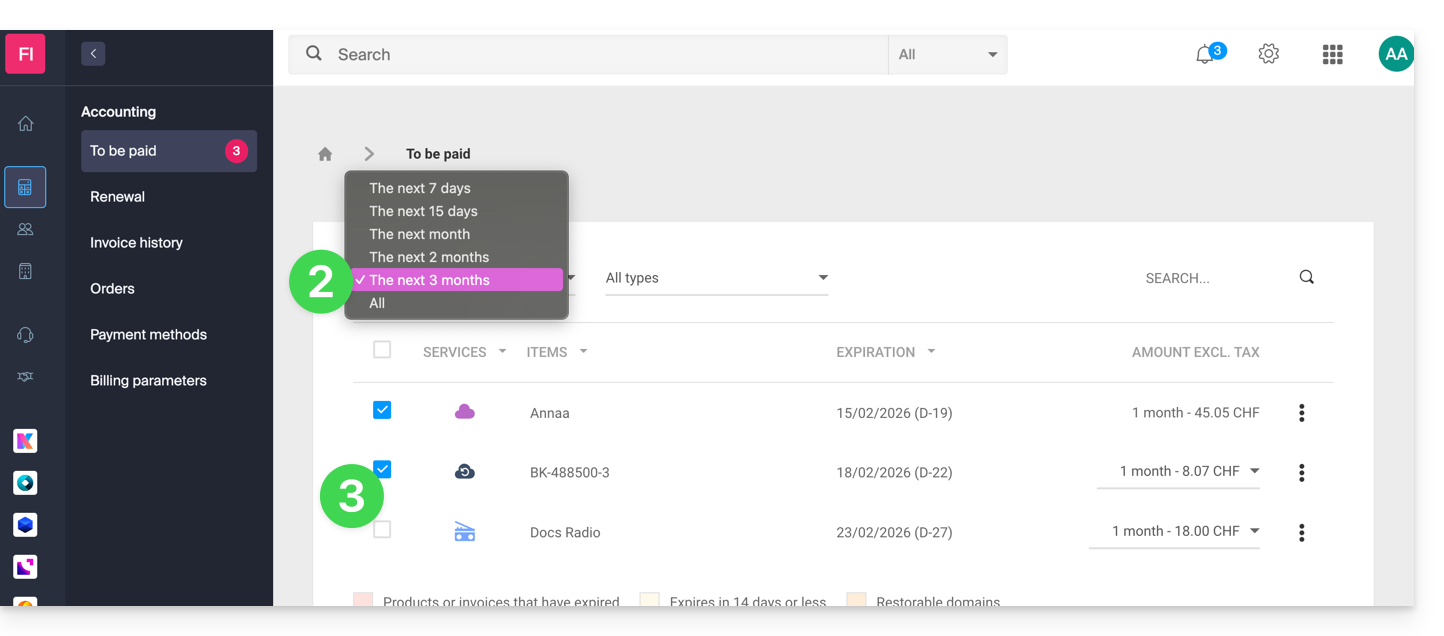
- Click on the Pay for my selection button (or on the button to its left to obtain a Pro Forma invoice before payment):
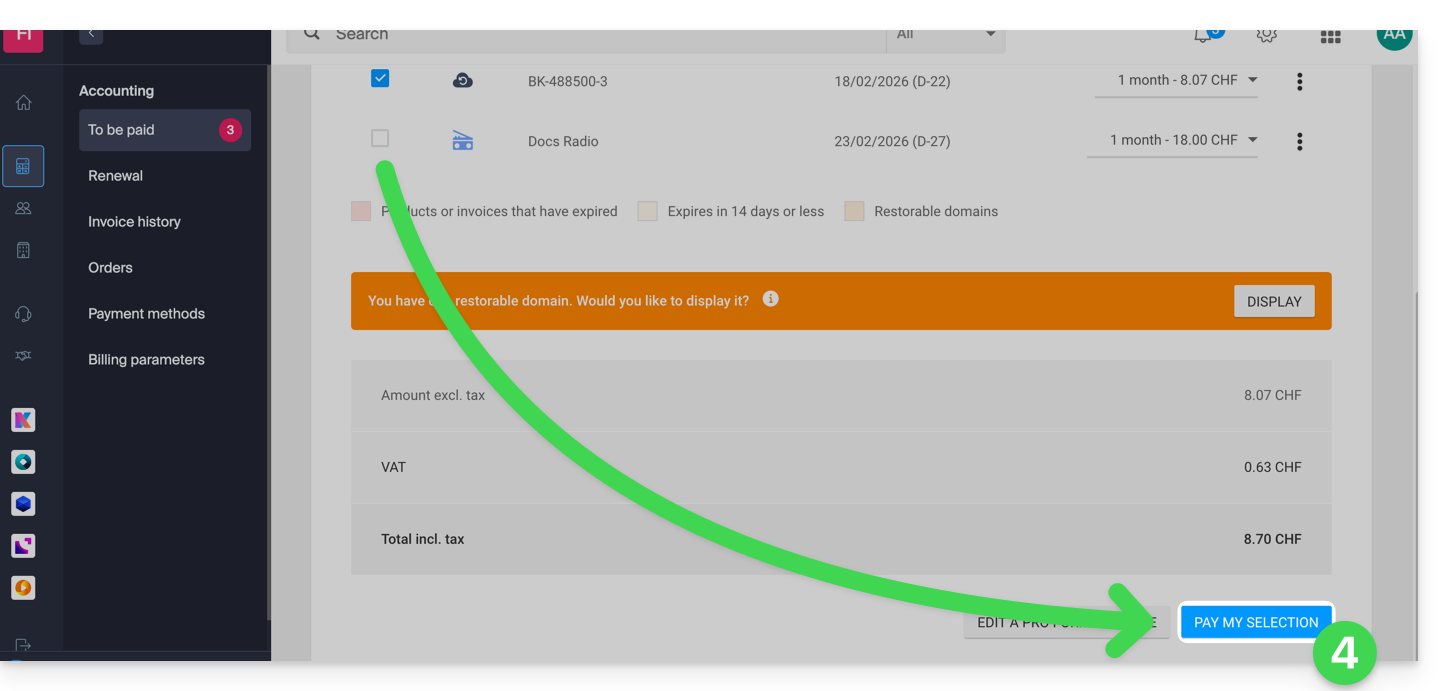
- Enable or ignore any options offered.
- Choose a payment method and complete the process.
Pay for an outstanding order
To manage your order:
- Click here to access the order management section in the Infomaniak Manager.
- Click on the action menu ⋮ located to the right of the relevant command.
- Choose Pay:
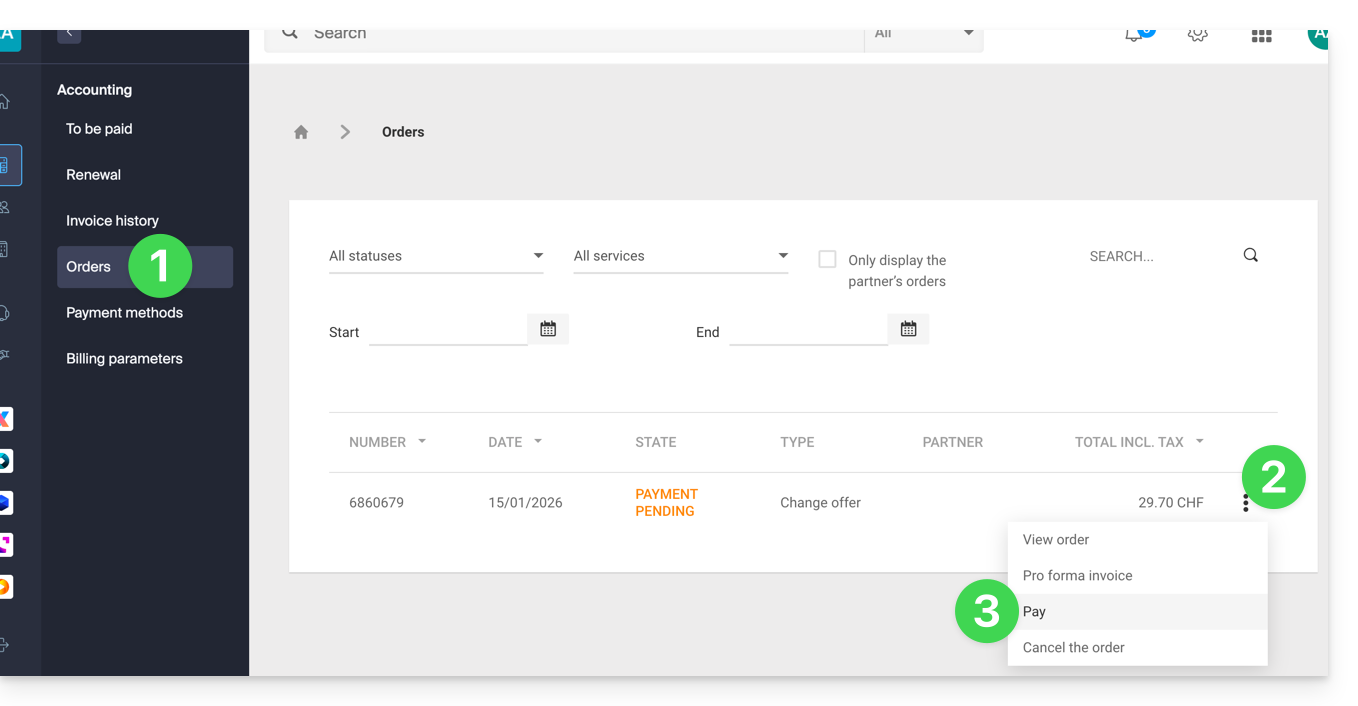
- Choose a payment method and complete the process.
Accepted payment methods
Topay for a new order, a renewal, or a change of plan, you can use:
- credit card Visa, MasterCard, CB Carte Bleue
- PostFinance card (if the currency is CHF)
- IBAN bank transfer (any bank charges will be your responsibility)
- PayPal
- Twint:Just like bank cards, when making a payment on the Manager or the Shop, your Twint profile will be saved in your account as a payment method, which can then be used for automatic renewals or payments without having to scan a QR code again.
- the prepaid account (it is possible to use the available balance and pay the remaining amount of an invoice with another payment method)
To top up a prepaid account, you can use:
- Visa, MasterCard, CB Carte Bleue credit card
- PostFinance card (if the currency is CHF)
- IBAN bank transfer (any bank charges will be your responsibility)
The limits for a deposit on a prepaid account are from 0.1 CHF/EUR to 9999 CHF/EUR.
Generate or print a PDF invoice
Please refer to this other guide if you are looking for information about Infomaniak invoices.
Link to this FAQ: https://faq.infomaniak.com/1385
Has this FAQ been helpful?
This guide explains how to add a user to an Organization within the Infomaniak Manager. This will allow you to grant the user access to certain Infomaniak products, as needed.
Introduction
- Since you opened your account with Infomaniak, you have been part of at least one Organisation (❓: help).
- If you were the only user and it wasn't an invitation, an Organisation was created in your name, and you automatically become its legal representative.
- Otherwise, you belong to the Organisation that invited you (to join its kSuite, to manage a product, etc.).
- You can define whether a user…
- … belongs to your Organisation and whether they should become:
- Legal representative
- Administrator
- Collaborator
- … is external to your Organisation (limited rights):
- External users are not taken into account in calendar and address book sharing for the entire Organisation.
- … belongs to your Organisation and whether they should become:
Invite the new user
Prerequisites
- If you cannot find the expected list of users, first switch to the desired Organization (❓: help).
- You must be an Administrator or Legal Representative within the Organization (❓: help).
- Learn about the different permissions (e.g., access rights to products) and administrative contact preferencesfor a user within an Organization (❓: help).
To add, and if necessary, create the new user for your Organization:
- Click here to access user management in the Infomaniak Manager (❓: help).
- Click on the Add User button:
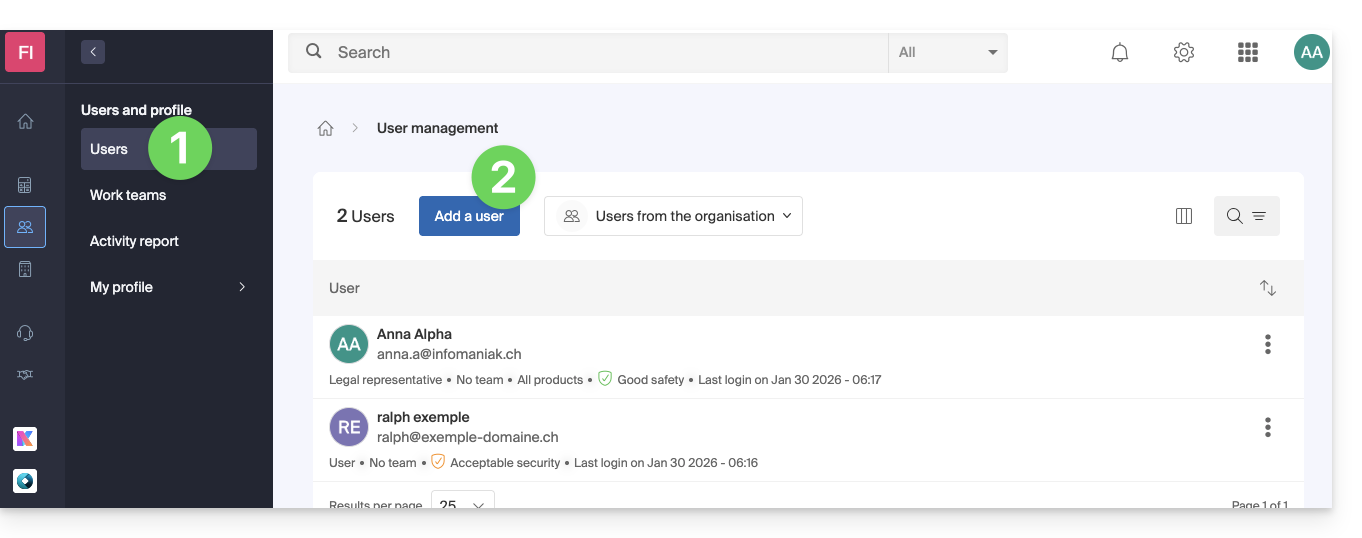
- Follow the wizard to complete the process:
- If the added user does not yet have an Infomaniak user account, they will be prompted to create one.
- If the added user already has an Infomaniak account, they will be prompted and then be able to switch from their original Organization to the new one (❓: help).
Link to this FAQ: https://faq.infomaniak.com/1404
Has this FAQ been helpful?
This guide explains how to create a request for proposal as an Infomaniak Customer in need of support, how to delete the request if you have found a solution, and how an Infomaniak Partner can respond to this request.
Create a request for proposal
Here is the process that takes place when you want to submit a request for proposal:
- Click here to access the request for proposal submission page.
- This is a free service that allows you to address your needs to all Infomaniak Partners who wish to receive this type of request.
- Once you send your request for proposal, each relevant Partner receives a message with an excerpt from the request.
- They are then invited to view your complete request for proposal on a dedicated interface within their Partner account on the Infomaniak Manager.
- If the offer is still valid (see below), the Partner will display your request for proposal and view your contact details.
- They can then make you an offer tailored to your needs, and you decide how to proceed:
- Collaborate with the Partner (e.g., become their Client within Infomaniak) and, in this case, you can delete the request for proposal (see below).
- Wait to receive other proposals over the next few days.
Delete the current request for proposal
When you submit a request for proposal, you automatically receive an email at your contact address:
- This email contains a link to cancel your request for proposal.
- Please note that the effect is immediate.
- It will no longer be visible in the interface available to Infomaniak Partners.
Link to this FAQ: https://faq.infomaniak.com/1437
Has this FAQ been helpful?
This guide details the different roles, rights, permissions, and privileges that users can obtain within an Infomaniak Organization.
Roles and administrative contact preferences
You can define the permissions (access rights to products, for example) as well as the administrative contact preferenceswhen adding a user, or later.
Define the roles of a new user
When you add a new user to an Organization, you must define their role and set their preferences at the administrative level: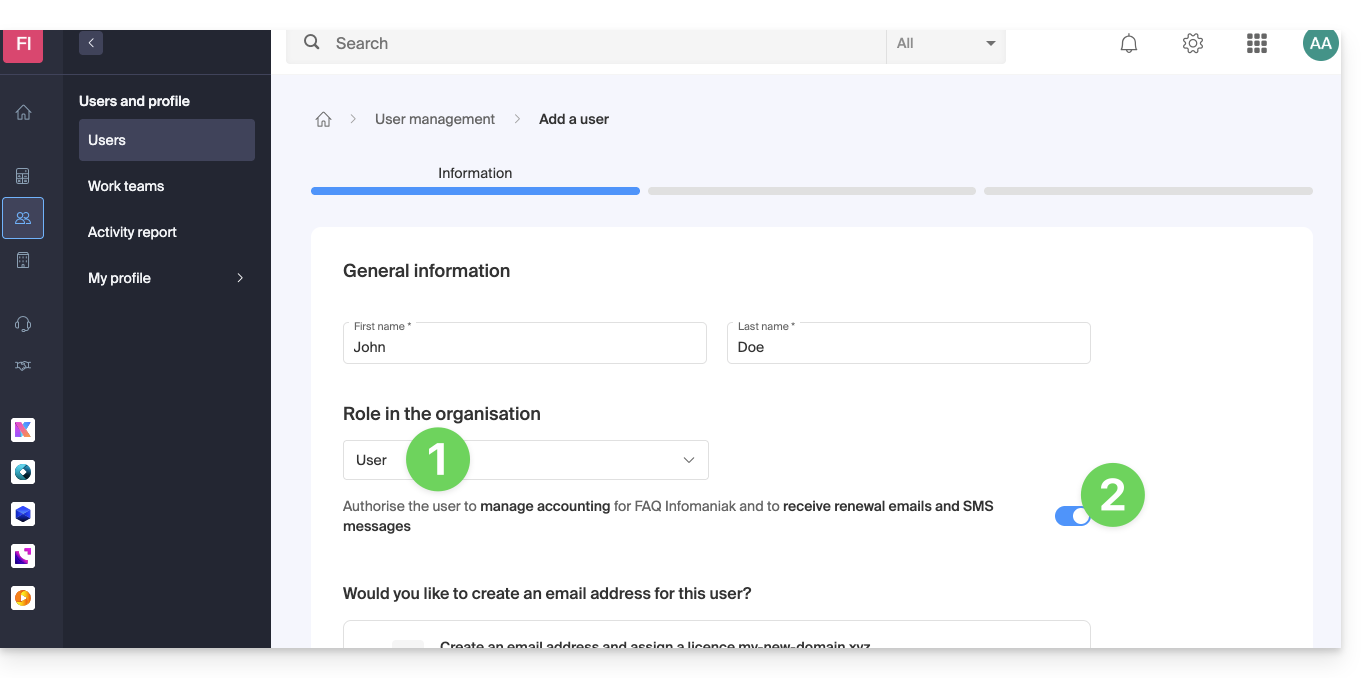
1. Possible roles within the Organization
- Legal Representative (all rights + legal responsibility (if you are considering replacing your role as legal representative))
- Legal responsibility for the organization
- Can manage all products and users
- Can manage accounting and new product orders
- Can manage all clients
- Administrator (all rights)
- Can manage all products and users
- Can manage accounting and new product orders
- Can manage all clients
- User (limited rights, collaborator)
- Can manage the products you authorize
- Can manage accounting if you authorize it
- Can manage the clients you authorize
2. Administrative permissions
Decide if you want to “allow receiving (email / SMS) billing reminders” so all communications, such as:
- New invoice
- Payment made to the account
- Payment received
- Order cancelled
- Automatic renewal scheduled
- Renewal completed
- PayPal transfer in your favor
- etc.
and if the “User” role should also be able to manage accounting.
Link to this FAQ: https://faq.infomaniak.com/1440
Has this FAQ been helpful?
This guide explains how to modify the postal and name details related to the Organization to which you belong.
Introduction
- The postal address specified determines the currency (CHF / EUR) used for future invoices, but you can add billing addresses.
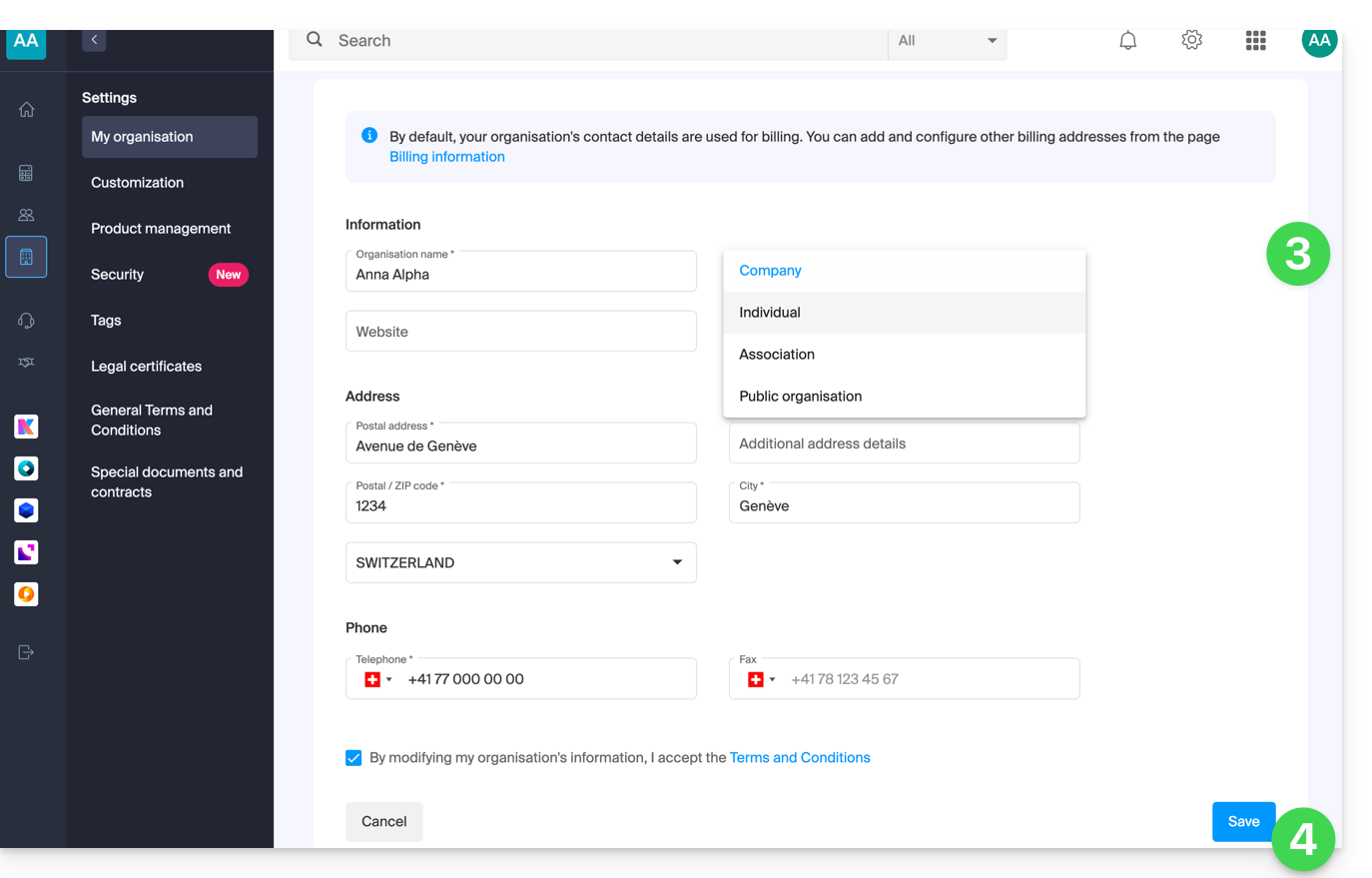
- You can modify, among other things:
- the name
- the postal address
- the contact phone number
- the type of your organization (individual, association, company, etc.)
- the logo
- A summary email is then sent.
- To manage your Infomaniak account details, please refer to this other guide.
Modify Organization Details
Prerequisites
- Be the Legal Representativewithin the Organization (any collaborator who also has access to your Organization will not be able to modify this information from their restricted account).
- Switch to the desired Organization beforehand, if necessary.
To modify the details of this Organization at any time:
- Click here to access the management of your Organization.
- Click on the Edit button (if it is not present, check the prerequisites above):
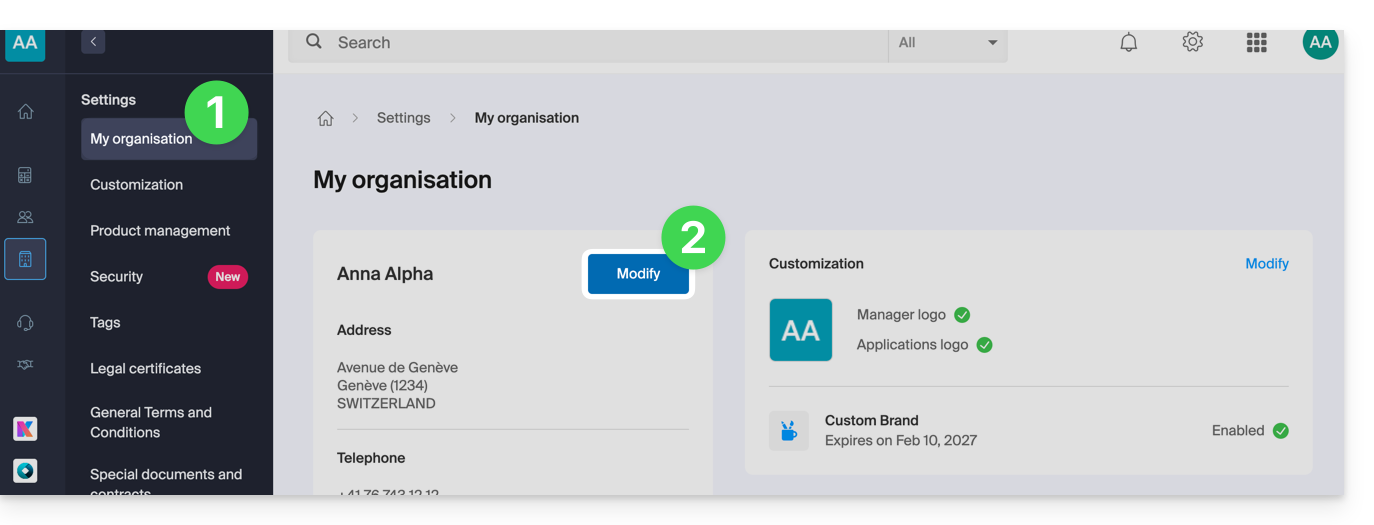
- Modify the desired information.
- Click the Save button to save your new information:
In case of a problem
If you do not see any menu as in step 2 above, check the requirements.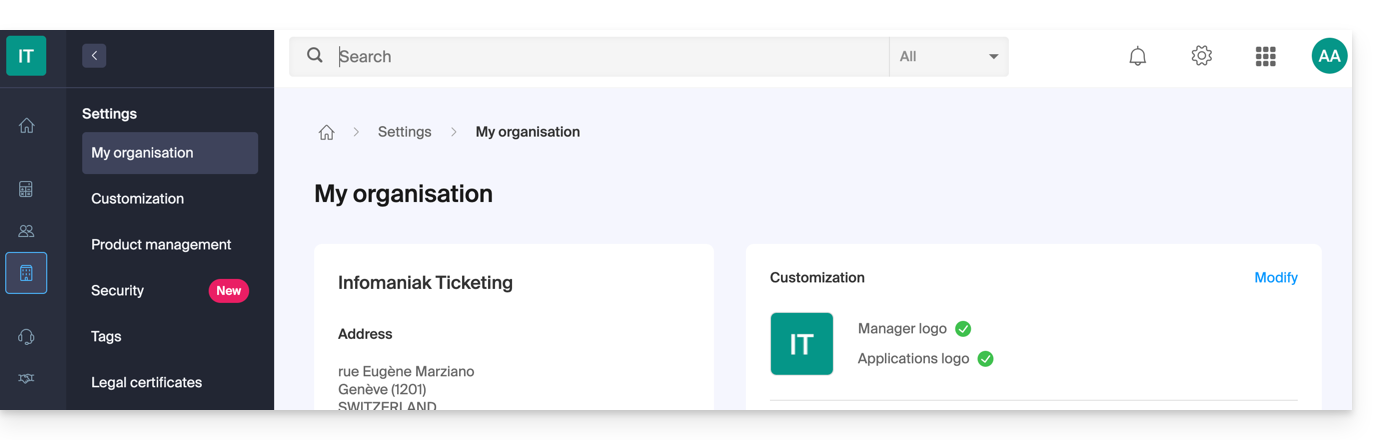
A my kSuite account no longer has this option: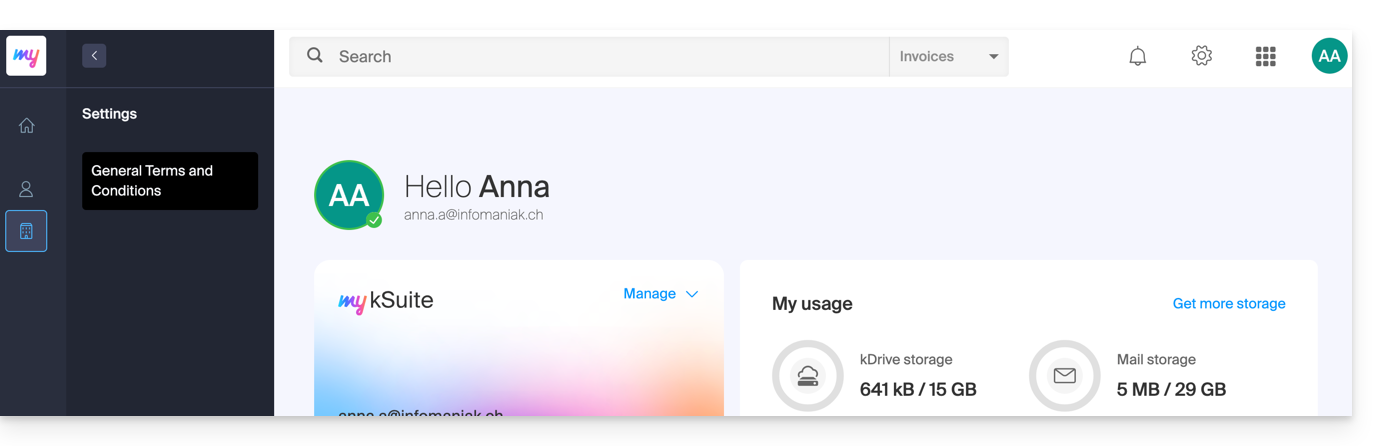
Link to this FAQ: https://faq.infomaniak.com/1462
Has this FAQ been helpful?