Knowledge base
1000 FAQs, 500 tutorials and instructional videos. Here, there are only solutions!
This guide details the mechanisms of email spoofing and the protection measures against unwanted messages that appear to come from your own domain.
Has my account been used without my knowledge?
Receiving an email that appears to be sent by you is a common psychological manipulation technique. This does not necessarily mean that your email account has been compromised. In most cases, it is simply a forged "From" header, similar to someone writing your address on the back of a paper envelope before mailing it.
Make sure that your own address is not listed in the allowlist of your anti-spam filterIf it is found, the security system ignores the security scan, assuming that the message is legitimate.
Diagnosis: Spoofing vs. Hacking
It is crucial to distinguish spoofing from intrusion. The global email sending protocol (SMTP) was designed without native sender identity verification.
Although Infomaniak's infrastructure applies rigorous security standards, it is technically impossible to prevent a non-secure, third-party server located anywhere in the world from sending a message claiming to be you. However, tools exist to make these messages undetectable or blocked by your recipients.
Strengthen your domain's integrity
To protect your digital reputation and limit the impact of these impersonations, implementing authentication protocols is the professional standard:
- SPF & DKIM: These digital signatures certify that your messages originate from our authorized servers.
- DMARC: This essential protocol allows you to give instructions to servers worldwide (e.g., "If the email is not signed by Infomaniak, reject it or place it in spam"). This is the most powerful tool foranalyze and limit fraudulent use of your domain.
- Catch-all management: Avoid using a "catch-all" address, which collects all messages sent to non-existent addresses on your domain, as it naturally attracts large volumes of spam.
Failure Notifications (Backscatter)
If you receive non-delivery reports for messages you never wrote, you are experiencing the phenomenon of Backscatter. Third-party servers that are poorly configured or botnets are using your identity to send mass content. When they encounter a non-existent address, the remote server sends the error to the displayed sender: you.
Link to this FAQ: https://faq.infomaniak.com/1127
Has this FAQ been helpful?
This guide lists the versions of the Windows operating system that can be installed when ordering a Cloud VPS / VPS Lite.
Regarding Linux, please refer to this other guide.
Supported Windows versions
When ordering your Server, you can choose the Windows version to install.
Windows Server
Available versions with Windows Server 2025, 2022, or 2019:
- Windows Server Standard designed for low-density or non-virtualized environments
- Windows Server Datacenter ideal for datacenter-defined and highly virtualized environments
Note:
- As a Microsoft partner, Infomaniak provides Cloud VPS / VPS Lite with Windows Server 2025, 2022, or 2019, including a Microsoft Windows Server license. If activation fails, please refer to this other guide.
- As a Microsoft partner, Infomaniak does not offer the possibility of using your own Windows Server license (or Bring Your Own License).
- If you use Microsoft software within Windows Server that requires a License Mobility license, such as Microsoft SQL Server, Microsoft Sharepoint Server, or Microsoft Exchange Server, you must provide the Software Assurance document via the Infomaniak contact form.
Windows 11 Professional Evaluation
Windows 11 Professional includes all the features of Windows 11 Home, as well as professional features for encryption, remote connection, virtual machine creation, and more.
The version 10 of Windows Professional Evaluation is also available.
Note:
- Windows will need to be activated; Infomaniak only provides an evaluation version.
Link to this FAQ: https://faq.infomaniak.com/2230
Has this FAQ been helpful?
This guide explains how to create a custom MX record (mx.domain.xyz, assuming that domain.xyz belongs to you) to be used in the MX configuration of your NAS.
An MX record cannot be declared directly as an IP address, for example 178.123.456.789.
Custom MX record
To access your domain names:
- Click here to access the domain management section in your Infomaniak Manager (❓: help).
- Click on the name of the domain in question.
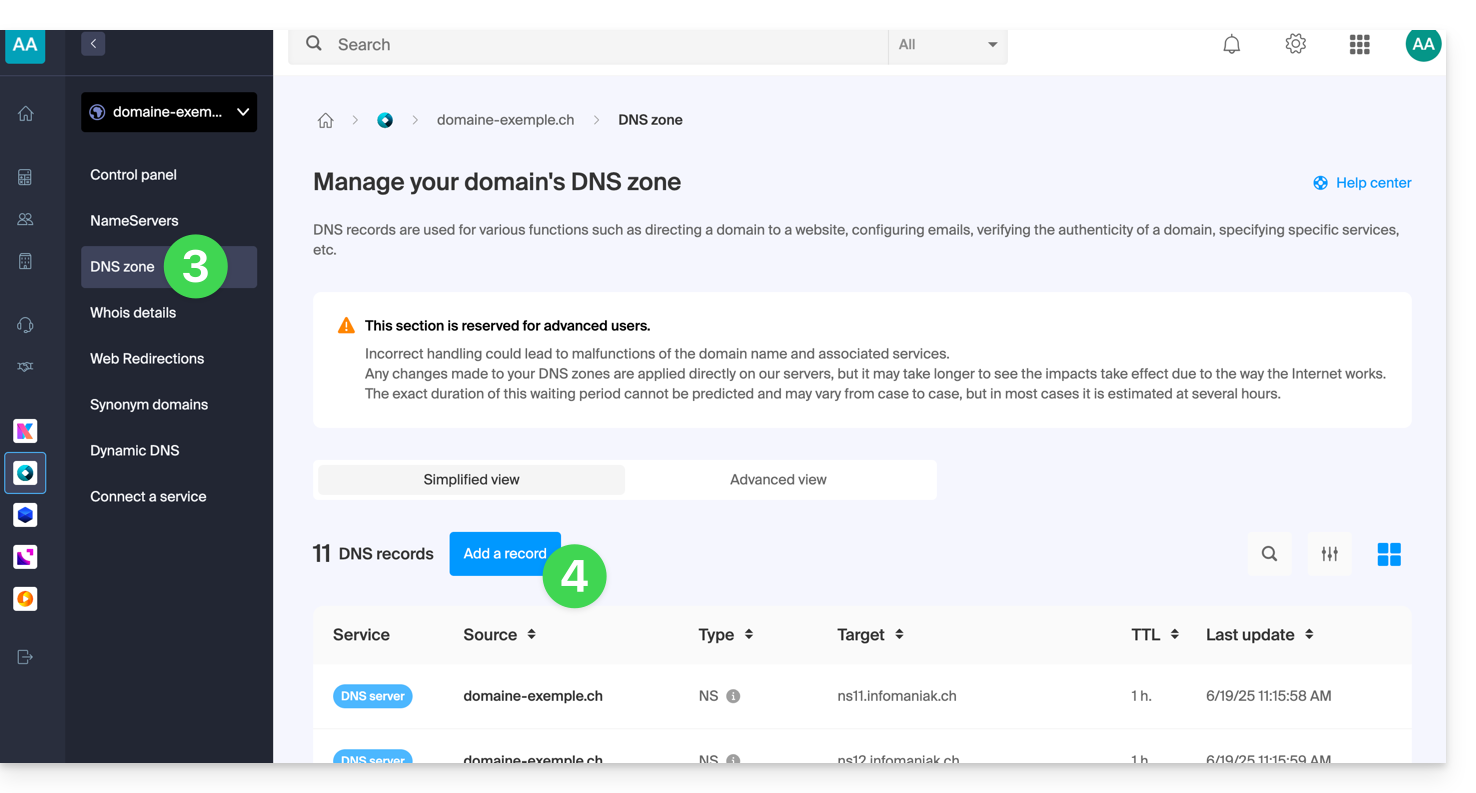
- Click on DNS Zone in the left-hand menu.
- Click on the blue Add record button:
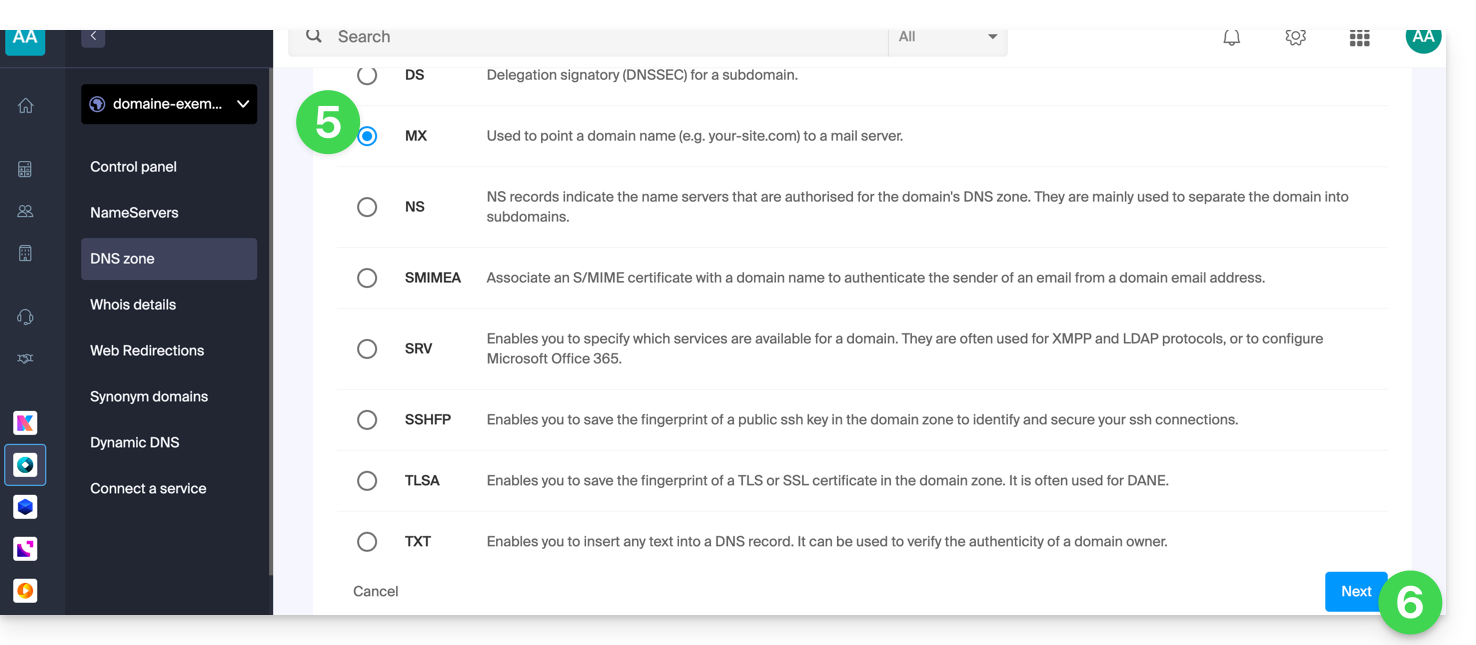
- Select MX as the type of record.
- Click on Next:
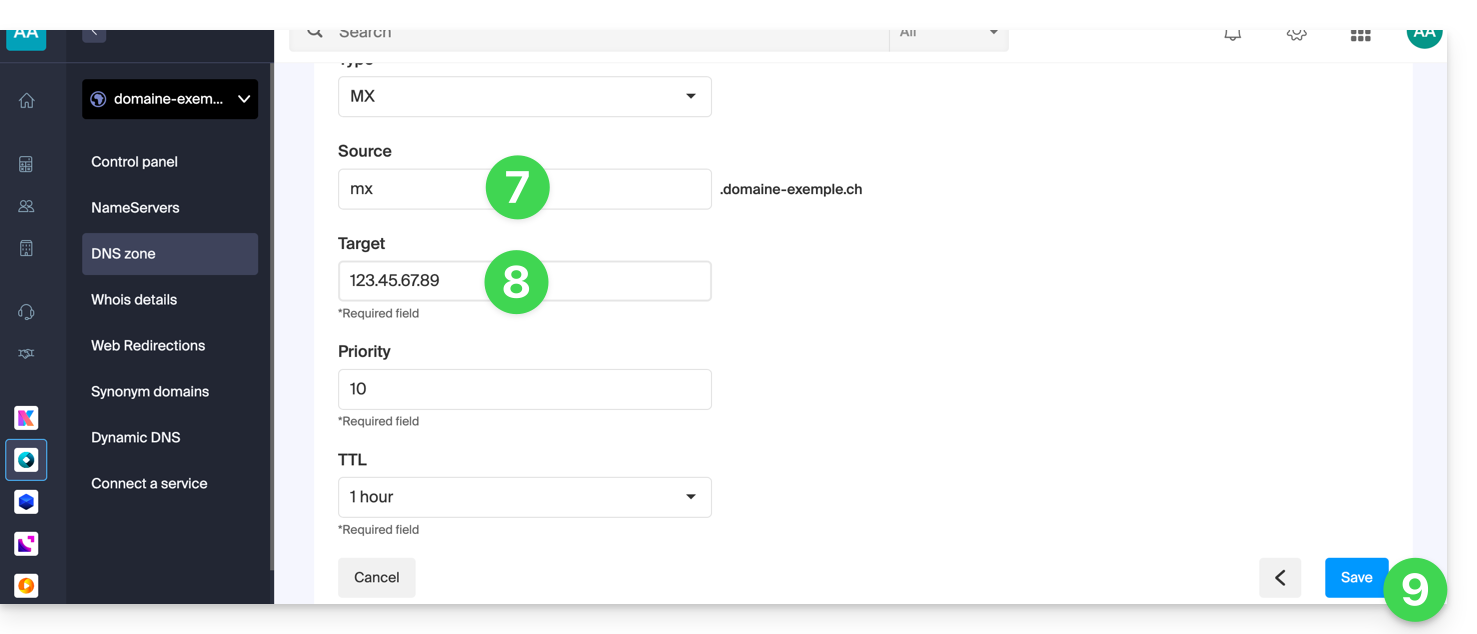
- Enter the desired MX record (e.g., "
mx.domain.xyz"). - Point the record to the desired IP address (target).
- Click on the Save button:
Link to this FAQ: https://faq.infomaniak.com/1896
Has this FAQ been helpful?
This guide provides some information about Windows licenses for Infomaniak Public Cloud.
Windows License Information
As a Microsoft Partner, Infomaniak provides and automatically bills for Microsoft licenses for the following operating systems:
- Windows Server 2019 standard and datacenter
- Windows Server 2022 Standard and Datacenter
- Windows Server 2025 Standard and Datacenter
Billing is based on the number of vCPUs of the instance.
The license belongs to Infomaniak and is not the property of the customer. It becomes active when the customer uses one of these versions of Windows Server and expires when the instance is deleted.
No license fees are charged when the instance is paused or stopped.
Microsoft Partner
- As a Microsoft partner, Infomaniak provides pre-activated images on the Public Cloud, via Horizon or the Openstack CLI.
- If activation fails, please refer to this other guide for more information.
- As a Microsoft partner, Infomaniak does not allow the use of a customer's personal license (Bring Your Own Licence); in the event of using their own license, Infomaniak provides and automatically bills for the licenses provided by Infomaniak.
- The customer can then activate their OS via the activation procedure.
- As a Microsoft partner, the non-use of licenses (i.e., using an 180-day Evaluation version) is also not permitted.
- These versions are intended for testing in an internal environment.
- In the case of using an evaluation version, Infomaniak provides and automatically bills for the licenses provided by Infomaniak.
- The customer can then activate their OS via the procedure for converting an evaluation version into a normal, activated version.
- If you are using Microsoft software within Windows Server that requires a License Mobility, such as Microsoft SQL Server, Microsoft Sharepoint Server, or Microsoft Exchange Server, you must provide the Software Assurance document via the Infomaniak contact form.
Link to this FAQ: https://faq.infomaniak.com/2797
Has this FAQ been helpful?
This guide explains how to renew or restore a domain name registered with Infomaniak.
Introduction
- You will automatically receive an email notification (at the address you provided) when one of your domain names is about to expire.
- If this domain name is not renewed before its expiration date, it enters a redemption period during which it is still possible to recover/restore it.
- The restoration fees and the duration of the redemption period are variable depending on the extension in question.
- Once the redemption period has expired, the domain name is free and can be registered again by anyone.
- If your domain is important for your business, Renewal Warranty offers you the assurance of never losing it: Infomaniak will do everything in its power to ensure that you can keep it, even if you do not provide timely notice before its expiration.
Renew a domain name before it expires
Renewing one or more domain names is done in exactly the same way as any other Infomaniak service renewal. Refer to this other guide if you are looking for information on how to renew the product in question.
Restore a domain name after expiration
To restore a domain during its redemption period:
- Click here to access the domain management section in your Infomaniak Manager (❓: help).
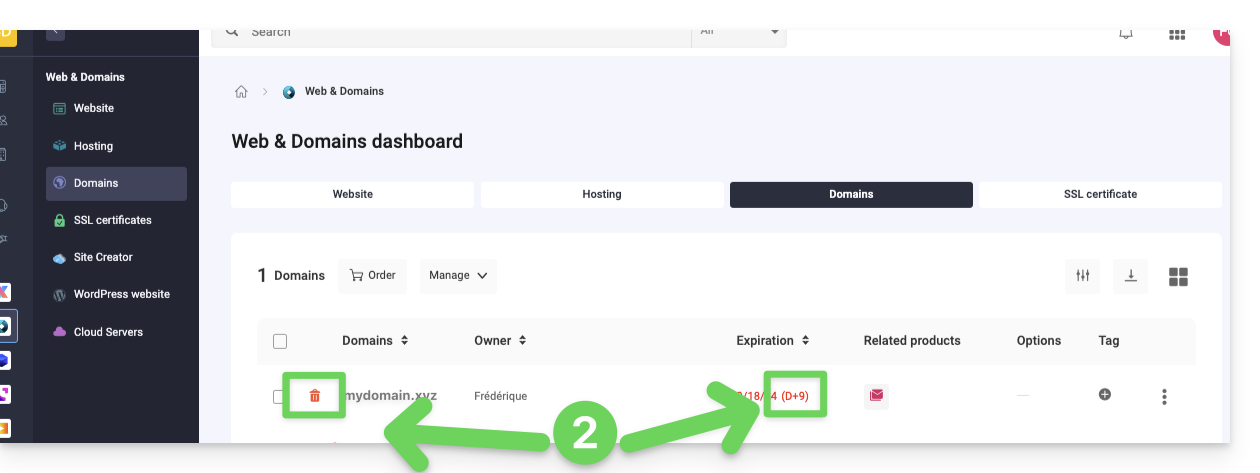
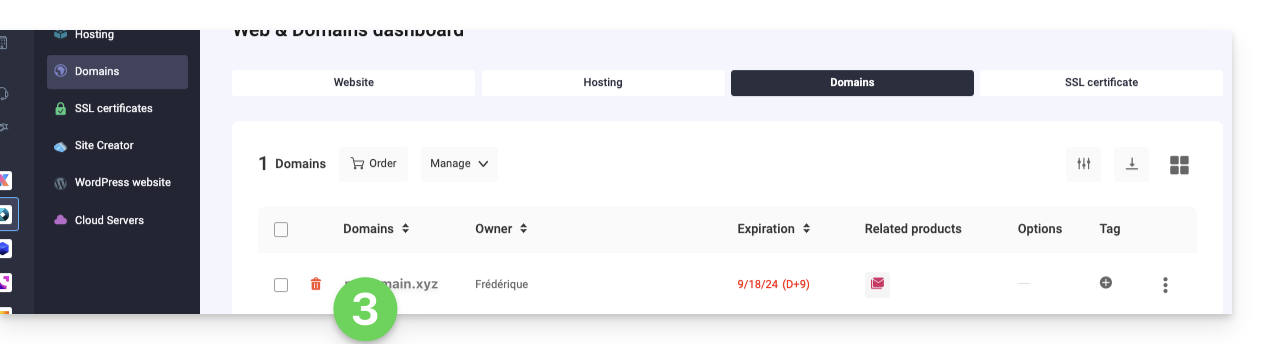
- An expired domain is indicated as such:
- Click on the name of the domain in question:
- Click on the Restore button:
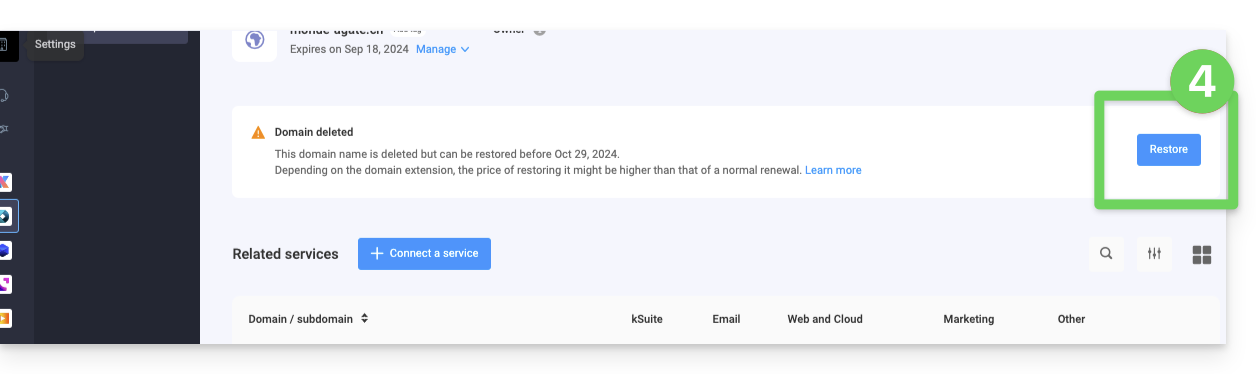
- Follow the restoration steps until the end.
Troubleshooting
What to do if the domain does not appear in your account?
- Make sure you are logged in with the correct Infomaniak account (user account), and that you are viewing the correct Organization if you are associated with multiple entities.
- Go to the DOMAIN section of the Managerand not to a section of products to be billed or renewed.
- Repurchase the domain name if it has not been reserved in the meantime.
Link to this FAQ: https://faq.infomaniak.com/1825
Has this FAQ been helpful?
This guide provides 2 methods for changing the billing frequency of the services you have subscribed to with Infomaniak.
Change the invoice frequency
First method
The first method involves changing the frequency during a payment:
- Click here to access payment management in the Infomaniak Manager (need help?).
- Select the relevant product.
- Click on the dropdown menu to the right of the item in question to modify the period to which the payment should correspond:
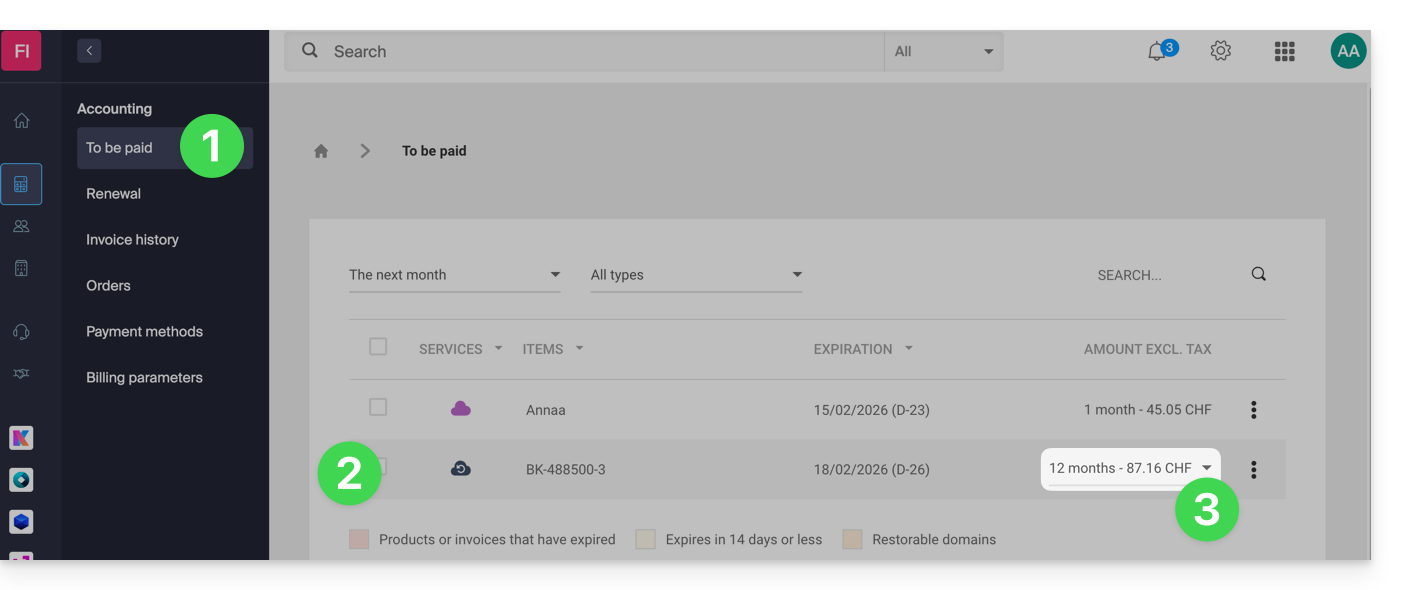
- Click on the blue button at the bottom of the page to pay for the selection and change the billing frequency of the selected product.
For the change to take effect, it is essential to change the frequency and pay the invoice including the product with the new frequency.
Second method
The second method is as follows:
- Click here to access the management of your products on the Infomaniak Manager (need help?).
- Click on the type of product concerned (e.g. hosting, Cloud Server, etc.)
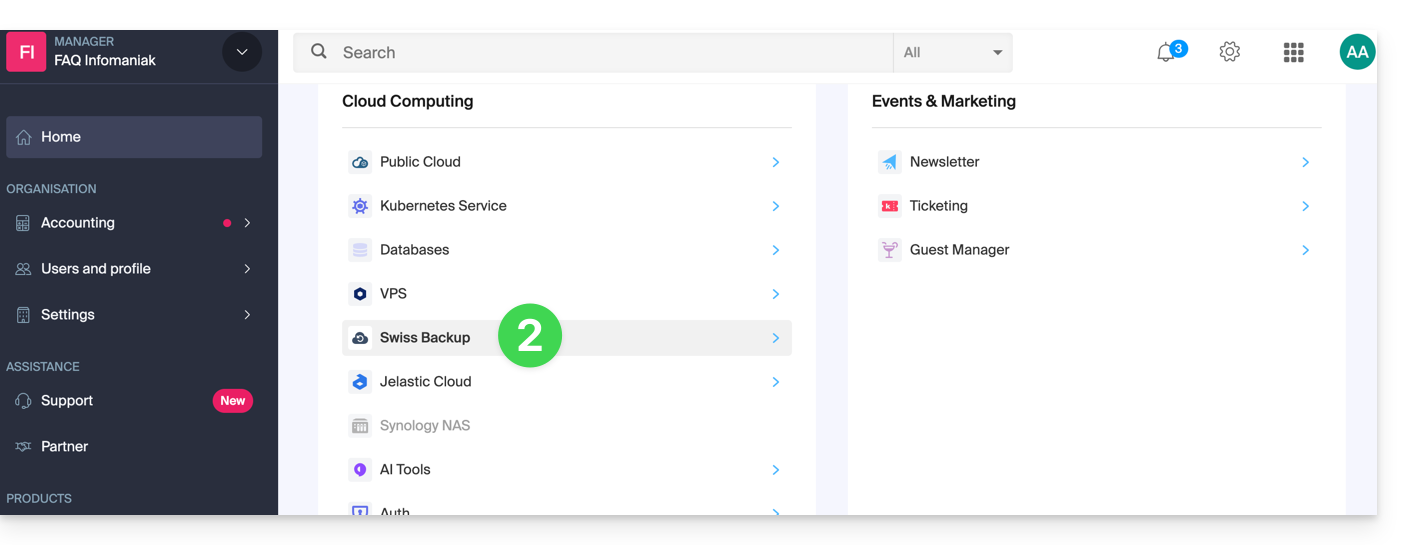
- Click on the name of the product concerned:
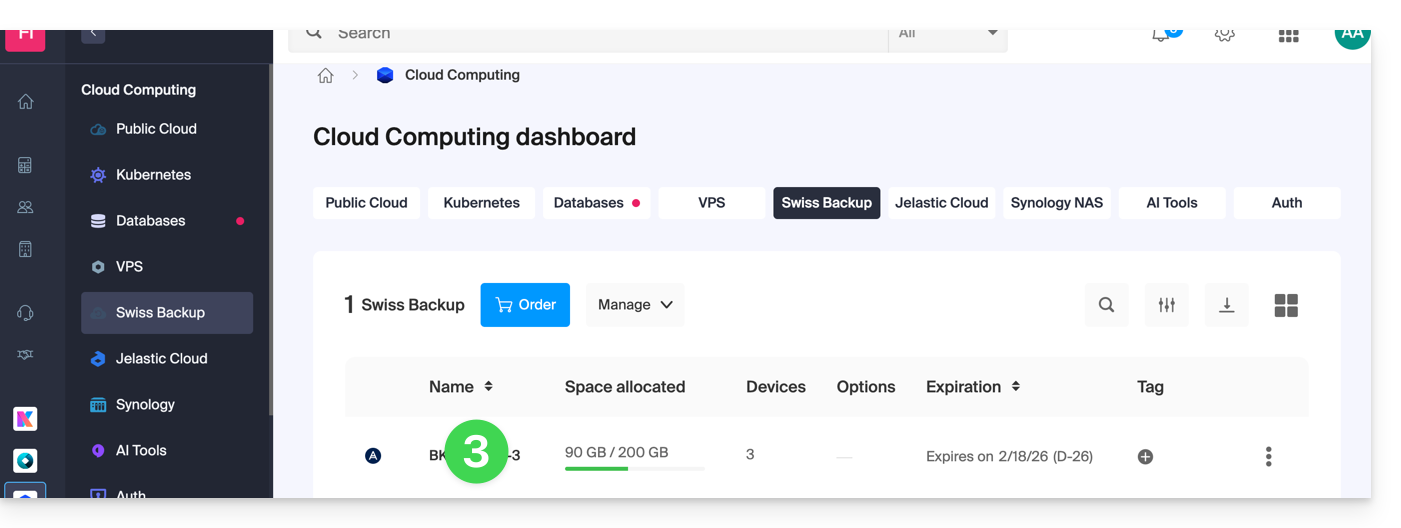
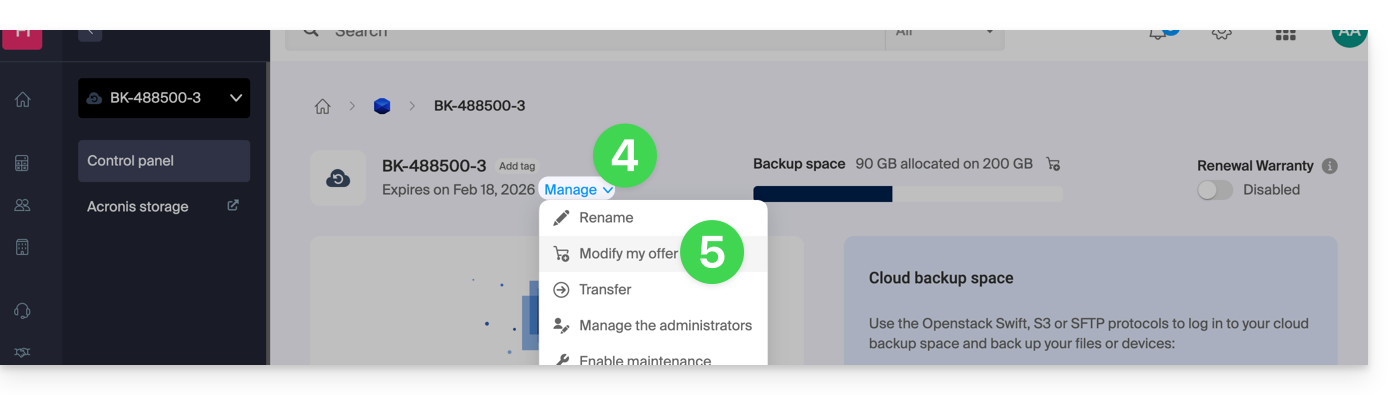
- Click on the Manage button.
- Click on Edit plan:
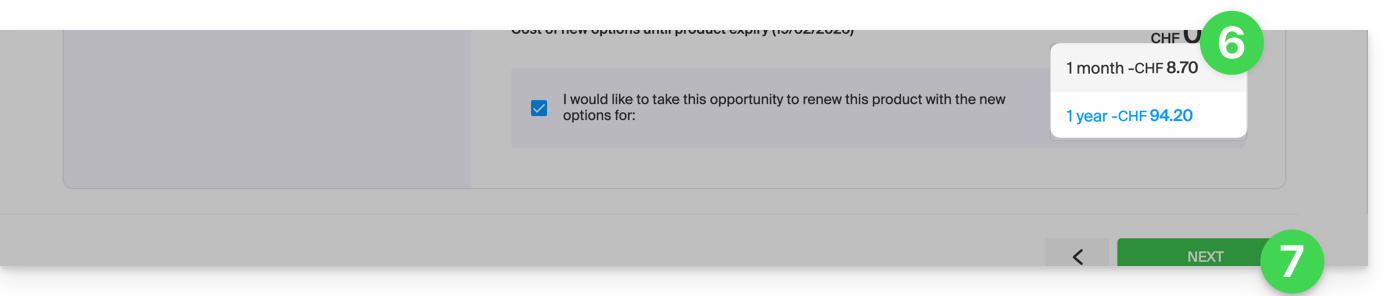
- Choose your preferred billing frequency.(only available from a certain amount).
- Confirm the change:
If you switch from annual billing to monthly or quarterly billing, you can only change the billing frequency during the month preceding the end of the current billing periodJanuary
Link to this FAQ: https://faq.infomaniak.com/2100
Has this FAQ been helpful?
This guide explains how to set up a pass or subscription renewal system (as part of the Infomaniak ticketing system). This feature will allow visitors with subscriptions to renew them for the new season.
Introduction
- It is not mandatory to have seasonal or annual subscriptions to use the pass renewal feature, but it is essential to have a new period with passes configured.
- If the subscriptions are configured with fixed, numbered seats on an unchanged seating plan, the renewed subscriptions will retain the same seats for the new season.
- Renewed subscriptions will retain the same QR codes from season to season.
Create a renewal
Prerequisites
- To enable renewals on your ticketing system, you must create the passes for the new period.
Next:
- Click here to access the management of your product on the Infomaniak Manager (need help?).
- Click directly on the name assigned to the ticket office concerned by the event (this will take you to the period during which renewals will be offered).
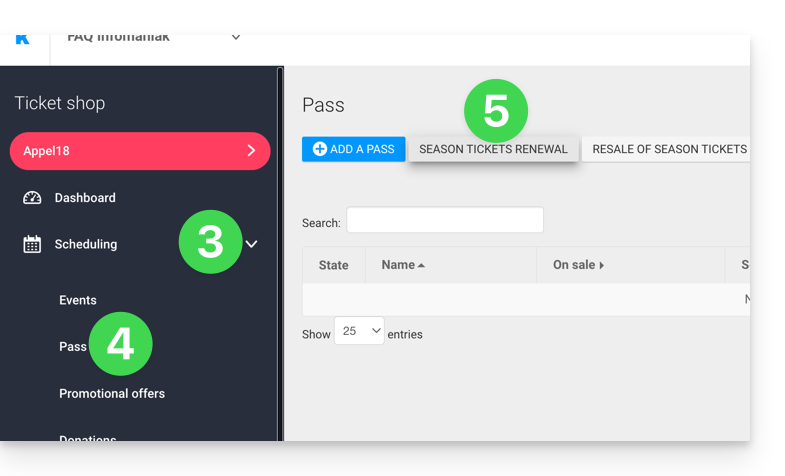
- Click on Programming in the left-hand menu.
- Click on Pass in the left-hand menu.
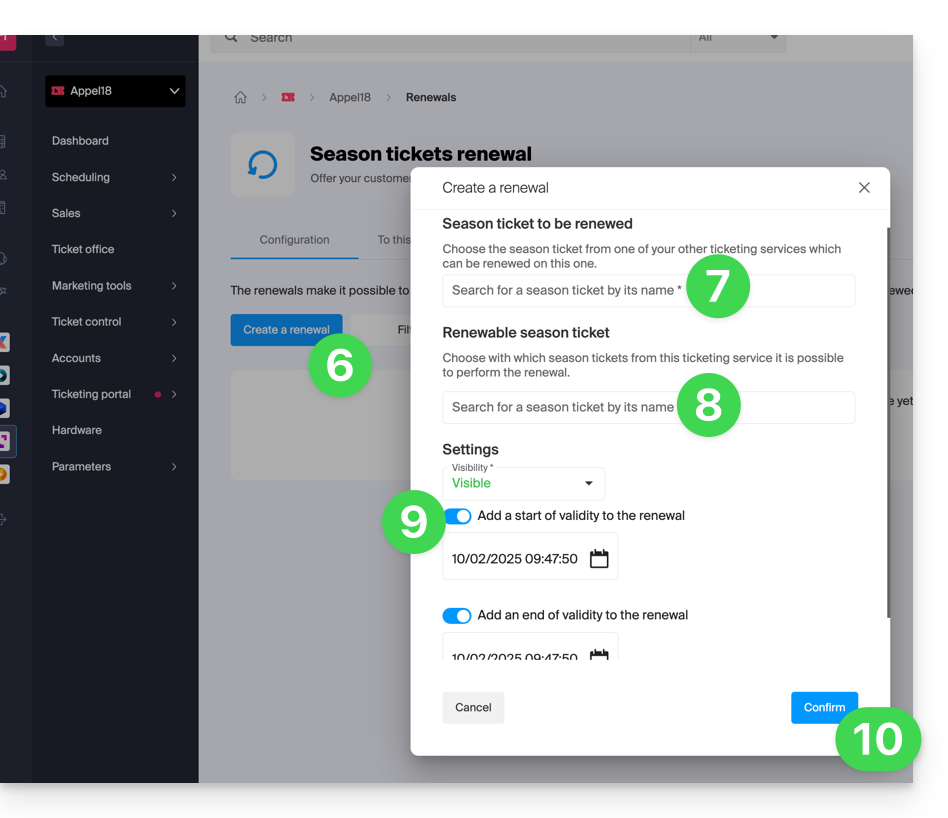
- Click on Subscription renewal:
- Click on Create a renewal.
- In the pop-up window, enter the subscription details from the previous period in order…
- … then the subscriptions that visitors can choose from when renewing; several subscriptions can be offered at this stage.
- If you wish, specify a validity period for the renewal.
- Click the button to Confirm:
Renewal procedure for visitors
The visitor can renew their subscription by following this procedure from the renewal link, which can be found at the bottom of your ticketing page.
For direct integration, you can use the URL of the desired ticketing page and add /pass-renew to the end. For example: https://infomaniak.events/shop/abcABC4242I/pass-renew
Renewal Tracking
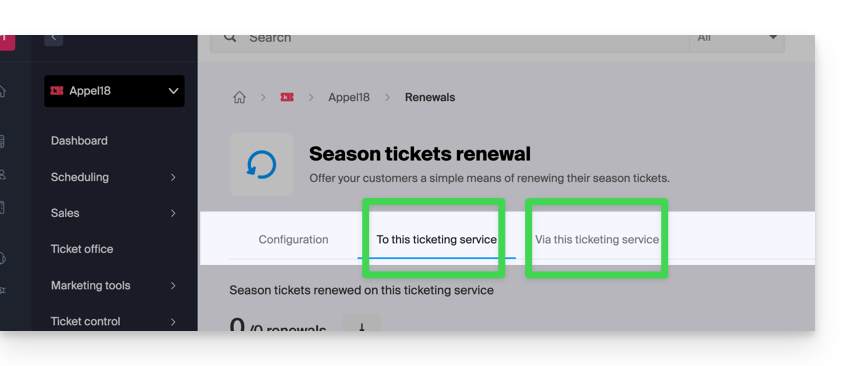
You can track each renewal via the renewal tabs:
- To this ticketing system: indicates the renewals made from a previous season to the current one.
- From this ticketing system: indicates the subscriptions renewed from the selected ticketing system to a new period.
Link to this FAQ: https://faq.infomaniak.com/2788
Has this FAQ been helpful?
This guide explains how to resolve an issue when importing a .csv file into a MySQL table. The proposed alternative is to read the CSV file line by line using PHP and insert the data into the MySQL database.
"LOAD DATA LOCAL INFILE" function disabled
The LOAD DATA LOCAL INFILE function allows you to import a CSV file directly into a MySQL table. However, this feature is often exploited by attackers to gain unauthorized access to websites hosted on servers that allow it.
To prevent any security risks and protect customer data, Infomaniak has disabled the LOAD DATA LOCAL INFILE function. Users who import their CSV files via phpMyAdmin (without checking the “CSV via LOAD DATA” option) are not affected.
Here is an alternative method for importing data in CSV format into a MySQL table. The example below shows how to properly handle errors when opening the CSV file and inserting data into the database.
This script uses mysqli to connect to the database and prepared statements to insert the data. This ensures better security, optimal compatibility with recent versions of PHP, and simple integration into your project, whether in an existing script or a new file located in the /web directory:
$fileName = "data.csv";

// Connect to MySQL database using mysqli
$link = new mysqli("localhost", "username", "password", "database");

// Check database connection
if ($link->connect_error) {
   die("Connection failed: " . $link->connect_error);
}

// Open the CSV file for reading
if (($handle = fopen($fileName, "r")) !== FALSE) {

   // Read each line of the CSV file
   while (($data = fgetcsv($handle, 1000, ";")) !== FALSE) {

       // Prepare the SQL query dynamically
       $query = "INSERT INTO `test` VALUES (" . str_repeat('?,', count($data) - 1) . "?)";
       $stmt = $link->prepare($query);

       // Check if query preparation was successful
       if ($stmt === FALSE) {
           die("Query preparation failed: " . $link->error);
       }

       // Bind parameters (assuming all columns are strings)
       $types = str_repeat('s', count($data));
       $stmt->bind_param($types, ...$data);

       // Execute the query
       if (!$stmt->execute()) {
           die("Query execution failed: " . $stmt->error);
       }

       // Close the statement
       $stmt->close();
   }

   // Close the CSV file
   fclose($handle);

} else {
   echo "Error: unable to open the file.\n";
   exit(1);
}

// Close the database connection
$link->close();
?>
Get help
Unfortunately, it is impossible to specify exactly where in the script these lines of code should be inserted.
If this method causes problems (for example, when importing multiple CSV files simultaneously without any error messages), the structure of the tables or the indexing of the fields may be the cause. In this case, contact your webmaster for verification.
Also, consult the official PHP documentation regarding the fgetcsv() function.
Link to this FAQ: https://faq.infomaniak.com/1312
Has this FAQ been helpful?
This guide is intended for users who have chosen Infomaniak, a hosting provider committed to the planet: you will find below the details of the calculation method used to display CO2 on invoices, as well as some tips to reduce your own digital footprint.
Introduction
- For Web Hosting and Mail services, Infomaniak displays the amount of CO2 emitted annually, a figure based on a rigorous Life Cycle Assessment (LCA) method that combines two key factors:
- Material impact (Full life cycle)
- Using emission factors from the ResilioDB database, the calculation includes emissions generated during the manufacturing (BLD), transport (DIS), and end-of-life/recycling (EOL) of each piece of equipment (servers, RAM, disks, etc.).
- Energy impact (Actual consumption)
- The actual electricity consumption of the servers is measured via IPMI probes.
- This energy is then converted into CO2 equivalent using Infomaniak's specific energy mix, which is very low in carbon (11.77g CO2eq/kWh).
- Material impact (Full life cycle)
- The total impact is then distributed according to the customer's unit of usage (per hosted website or per mailbox).
What can you do?
If the hosting provider optimizes its infrastructure, the end-user also plays a key role. Here's how to reduce the environmental impact of your services.
For websites
The goal is to minimize the energy consumption of servers and visitors' devices:
- Technical optimization: Compress images, minify scripts, and use modern formats (WebP).
- Clean design: Limit autoplay videos, advertisements, and heavy scripts that consume bandwidth.
- Best practices: For WordPress in particular, it is recommended to consult the GreenIT guides.
For email
Email communication can also be optimized:
- Simplicity: Prefer plain text emails over HTML emails and limit the use of large, graphical signatures.
- Attachments: Prefer sending download links (via kDrive or SwissTransfer) instead of large attachments, or use compressed PDF format.
- Cleanup: Unsubscribe from unnecessary newsletters and use tracking tools to avoid sending emails that are not opened.
It is recommended to regularly monitor statistics to improve environmental performance. While waiting for Infomaniak's future integrated tools, it is possible to audit the impact of web pages via GreenFrame.io.
Link to this FAQ: https://faq.infomaniak.com/1160
Has this FAQ been helpful?
Thank you for choosing Infomaniak to host your IT solutions, and congratulations on optimizing your customer experience. You're taking it to the next level with the Premium Support offer.
Introduction
- Since its inception, Infomaniak's Support department has been dedicated to resolving customer issues effectively.
- It provides free and unlimited support, responding to all your requests as quickly as possible, 5/7 days from 9 am to 6 pm by phone and 7/7 days by email from 6 am to 11 pm.
- Infomaniak does not directly intervene on your machines or networks but may request, on a case-by-case basis, access to Mail or kDrive.
- Numerous technical guides answer common questions, and specialized partners offer personalized support beyond the role of the hosting provider.
- The commitment to Premium Support is a minimum of 6 months, with no option to cancel before the end of the term.
Infomaniak Premium Support
By choosing one of the 3 support options, you benefit from personalized advice, product optimization, and faster response times with extended hours compared to standard support. Here are the details of these 3 versions:
Support Plus
- Partners can benefit from this support.
- A first response is guaranteed within 4 hours (during the opening hours mentioned above).
Pro Support
- A response is guaranteed within 2 hours (during the opening hours mentioned above).
- Emergency calls can be made 24/7.
- You benefit from a dedicated account manager, 5 days a week from 9 am to 6 pm.
Enterprise Support
- A response is guaranteed within 1 hour (during the opening hours mentioned above).
- Emergency calls can be made 24/7.
- Personalized support is provided 5 days a week, from 9 a.m. to 6 p.m.
- You will have two dedicated account managers (including one technical expert).
Frequently asked questions
- What is the VIP code and where can I find it?
- What is a PDF technical document?
- Contract duration
- Premium Support Limitations
- Is it beneficial to pay annually?
- What does the guaranteed response time mean?
The entire Infomaniak team is eager to provide you with superior service and help you get the most out of our offerings.
Link to this FAQ: https://faq.infomaniak.com/2500
Has this FAQ been helpful?
This guide explains how to modify the contact details associated with a domain name registered with Infomaniak (WHOIS information for the owner, administrator, technical contact, or billing contact).
Introduction
- WHOIS contact details are specific to each domain name and are independent of the Infomaniak account that manages the product; they can be viewed online on public services such as whois.infomaniak.com or whois.nic.swiss.
- These contact details are authoritative in the event of a dispute regarding ownership; it is essential to keep them up to date, even if you activate Domain Privacy (❓: help): an invalid WHOIS email address, for example, may block the annual ICANN accuracy check.
- A contact record can be linked to multiple domains; modifying a record automatically applies to all associated domains (❓: help).
- Depending on the domain extension (e.g.,
.es,.se, or.de), specific registry procedures or fees may apply.
Accessing a domain name's contacts
To access the different types of contacts (Owner, Administrator, Technical, Billing):
- Click here to access the domain management section in your Infomaniak Manager (❓: help).
- Click on the domain name in question:
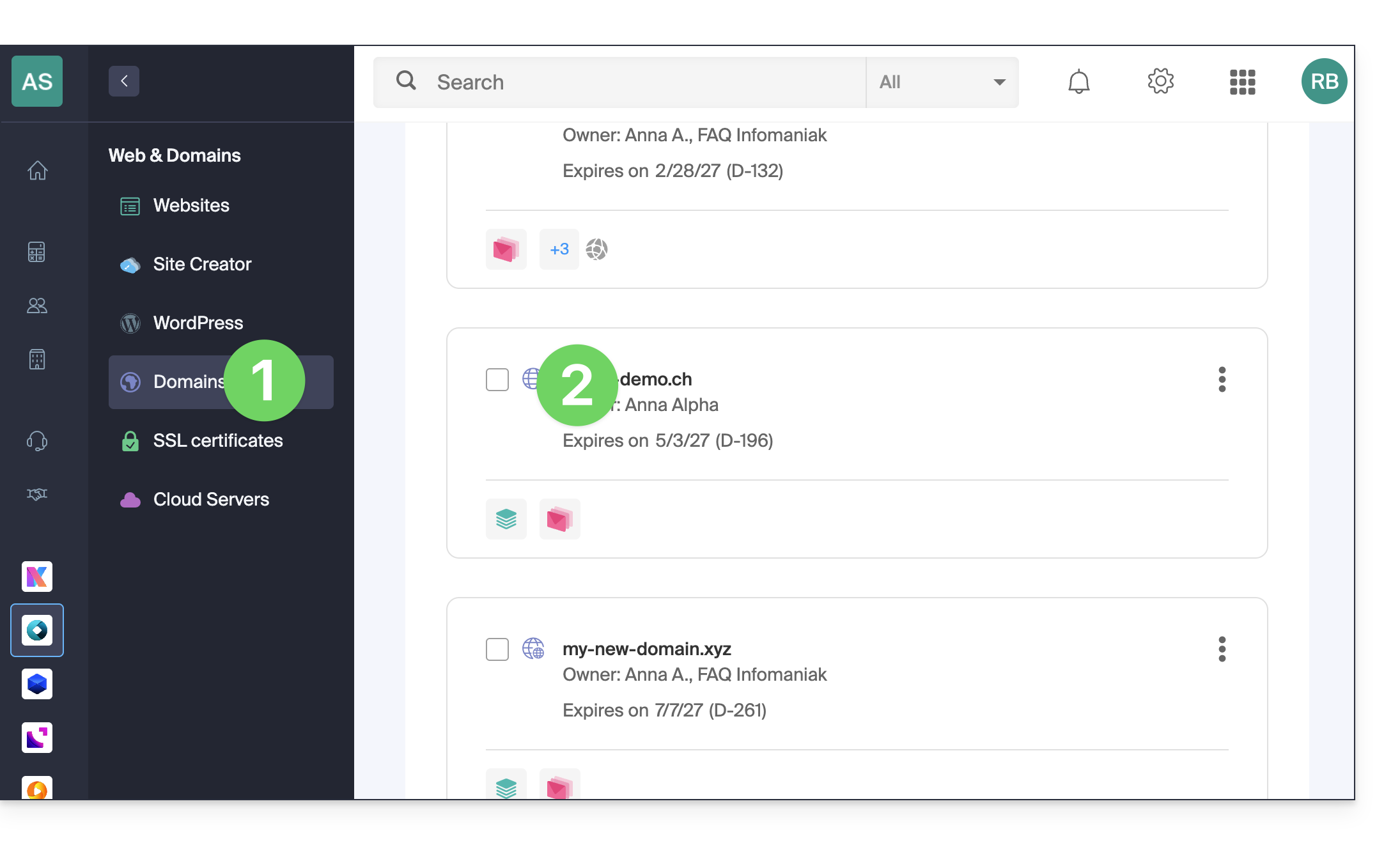
- Click on WHOIS Information in the left-hand menu:
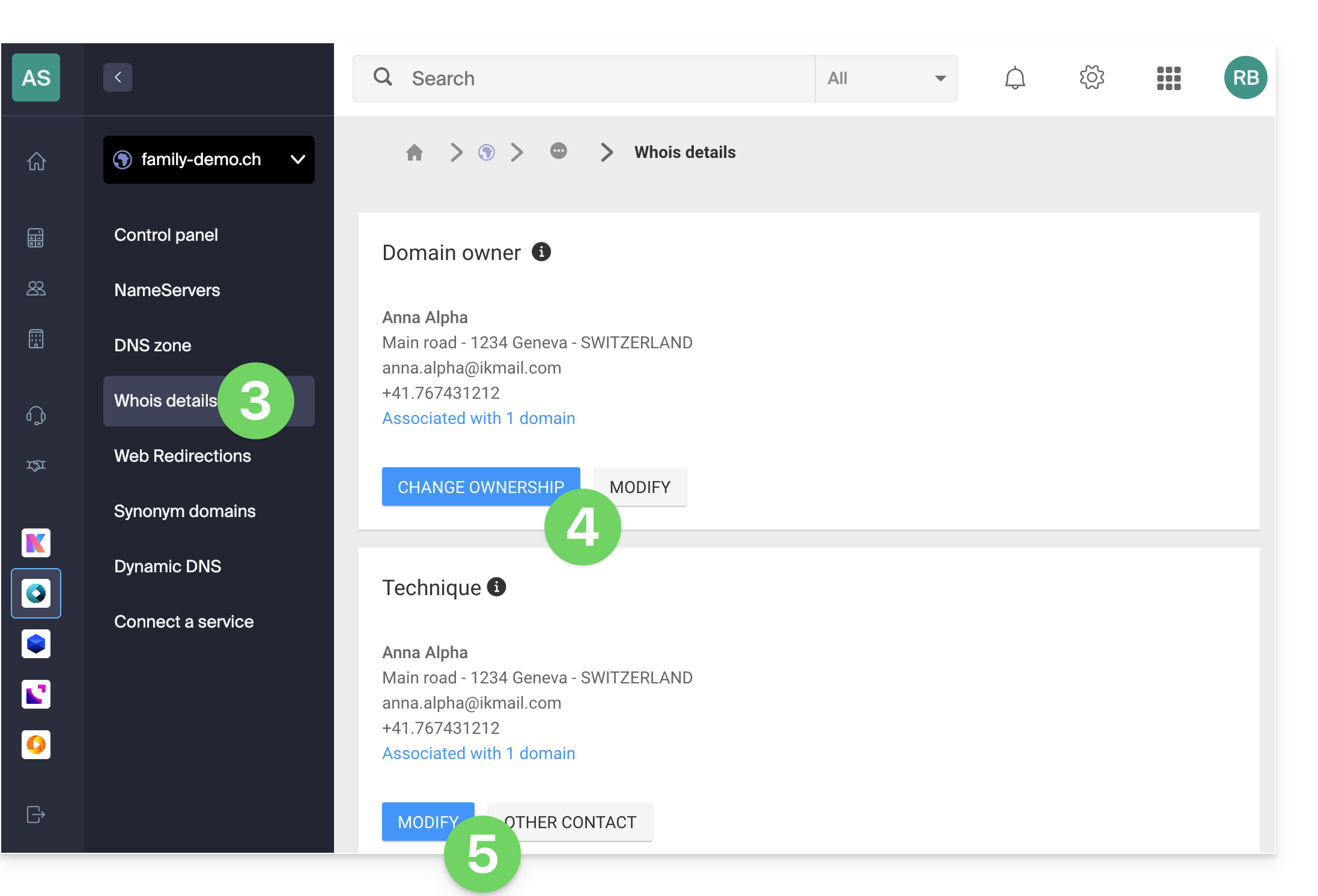
- For the Owner contact, you have the following options:
- Change contact: click on Change owner to create a new contact entry or select another one (requires the agreement of both parties).
- Modify an existing contact: allows you to update the postal address, phone number, or language for notifications (❓: help).
- For each other role (Administrator, Technical, or Billing), you have the following options:
- Edit an existing contact: click the Edit button to update the mailing address, phone number, or language for communications (❓: help).
- Change contact: click Other Contact to create or select a different contact record.
WHOIS modification validation
Any changes to the WHOIS contact information must be validated by the current contact:
- The current contact will receive an Email with a validation link valid for two days.
- The email also indicates the domain names and the types of contacts concerned by the operation.
- While awaiting validation, a warning message is displayed on the domain management page.
- The change will not be applied if all validation steps are not fully completed before the deadline expires.
Unable to access the verification email address?
If the current contact address is inactive, outdated, or inaccessible for confirming the change, please refer to this other guide.
Link to this FAQ: https://faq.infomaniak.com/1853
Has this FAQ been helpful?
This guide explains how to select the folders that will be synchronized between the web app kDrive (online service ksuite.infomaniak.com/kdrive) and the desktop app (desktop application on macOS / Windows / Linux).
Prerequisites
- Have a kDrive / kSuite plan.
- Have the kDrive application on the device to be synchronized.
Do not synchronize everything to a single device
When you install the kDrive application on your computer, everything that is already on the kDrive web app (online service ksuite.infomaniak.com/kdrive) will be visible on your computer in a /kdrive (or /kdrive2, etc.) folder:
- either virtually if you choose to enable Lite Sync (for example, 10 GB on the web will be reduced to just a few MB on your computer),
- either physically with the same storage size (10 GB on the Web will require 10 GB on your computer).
But you can specify in the kDrive app on your device that it should not display everything, so that some of your data remains on kDrive (Web) and is neither downloaded, displayed, nor synchronized on your device. This is particularly useful, especially when using advanced synchronization (❓: help).
Desktop app v4.x
To choose which folder(s) you want to be able to view on your computer and exclude others, assuming that your synchronization is currently complete between kDrive Web and your computer: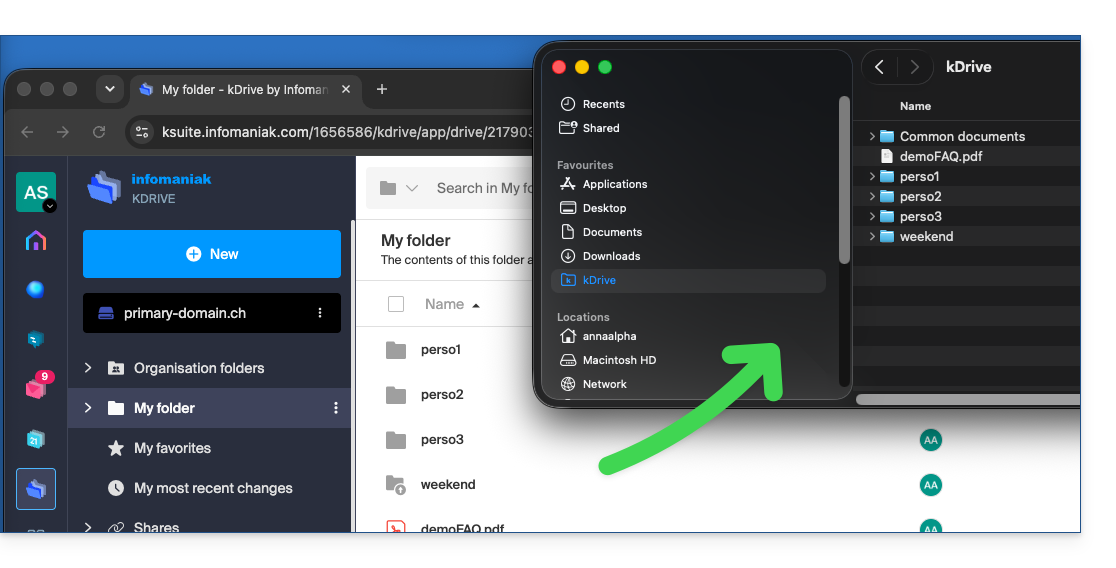
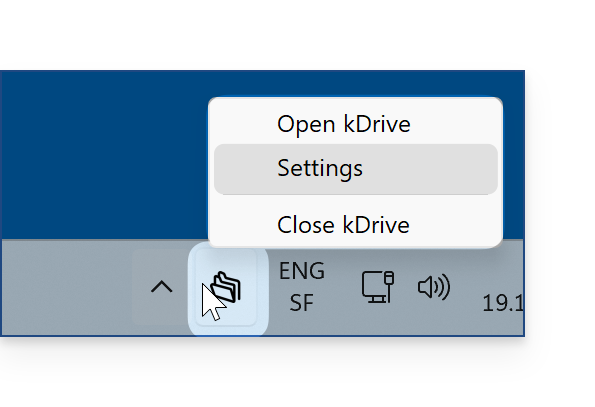
- Launch kDrive on your device: the app icon should be visible in the top right corner on macOS/Linux, and in the bottom right corner on Windows (❓: help).
- Right-click on the icon and choose Settings:
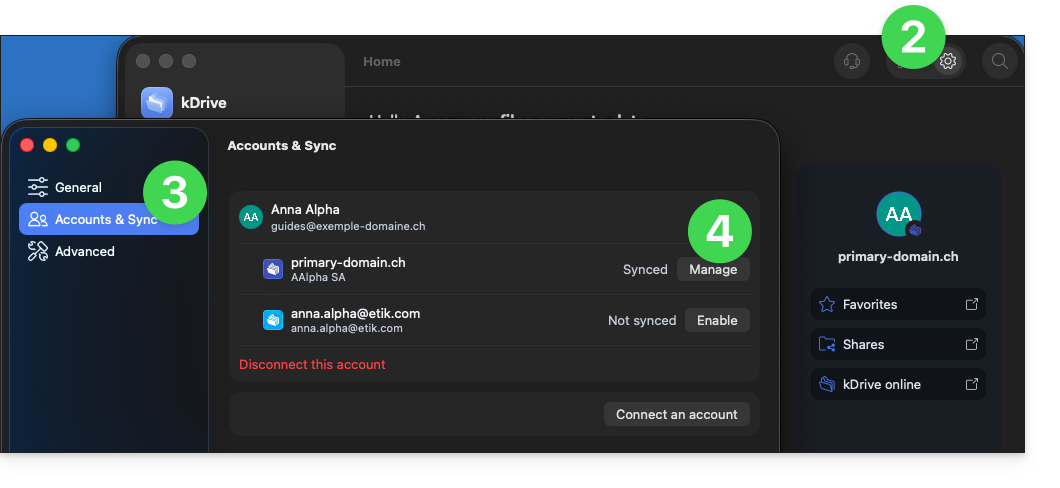
- Go to Accounts & Sync.
- Click on Manage (or ❯) to the right of the current sync:
- Click on Manage synchronization:
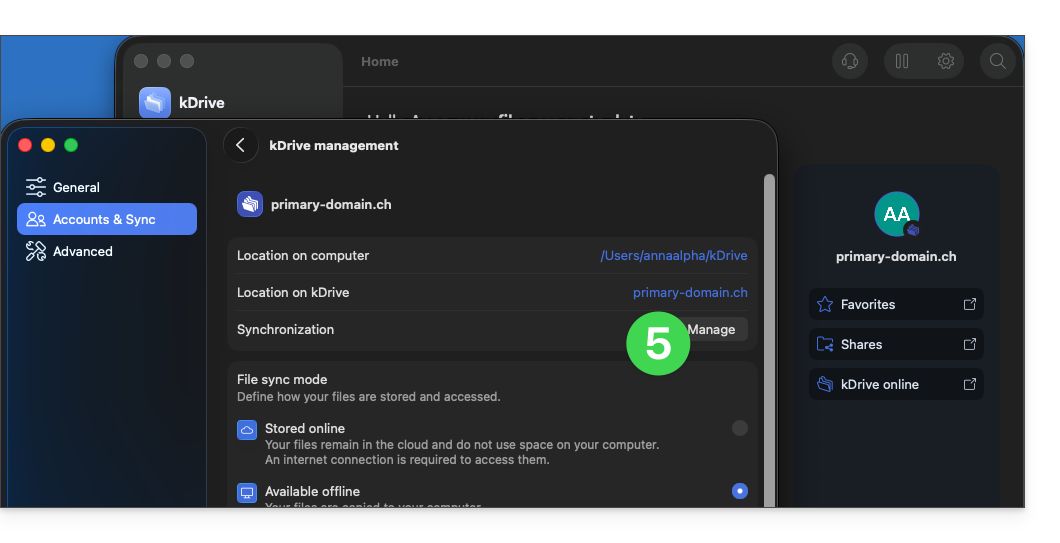
- Enable or disable the boxes corresponding to the data that should no longer appear on your device after the next synchronization.
- Save your changes:
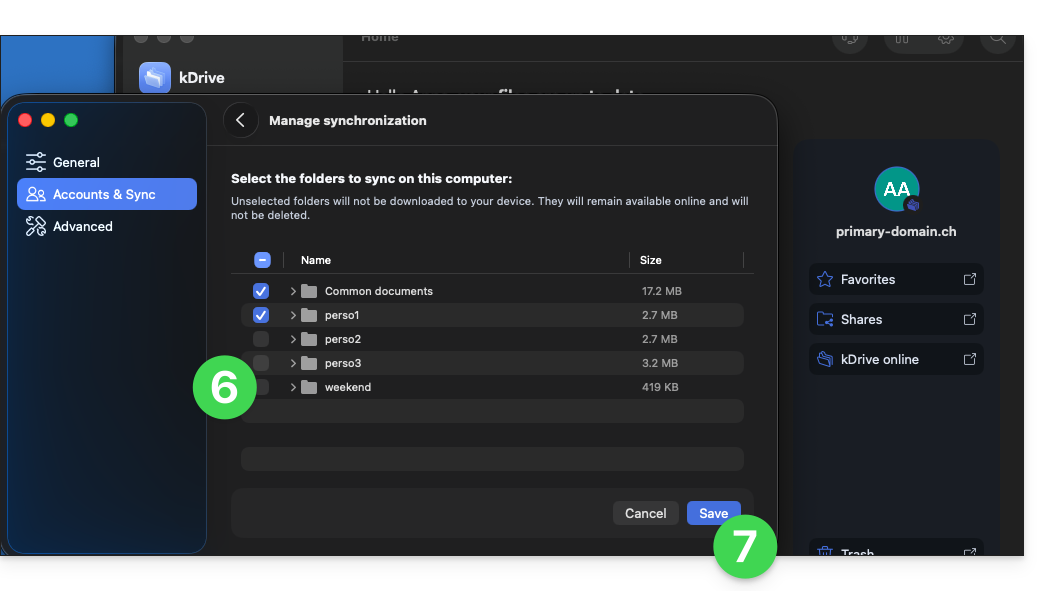
- The effect is immediate; only the files checked in the list will remain synchronized with your device; the rest will be excluded and will no longer be synchronized:
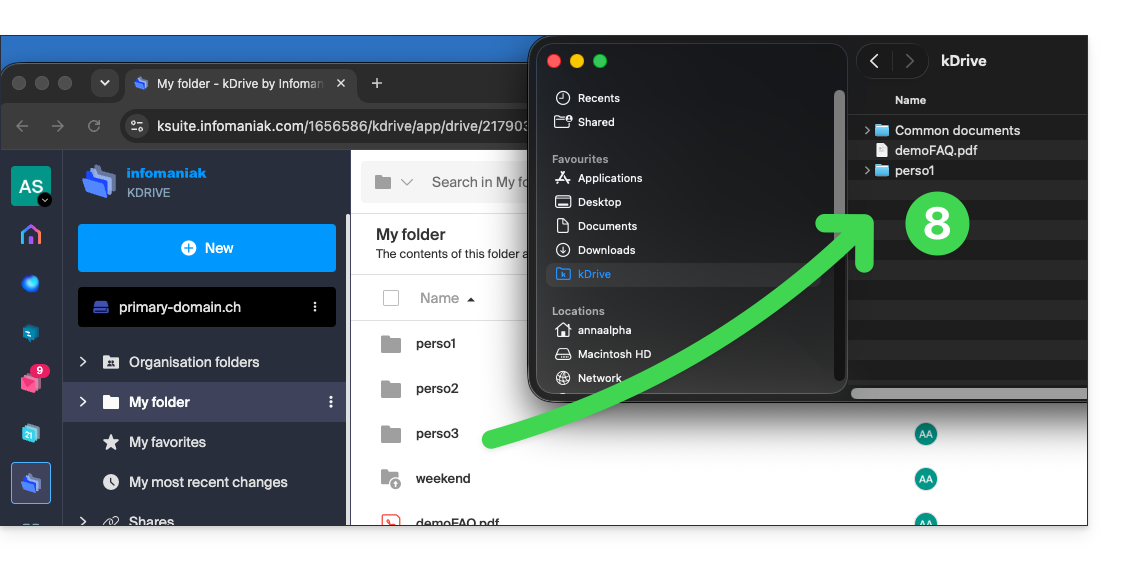
- The kDrive folders in the online version accessible via a browser such as Brave, Chrome, Edge, Firefox, Opera, Safari, etc., will not be affected, but you must ensure, before the operation, that the folder in question was properly synchronized and fully present in this online version (especially if you had just placed it within your synchronized directory).
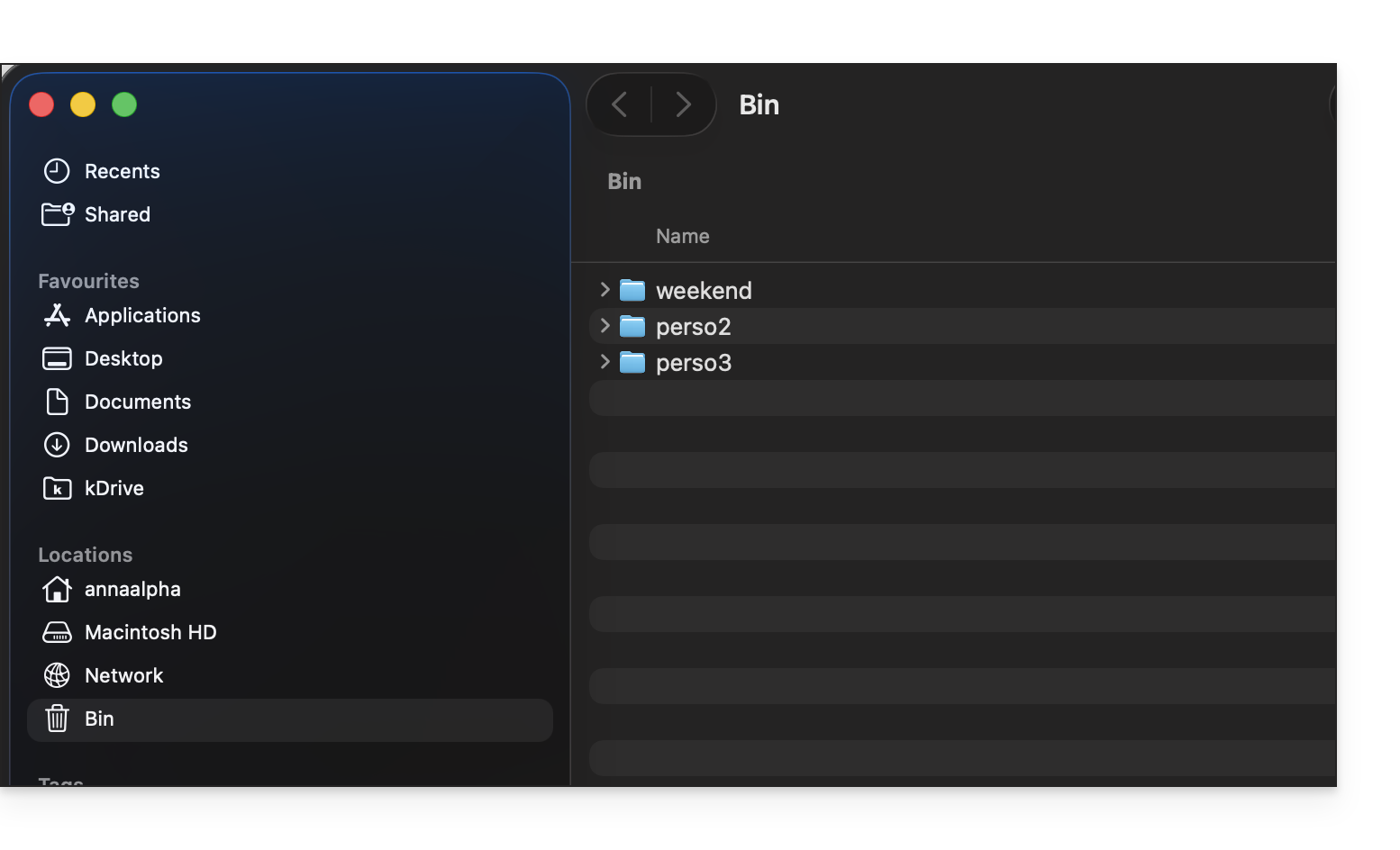
- The data removed from synchronization will go to the device's recycle bin:
- If in doubt, also make sure that your computer does not instantly delete items that are too large when they are placed in the recycle bin, due to the size of the Windows recycle bin, for example:

Desktop app v3.x
To choose which folder(s) you want to be able to access on your computer, go to the settings of the kDrive application on your computer:
- Left-click on the desktop app icon in the notification area of your computer (top right on macOS, bottom right on Windows, and double-left-click in the taskbar on Linux).
- Click on the action menu ⋮ on the right of the window that appears.
- Click on kDrive Settings.
- Click on the chevron to the left of your synchronization name to display the list of folders (currently stored on kDrive Web).
- Expand the contents of the listed folders as needed and check / uncheck the folders to be synchronized with your computer.
- Click the blue Validate button.
But be careful:
- When deselecting a folder that was selected in the list, a message next to the button (point 6 above) warns you that a This folder will be moved to your computer's Recycle Bin..
- This is the folder that was in your kDrive folder structure on your computer.
- The kDrive folders in the online version accessible via a browser will not be affected, but you must ensure, before the operation, that the folder in question was properly synchronized and fully present in this online version (especially if you had just placed it within your synchronized directory).
- If in doubt, also make sure that your computer does not instantly delete overly large items when they are placed in the recycle bin, due to the size of the Windows recycle bin, for example:
Link to this FAQ: https://faq.infomaniak.com/2454
Has this FAQ been helpful?
This guide explains how to create a pass (within the Infomaniak ticketing system). The pass can then be configured in several steps:
- Define the type during creation (subscription, ticket package, etc.) as well as the basic information and parameters (below)
- Associate events with passes
- Configure the visual appearance and information related to the pass
- Define and collect information from subscribers that will be linked to the passes
1. Start creating a pass
To do this:
- Click here to access the management of your product in the Infomaniak Manager (need help?).
- Click directly on the name assigned to the ticketing system for the event.
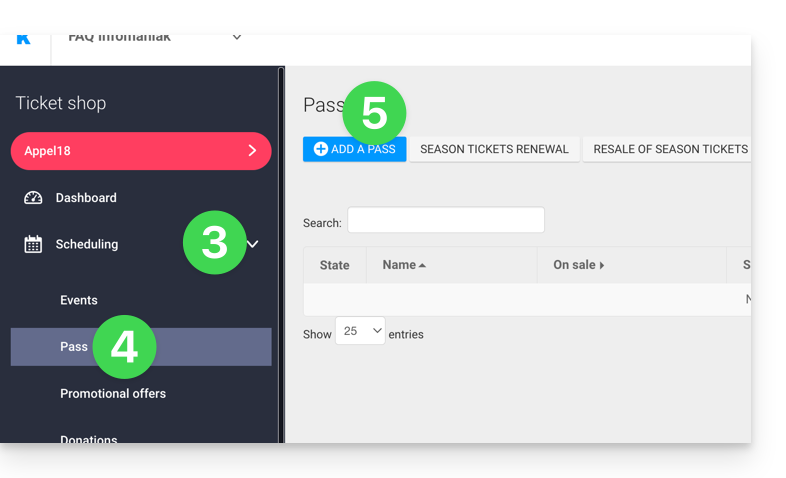
- Click on Scheduling in the left-hand menu.
- Click on Pass in the left-hand menu.
- Click on Add a pass:
Pass name and description
This section allows you to define the pass name and a description for the pass: 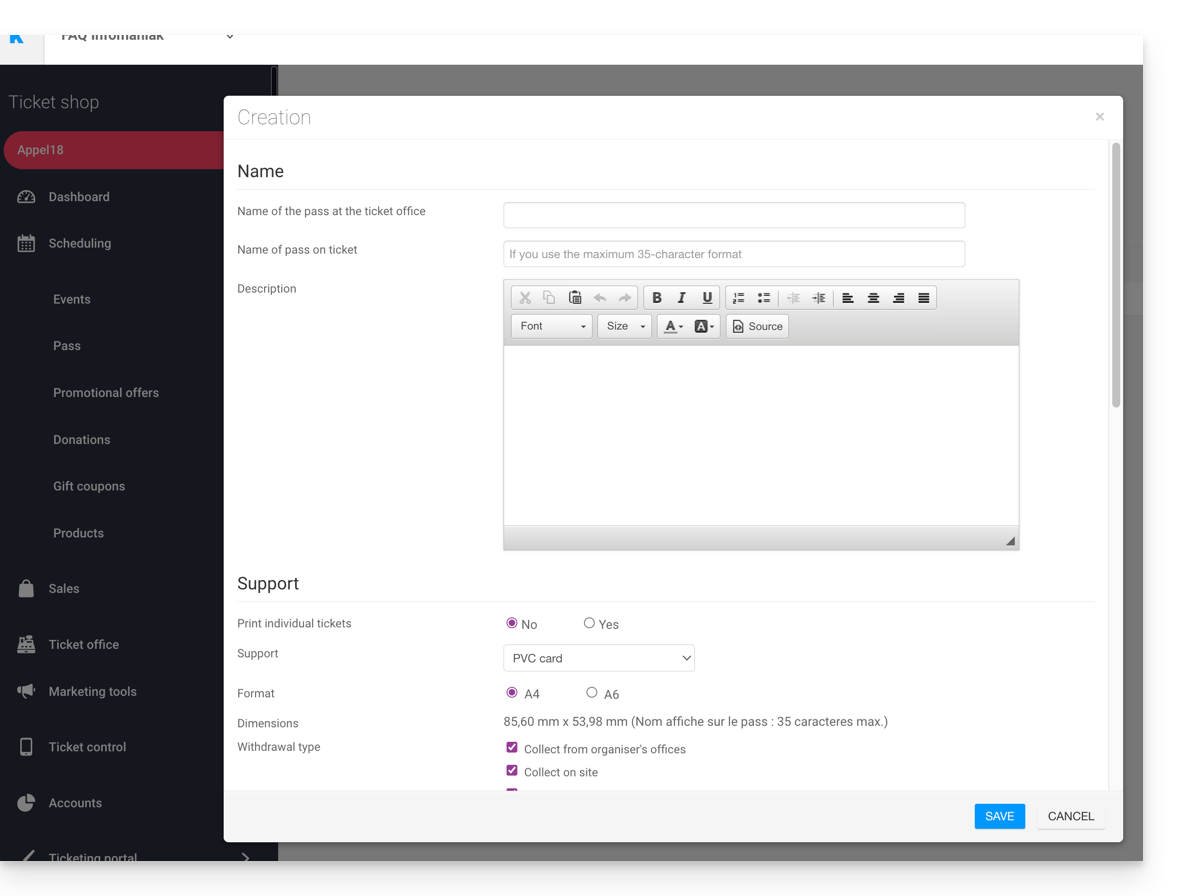
It is recommended to use a sufficiently short name in the Pass Name on Ticket field, as this will be printed directly on the pass.
Pass Support
You can choose from two types of support: 
- The PVC card, similar to a credit card, is often used for seasonal or annual subscriptions.
- Pay attention to the text size used for the Name displayed on the ticket, which will be reproduced here and limited to 35 characters.
- Choose the appropriate pick-up method that will be made available to the customer.
- The Phone/Paper format prioritizes the use of a mobile phone but also allows printing the ticket on an A4 or A6 sheet.
- The visitor will receive their pass in digital format in an email.
- They can download their pass in PDF format from the link included in the email.
Infomaniak does not send physical passes or tickets to visitors. Sending the pass is the responsibility of the organizer.
The appearance of the pass can be configured once the pass has been created (see step 3).
Manage the display during scan-based checks
The two options presented here allow you to define the parameters used for password checks:
- Passes will have random barcodes when created, but the organizer can freely modify them from the pass management section.
- The icon that will be displayed when checking the pass:

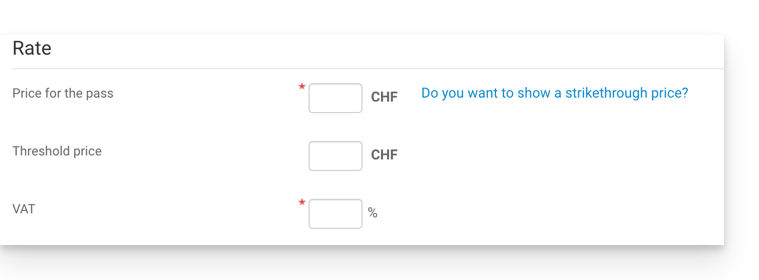
Pass price
- Enter the desired amount:
Validity period
- The validity period will be used if you want to ensure that this pass is only available for a limited time.
- For example, you can configure a ticket package that can only be used during the winter season, for a seasonal promotion.
- Please note that if a pass is outside its validity period, it will be possible to purchase it, but it cannot be used or accessed to add tickets to it.
Types of passes
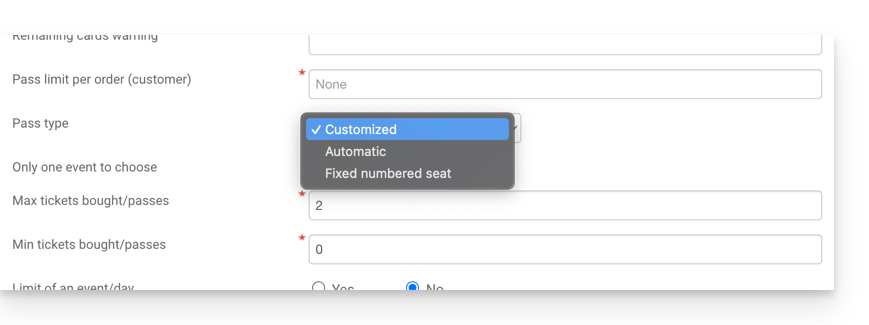
1. Custom
This pass allows the customer to choose events and dates from the available options. Therefore, the limitations of the pass must be defined:
- Only one event can be selected:
- The customer can only choose one event, but depending on the ticket limit, they can choose one or more tickets for the selected event.
- Please note: When a customer purchases a pass, the system will deduct the number of tickets entered in this field from all events associated with the pass.
- These tickets will be "reserved" for this pass.
- When the customer uses the pass at the scanners, the system will release the tickets for all other events.
- Maximum tickets
- The number of tickets that can be associated with the pass.
- Minimum tickets
- If a minimum of 0 is set, the customer can purchase an empty pass and choose their seats later.
- Any number other than 0 will require the customer to choose tickets when purchasing the pass.
- Limit of one event per day
- The pass is limited to one event per day.
- The customer cannot order more than one ticket per day for this pass.
- All tickets on the same day
- Allows you to choose a date and then select the events for that date.
- Limit the number of events per pass
- This option allows you to define whether a customer can attend the same event multiple times (in the case of multiple dates).
- If enabled, the customer can only book one ticket per event with the "same name" (or "same performance") for this pass.
- Note: the spelling of the event name must be identical.
- Minimum number of different events per pass
- The customer must book tickets for at least as many different events as are available on the pass.
- This is used to prevent visitors from booking all their tickets for a single event.
2. Automatic
The pass will not be customizable by the customer: it will automatically include the tickets defined by the organizer.
3. Fixed numbered seat
If the event takes place in a venue with a seating plan, this type of pass allows the customer to choose a pass with a numbered seat on the seating plan. This seat will remain the same for all events associated with the pass that take place in the same venue.
An organizer may want to set up passes with registration validation.
After creating the pass, the next step is to associate it with the corresponding events and configure the various available options.
Link to this FAQ: https://faq.infomaniak.com/2770
Has this FAQ been helpful?
This guide covers data protection regulations in Switzerland and Europe, and the measures taken by Infomaniak to secure your customer data and data within Web Hosting and Mail Services.
Understanding the difference between data security and data privacy
Data security aims to prevent unauthorized access to your information. It relies on measures such as encryption, firewalls, or VPNs. A security breach can have disastrous consequences: imagine a hacker stealing your entire customer database and demanding a ransom to recover it. This type of attack – ransomware – can cripple a company overnight.
Data privacy concerns who can access your information and how it is used. Even if your data is secured against hacking, it can be collected, analyzed, and resold… perfectly legally.
Example: you carefully store your customers' information, but without realizing it, a service you use shares this data – anonymously – with third parties. Result? Your competitors can obtain valuable insights into your market and target your own customers without ever needing to resort to hacking.
LPD & GDPR
In Switzerland, the LPD (Federal Act on Data Protection) and nLPD (for the "new Law" in force since September 2023) protect the privacy of residents by regulating the collection and processing of personal data by organizations.
The GDPR (General Data Protection Regulation) of the EU, in force since May 2018, also affects global companies that process the data of European residents, including in Switzerland. While the LPD applies to the data of Swiss residents, the GDPR concerns the data of EU residents. Swiss companies that manage European data must comply with the requirements of the GDPR, including the designation of a Data Protection Officer and the performance of Impact Assessments in the event of risky processing.
Your role as an Infomaniak customer
With regard to the data hosted that belongs to you – and in particular if this data contains personal data of your visitors, contacts or customers – you are responsible for ensuring its compliance.
When processing this personal data, it is essential to inform users about the purpose and methods of this processing. This is generally done through a privacy policy or a data processing agreement (DPA).
Agreement between data controller and data processor
A DPA (Data Processing Agreement), known as AVV (Auftragsverarbeitungsvertrag) in German, ATD (Accordo di Trattamento dei Dati) in Italian, and CTA (Contrato de Tratamiento de Datos) in Spanish, translates to Data Processing Agreement or Data Processing Contract.
This is a mandatory contract required by the GDPR between a data controller and a data processor. It defines the purpose, duration, and nature of the processing, as well as the obligations and security measures. Its objective is to protect the personal data entrusted to a service provider.
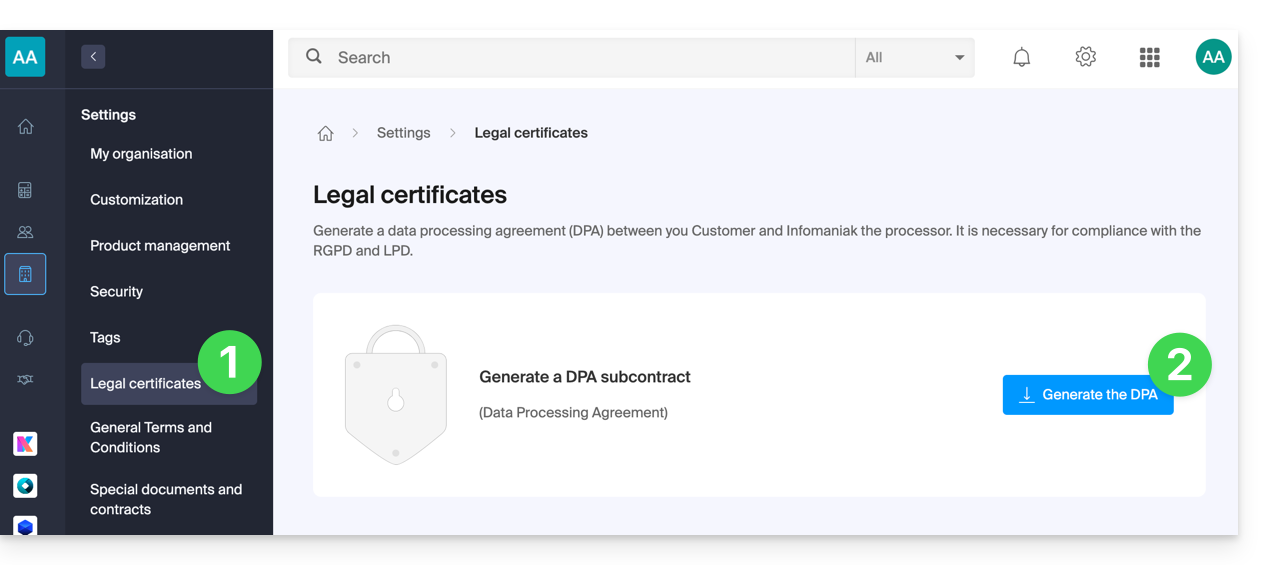
This GDPR certificate (in PDF format) can be generated and downloaded from the Manager (accessible to users within the organization who are owners or administrators):
- Click here to access the DPA management section in the Infomaniak Manager (need help?).
- Click the Generate button to download the customized PDF document:
Here are some tips on this:
- Provide information on all data processing activities, not just those related to the website.
- Ensure easy access to the privacy policy on the site, for example in the footer of each page.
- In general, it is not necessary to obtain user approval for privacy policies (e.g. for forms); simply indicate where to find the policy (example Site Creator).
- Keep in mind that the new, more detailed information rules may require adjustments to existing privacy statements.
It is crucial to differentiate between the security of the infrastructure where your data is hosted and the management and implementation of your data on your end. As a hosting provider, Infomaniak acts as a subcontractor for your GDPR-related obligations. In this context, its privacy and cookie policies, as well as its terms and conditions, provide you with the necessary guarantees regarding its compliance as a subcontractor.
If necessary, you can find professionals or online guides to help you with the compliance process.
Infomaniak's Role
Like companies that work with user data, Infomaniak must comply with the LPD and, because some of its users are European citizens, also with the GDPR:
- the data privacy policy details the data that Infomaniak stores to provide and deliver its services
- the policy related to the protection of your personal datadescribes Infomaniak's commitments as a subcontractor hosting all of your data, including personal data.
These commitments, as outlined in the general and specific terms and conditions, are as follows:
- store your data within data centers exclusively located in Switzerland and never transfer your information outside of these infrastructures
- apply rigorous security standards and constantly improve processes to guarantee a high level of security across all services
- promptly inform you in the event of a data breach
- ensure transparency with you when Infomaniak uses subcontractors who may process your data
- strengthen and develop physical security measures to prevent any unauthorized access to the infrastructure where your data is stored
- implement physical and/or logical isolation systems (depending on the services) to separate the hosting of different customers; in addition, Infomaniak conducts annual penetration tests to guarantee data isolation between customers
- demonstrate a high level of responsiveness in securely updating the systems under their responsibility
Manage infomaniak.com website cookies
When you visit the infomaniak.com page, you must make a choice regarding the acceptance of certain cookies. To change this choice later, access your preferences from the footer of the website: 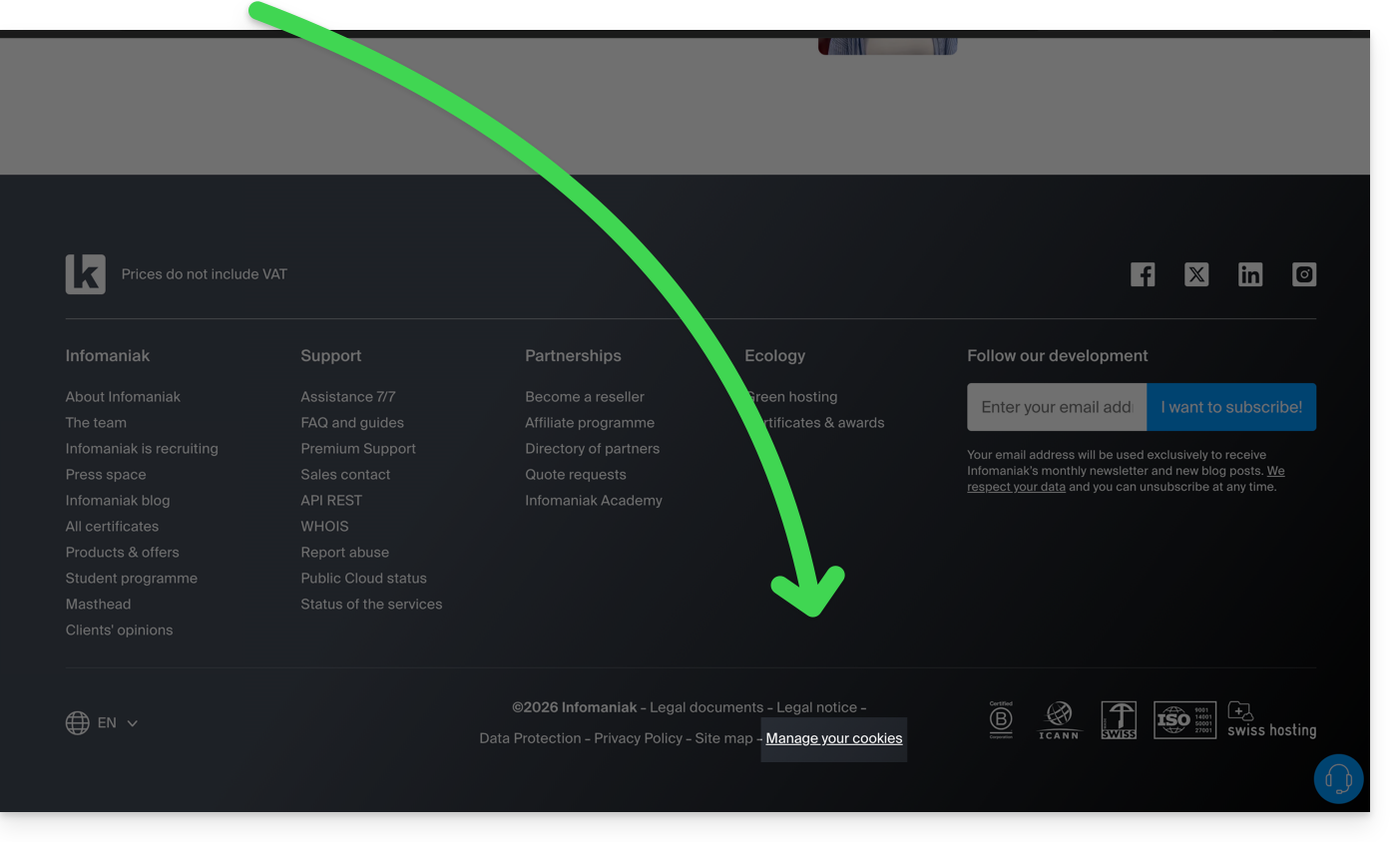
Link to this FAQ: https://faq.infomaniak.com/2820
Has this FAQ been helpful?