Knowledge base
1000 FAQs, 500 tutorials and instructional videos. Here, there are only solutions!
This guide explains how to protect a part of a website on a Web Hosting by making the entry of a password mandatory before consulting a directory (including subdirectories) from a browser. 
Note, this does not prevent a user from consulting the folder via FTP.
Simple method
Password protect (authentication Digest) a directory using the "Folder Protection" tool:
- Click here to access the management of your product on the Infomaniak Manager (need help?).
- Click directly on the name assigned to the product concerned.
- Click on Security in the left sidebar:
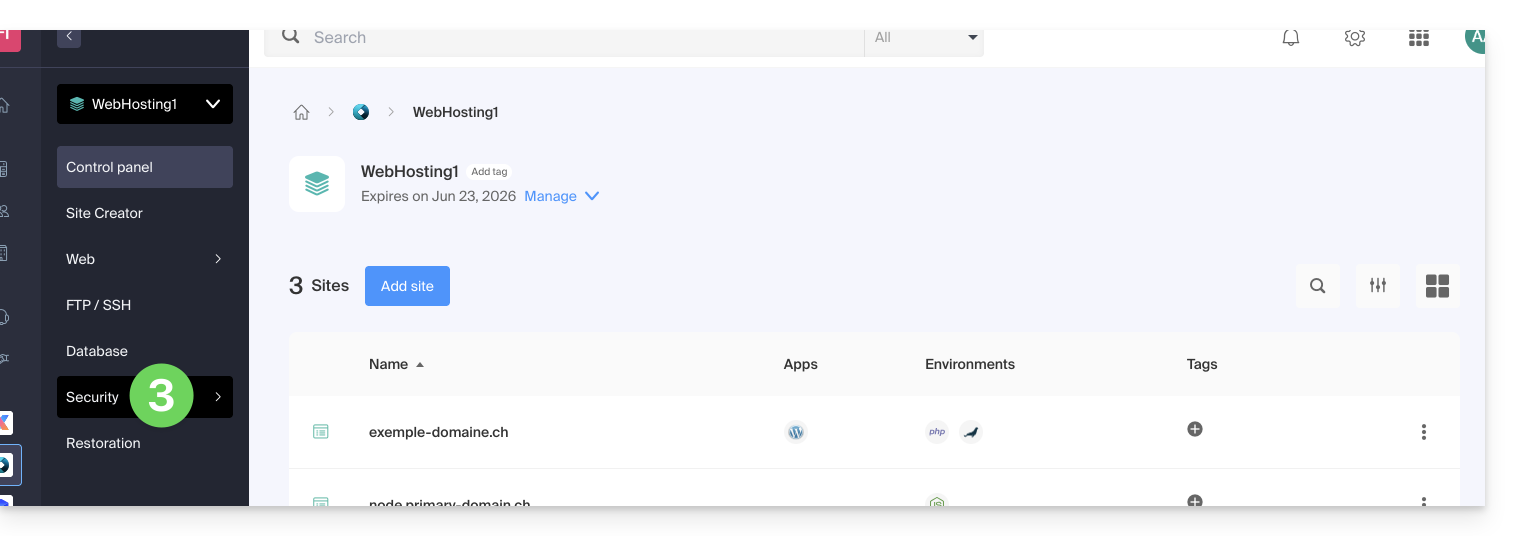
- Click on Folder Protection in the left sidebar.
- Click on the directory to protect.
- Activate the protection with the toggle switch and then create one or more users*:
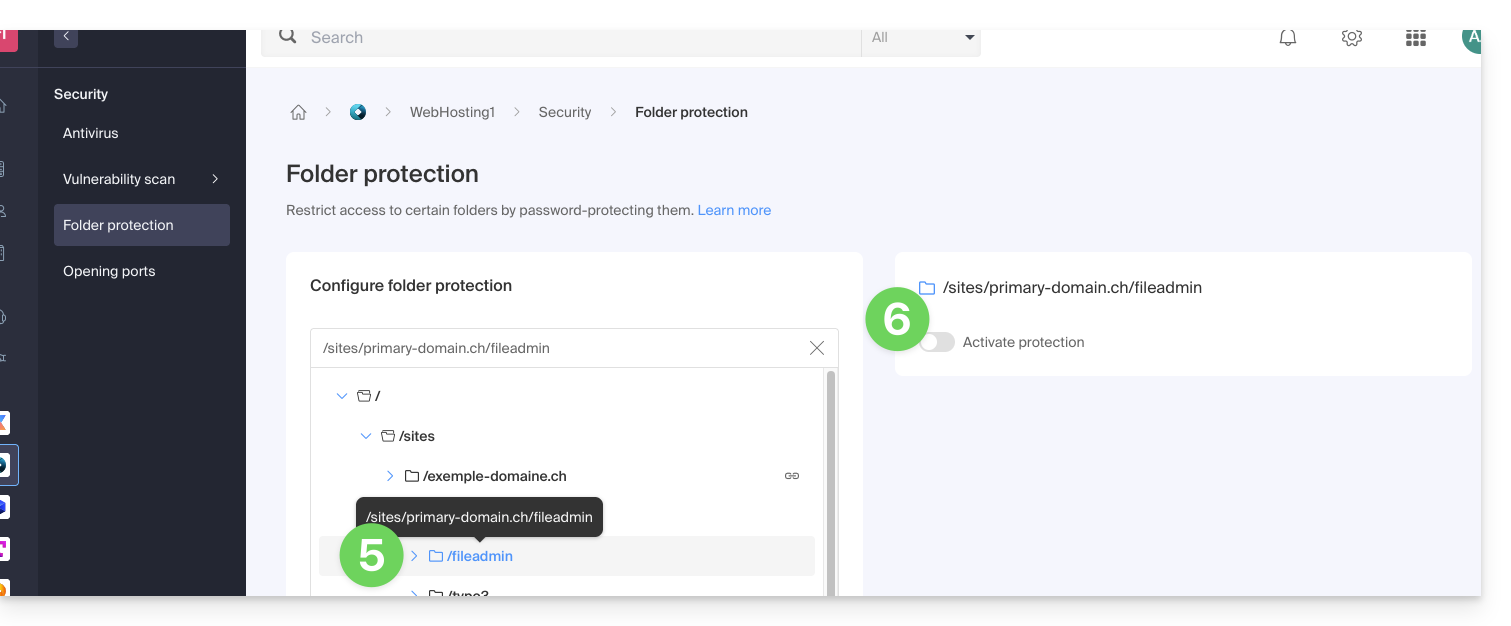
- * Users are defined per directory; the tool does not allow managing user groups:
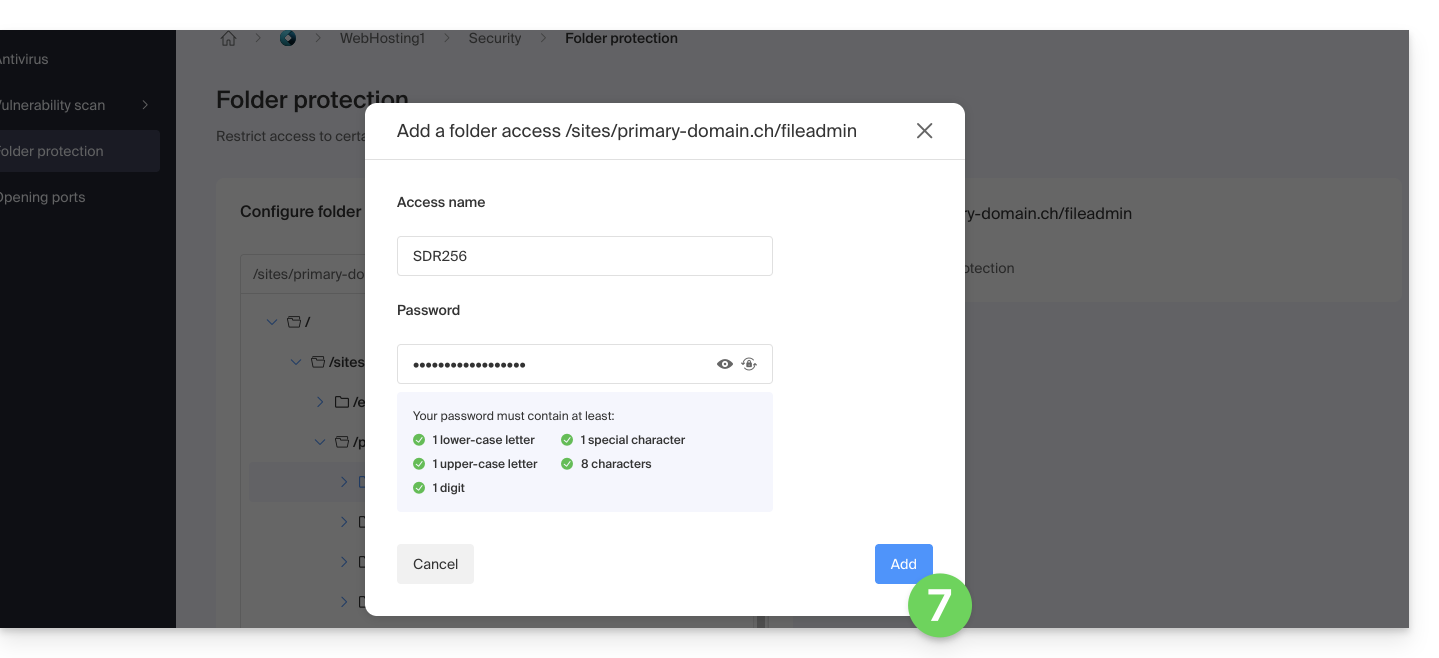
- * Users are defined per directory; the tool does not allow managing user groups:
- Click on the Add button.
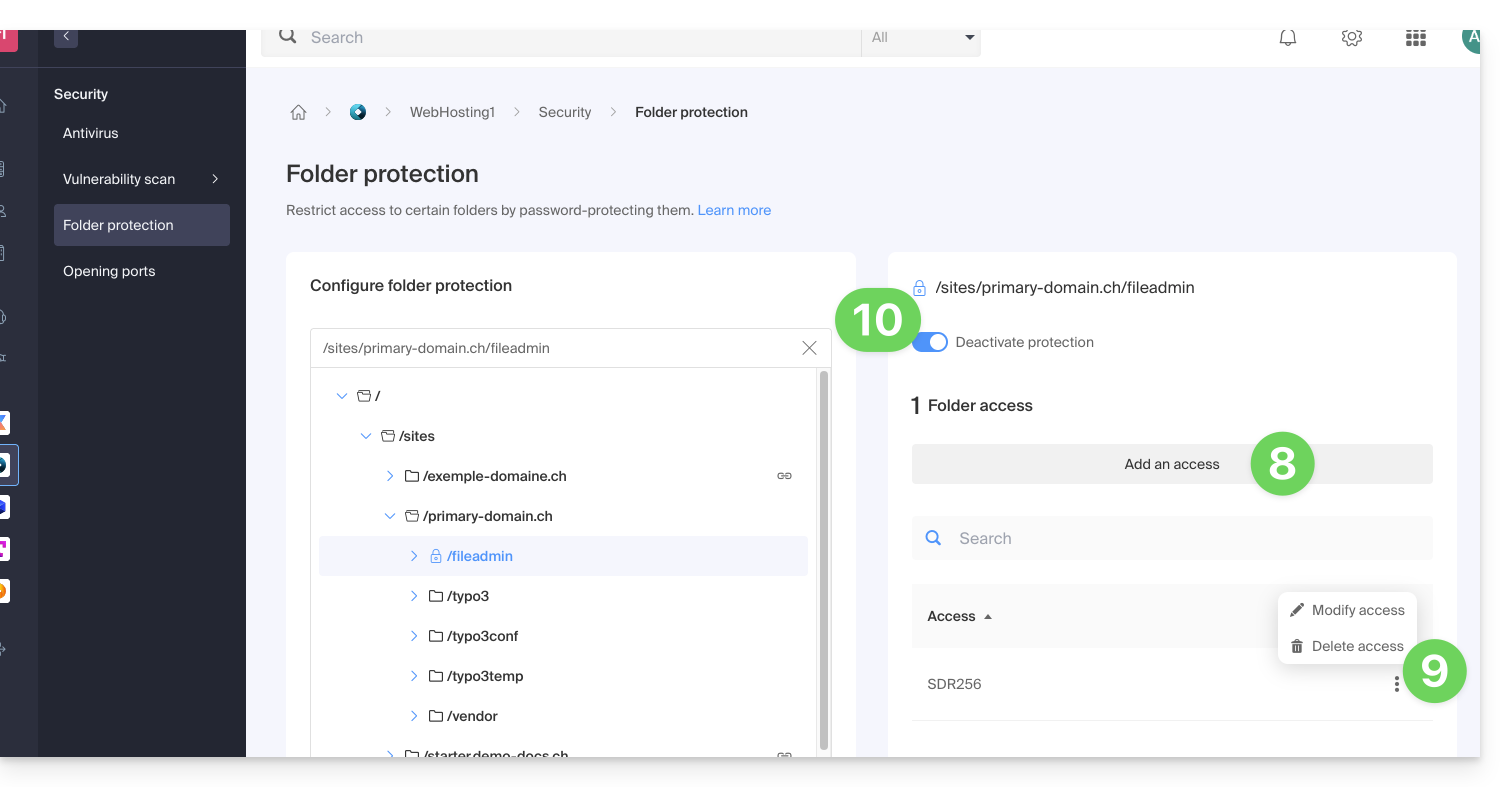
- Click on the button to add access for an additional user if necessary.
- Click on the action menu ⋮ located to the right of the user concerned to modify or remove them.
- Click again on the toggle switch to completely deactivate the directory protection:
Manual method via .htaccess
To password protect a folder using the .htaccess file of your site:
- Connect to your hosting via an FTP software/client or Web FTP.
In the folder to protect, create a file called
password.phpand adapt the following content inside by replacing12345with the desired password:<?php $password = "12345"; echo password_hash($password, PASSWORD_DEFAULT); // Displays the hashed password ?>- Open a web browser and display the
password.phpfile (example: domain.xyz/folder-to-protect/password.php). - The web browser displays your encrypted password; copy the encrypted password, it will be needed later...
In the folder to protect, create a file named .htaccess and adapt the following content inside:
AuthName "Protected Administration Page"
AuthType Basic
AuthUserFile "/example/.htpasswd"
Require valid-user
Replace /example/ with the absolute path of the folder to protect. Example:
AuthUserFile "/home/clients/0f83c7afb710e5ae2645a1b704d8772f/web/protected_folder/.htpasswd"In the folder to protect, create a file named htpasswd.txt and adapt the following content inside:
username:hashed_password- Replace
usernamewith the desired login. - Replace
hashed_passwordwith the encrypted password copied in step 1 of this guide.
Once the file htpasswd.txt is saved, rename it as follows: .htpasswd.
Open a web browser and try to display one of the pages contained in the protected folder. If the guide has been followed correctly, the login and password (not encrypted) chosen allow access to the protected folder.
Other restrictions can also be added by .htaccess.
Link to this FAQ:
Has this FAQ been helpful?
This guide explains how to redirect a domain name directly to another or how to automatically send visitors to your website to another page address (internal or external URL).
Preamble
- To redirect traffic, you will need to act…
- … either on the domain name itself (it must be hosted by Infomaniak and its DNS must also be those of Infomaniak),
- … or on the code present in your pages (page .htaccess, homepage, etc.) if you have a website.
Act on the domain name
via Web Redirection Tool
The tool available on the Manager allows you to act simply on the domain name (or subdomain) in order to redirect it to the Internet address of your choice.
via DNS modifications or A record
Change the DNS of the domain name or modify its A/AAAA records allows you to direct web traffic to another provider.
Act on the code of the pages…
… via HTML code to insert
Insert this line of code between the <head> and </head> tags of your homepage (usually named index.html):
<meta http-equiv="refresh" content="5;url=INSERT-HERE-NEW-URL">Replace 5 with the desired wait time in seconds (0 for it to happen immediately).
The search engine Google indicates that it is preferable to use a 301 server-side redirect (read below). The W3C also advises against using it.
… via PHP code to insert
If the site page has a .php extension, insert this header function call at the very top of the file:
header("refresh: 5; url=INSERT-HERE-NEW-PAGE-URL");… via .htaccess file
To redirect all traffic targeting your site (regardless of the page called) to another address, insert this in the .htaccess file at the root of your site:
RewriteEngine On
RewriteRule ^(.*)$ INSERT-HERE-NEW-URL/$1 [R=301]
To target the page that needs to be redirected:
Redirect permanent /ancienne_page.html insérer ici adresse URL de destinationRedirectpermanent, Redirect permanent and Redirect 301 are equivalent commands.
Here is another example of redirecting a sub-section to the home page (this directive has the advantage of working with "deep links" unlike a permanent redirect):
RewriteEngine on
RewriteRule "old/path/url "/" [L]
Refer to this other guide on this subject.
Link to this FAQ:
Has this FAQ been helpful?
This guide explains how to enable support for certain file types (e.g., .inc) on an Infomaniak Web Hosting account so that they are processed in the same way as a .php file.
Preamble
- Previously, you had to add the following line to a
.htaccessfile:AddType application/x-httpd-php .inc- This prevented the file content from being displayed as plain text when accessed via a browser, instead of being correctly interpreted by PHP.
- Now you can manage file extensions via the FPM Extensions field in the Manager of your hosting.
Manage extensions recognized by PHP
To add support for a specific file type:
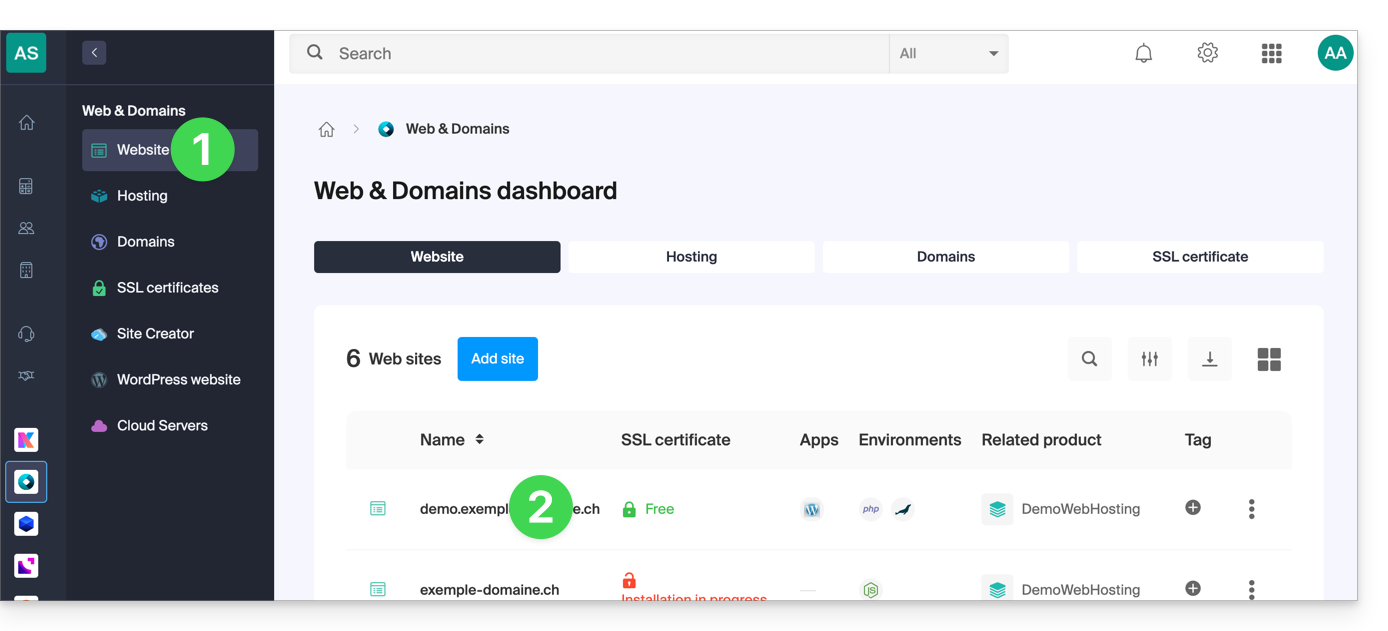
- Click here to access your site management on the Infomaniak Manager (need help?).
- Click directly on the name assigned to the site in question:
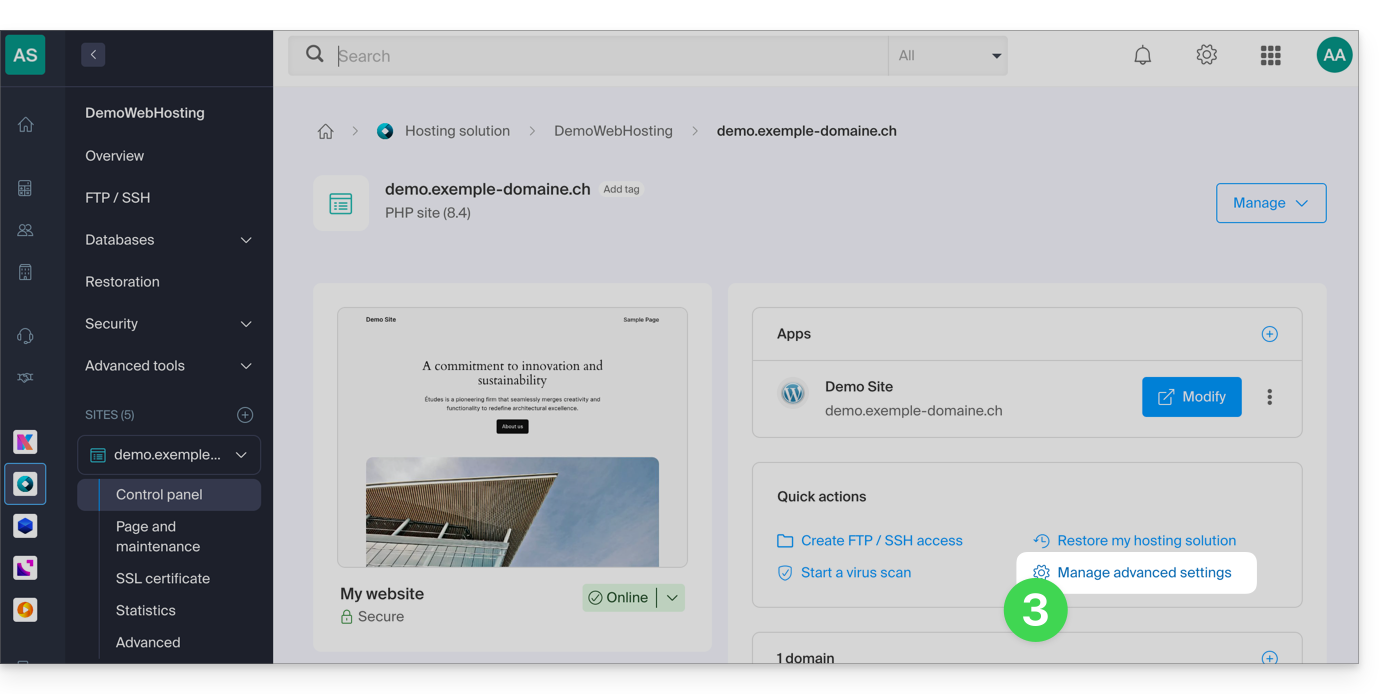
- Click on Manage advanced settings:
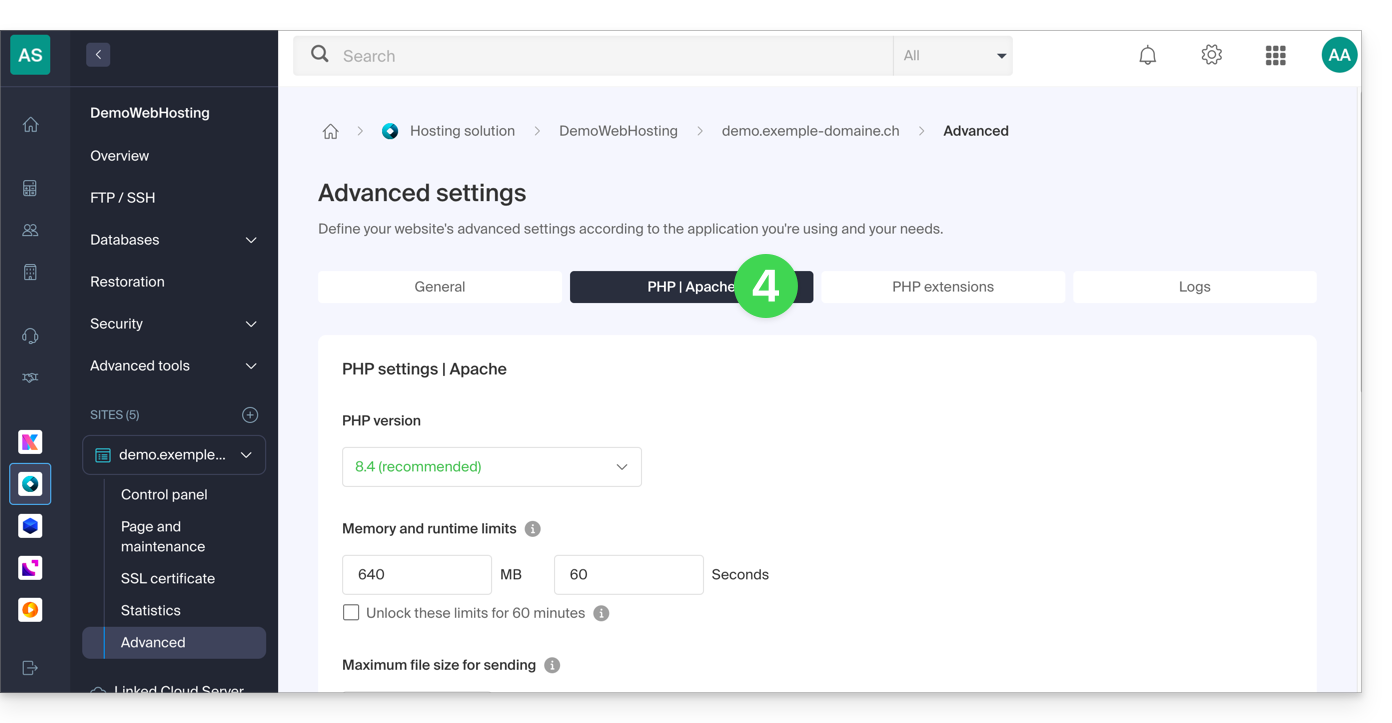
- Click on the PHP / Apache tab:
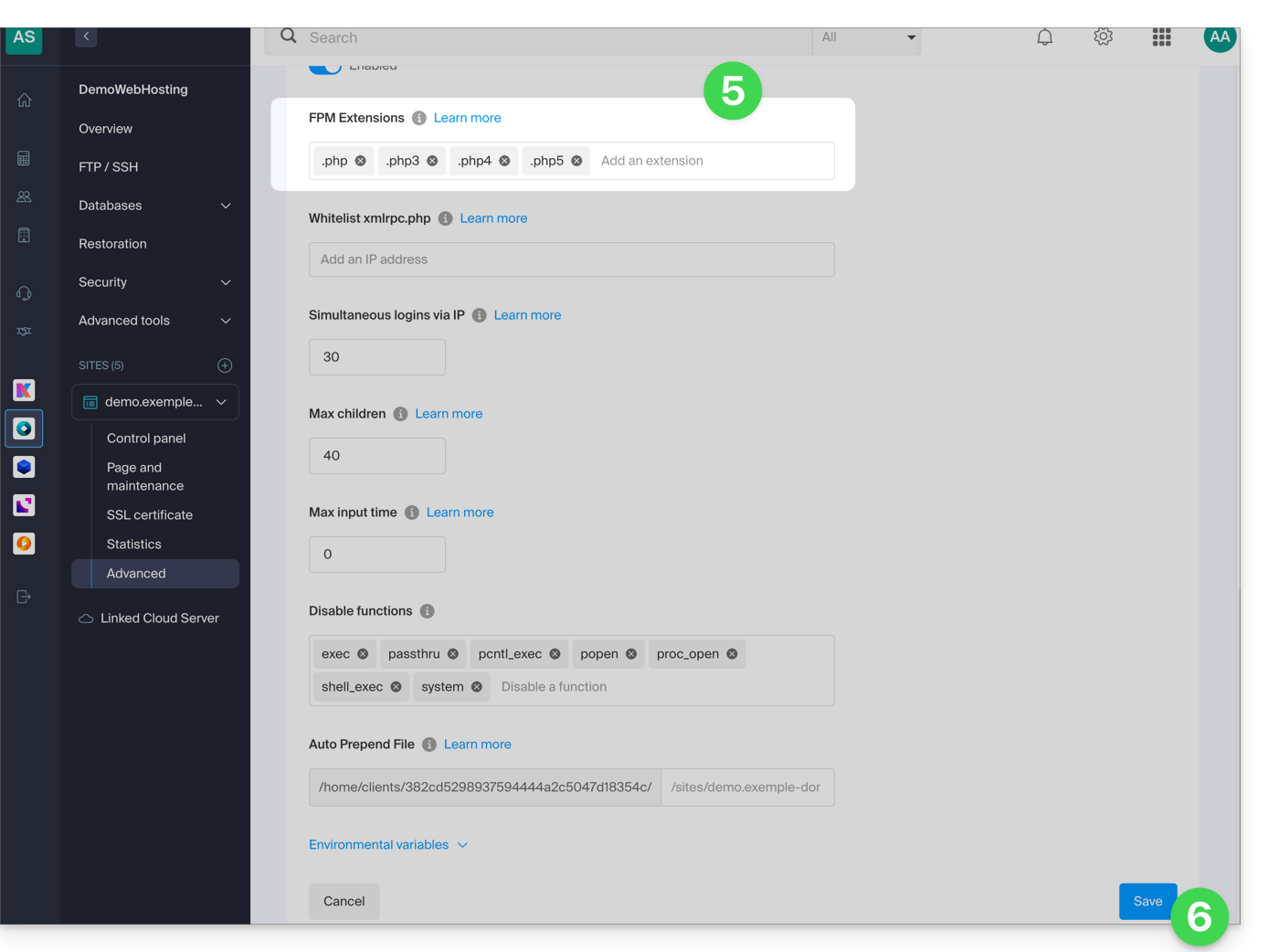
- Edit the FPM Extensions field to add the desired extension.
- Click the button at the bottom of the page to save:
Link to this FAQ:
Has this FAQ been helpful?
This guide explains how to view information about visitors who have accessed your Web Hosting sites (traffic statistics).
Preamble
- The result is presented in a simple format with graphs, allowing for easy interpretation.
- Annual, monthly, daily, and hourly statistics are displayed by site, HTTP address, referring site, country, etc.
- Refer to this other guide if you are specifically looking for access logs.
Accessing visit statistics
To view public traffic statistics:
- Click here to access your site management on the Infomaniak Manager (need help?).
- Click directly on the name assigned to the site in question.
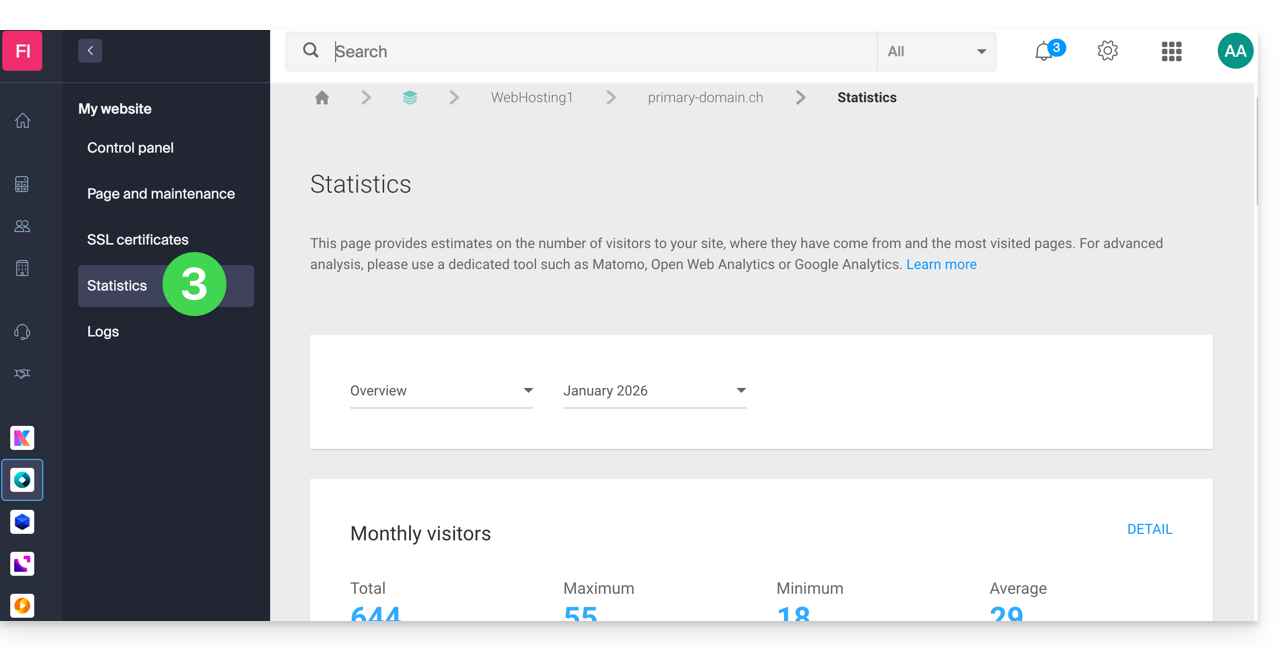
- Click on Statistics in the left sidebar:
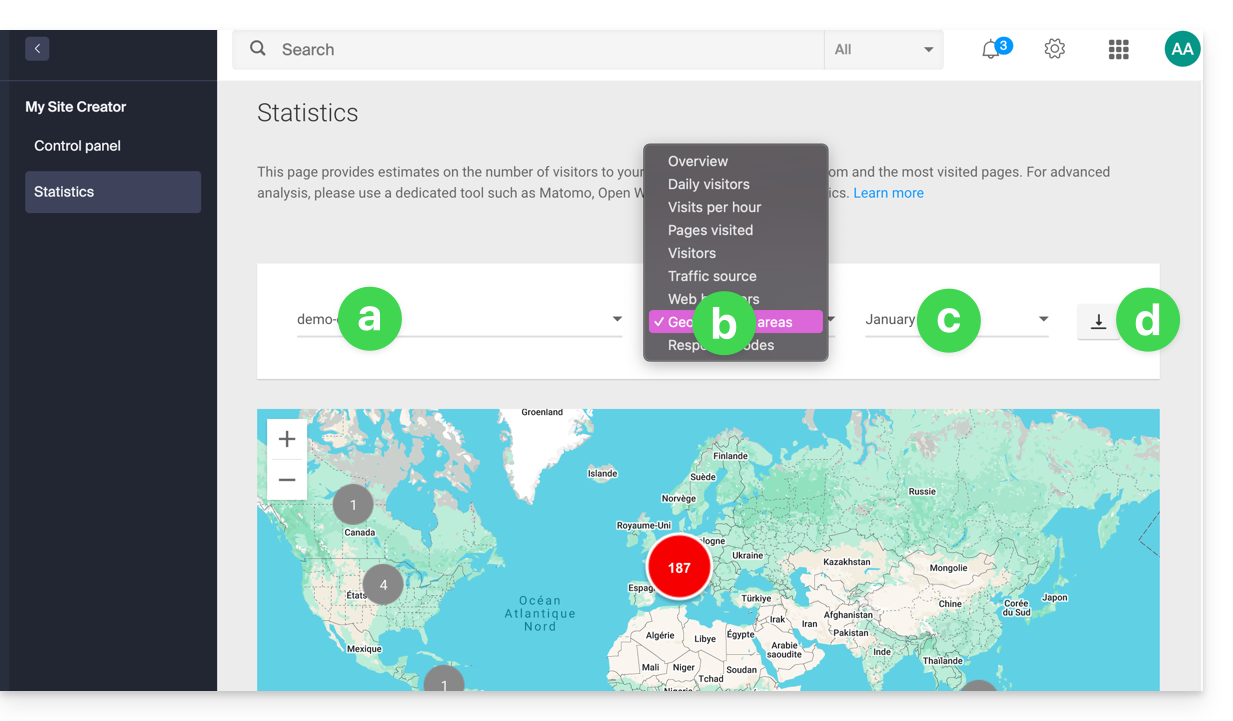
- The upper part allows you to choose:
- the site,
- the type of statistics,
- the period,
- or to download the data for a third-party tool:
Explanation of terms
There is no distinction between humans and robots. You can also use tools like Matomo, Open Web Analytics, or Google Analytics.
| Category | Description | Details |
|---|---|---|
| Hits | Any request addressed to the server. | Includes everything (HTML, images, audio, etc.). Each element requested, visible or not, counts as a hit. It's as if a visitor activates an invisible button with each interaction. |
| Files | Requests requiring data to be sent back. | Records requests that require the server to return a file (graphic, HTML). The difference with hits corresponds to the ratio between incoming requests and outgoing data. |
| Pages | Number of pages displayed on your site. | Measures the HTML pages viewed, excluding graphic or audio files. Each access to a new HTML page is recorded as a page view. |
| Visits | Sessions based on the IP address. | A visit begins with an IP request. If the address returns within 30 minutes, it is a unique visit. Beyond that, a new visit is counted. |
| Sites | Estimation of visits via fixed IP addresses. | Excludes mobile or dynamic connections. This targets regular visitors (companies, institutions) to better understand your target audience. |
| KB | Volume of data sent by the server. | Total amount of data transferred during the period, calculated via log files (with a possible margin of error depending on the size of the files). |
| Total hits | Overall cumulative requests. | A page with 3 images and a text generates 5 hits (the page + the text + the 3 images). This total is therefore much higher than the number of pages viewed. |
| Total Pages / Visits | Engagement indicators. | The number of pages viewed relative to unique visits allows you to assess the interest of internet users in your content. |
| Total unique sites | Number of distinct IPs. | Represents the diversity of traffic sources and helps identify the most active audience segments during the period. |
| Total unique URLs | Distinct paths taken. | Corresponds to the different pages or files consulted, providing an overview of your navigation structure and the most popular content. |
| Total unique referrers | Number of source sites. | External sites that have directed traffic to you. This is a key indicator of the effectiveness of your marketing and partnerships. |
Meaning of 'Commercial (com)' and 'Unresolved'
"Commercial" often represents a significant portion of geographic traffic. It includes users connected through Internet Service Providers (ISPs) using a .com domain. Since this extension is used by many ISPs and companies worldwide, it does not allow for the determination of a specific country.
"Unresolved" are geographically unresolved IP addresses, often due to privacy settings, the use of VPNs, or network restrictions.
Link to this FAQ:
Has this FAQ been helpful?
This guide is for you if you encounter a 500 error that can have various causes generally related to the development of your website on a Web Hosting, particularly with the rewrites of your .htaccess files.
Preamble
- Apache2, in place on the servers, no longer supports certain modules such as
mod_auth_anon,mod_auth_dbm,mod_authz_dbm,mod_cern_meta,mod_imap,mod_imagemap,mod_mime_magic - Apache2 is strict about syntax errors and when it encounters syntax errors in a
.htaccessfile, this can result in 500 Internal Server Errors or unexpected URL rewrite errors
Syntax examples and correction
In this first example, the syntax error is that the rewrite rule does not specify the HTTP redirection response code to return.
RewriteRule ^articles/([0-9]+)/$ /article.php?id=$1 [L]The correction adds the R=301 directive to specify that the redirection should return a 301 (permanent) code:
RewriteRule ^articles/([0-9]+)/$ /article.php?id=$1 [L,R=301]
In this second example, the syntax error is that the Options directive does not correctly specify the options to enable or disable.
Options -Indexes FollowSymLinksThe correction adds the "+" sign to specify that FollowSymLinks should be enabled rather than disabled:
Options -Indexes +FollowSymLinksResolving these errors
- If the first page or another page displays a 500 error, rename the
.htaccessfile or comment out all lines with#and uncomment line by line until you find the problematic section. - If the error occurs after a modification made to one of your pages, the simplest solution is to restore the previous version of the file.
Link to this FAQ:
Has this FAQ been helpful?
This guide concerns the installation of PHP extensions on Infomaniak Web Hosting.
Using Zend PHP extensions
- Zend Guard Loader is a PHP extension that allows you to run PHP scripts encrypted via Zend Guard.
- Zend Guard Loader is installed by default for PHP <= 5.6 on all web hosting and is not available for PHP versions >= 5.6.
- Since PHP 5.3.x, the Zend Optimizer module has been replaced by ZendGuardLoader
- The ZendOPCache extension requires a Cloud Server configured with PHP 5.5 minimum
Link to this FAQ:
Has this FAQ been helpful?
This guide explains the "Options +Indexes" directive for Web Hosting, which facilitates navigation for visitors and allows for more advanced customization of how files are displayed.
Preamble
- One of the main advantages of enabling directory indexing is that visitors can view and list all files and subdirectories of a given directory, even if they do not know the exact name of the file they are looking for. This can be particularly useful for file-sharing websites or download sites.
- Directory indexing also facilitates navigation for visitors who are not familiar with the file structure of the site. They can simply browse through the subdirectories to find the file or folder they need.
- The "
Options +Indexes" directive can be customized to display additional information, such as the size and modification date of files, or to hide specific files or directories. - Without this directive, a visitor may encounter an error of the following type:
Accès interdit!
Vous n'avez pas le droit d'accéder au répertoire demandé.
Soit il n'y a pas de document index soit le répertoire est protégé.
Si vous pensez qu'il s'agit d'une erreur du serveur, veuillez contacter le gestionnaire du site.
Error 403
Listing the contents of a web folder
To list the items contained in a folder without a specific index:
- Create a .htaccess file in the folder in question.
- Enter the following command:
Options +Indexes
It should be noted that this solution will only work if you have no index in the directory in question; you need to remove the index.php, index.html, index.htm files, etc. but also the possible welcome.php file...
Customizing the display
Here is an example of code to customize the appearance of the file list generated by Apache:
Options +Indexes
IndexOptions FancyIndexing
IndexOptions FoldersFirst IgnoreCase NameWidth=* DescriptionWidth=* Charset=UTF-8
HeaderName header.html
ReadmeName footer.html
In this example, the user enables the "Indexes" option, adds the "FancyIndexing" option for a more aesthetic appearance, specifies the sorting order of the files, defines the width of the columns for the name and description of the files, and specifies the names of the files to use for the header and footer of the file list.
Link to this FAQ:
Has this FAQ been helpful?
This guide explains how to activate the following functions on Web Hosting (in italics, Cloud Server only):
proc_openpopenexec()shell_exec()set_time_limitpassthrusystem
These functions are disabled by default as they pose a significant security risk in case of a website hack. Only activate them if there is a real need (for a script or CMS ImageMagick, Typo3, CraftCMS, etc.).
Enable PHP functions
To access website management:
- Click here to access your site management on the Infomaniak Manager (need help?).
- Click directly on the name assigned to the site concerned:
- Click on Manage advanced settings:
- Click on the PHP / Apache tab:
- Click on the toggle switch On/Off buttons as desired:
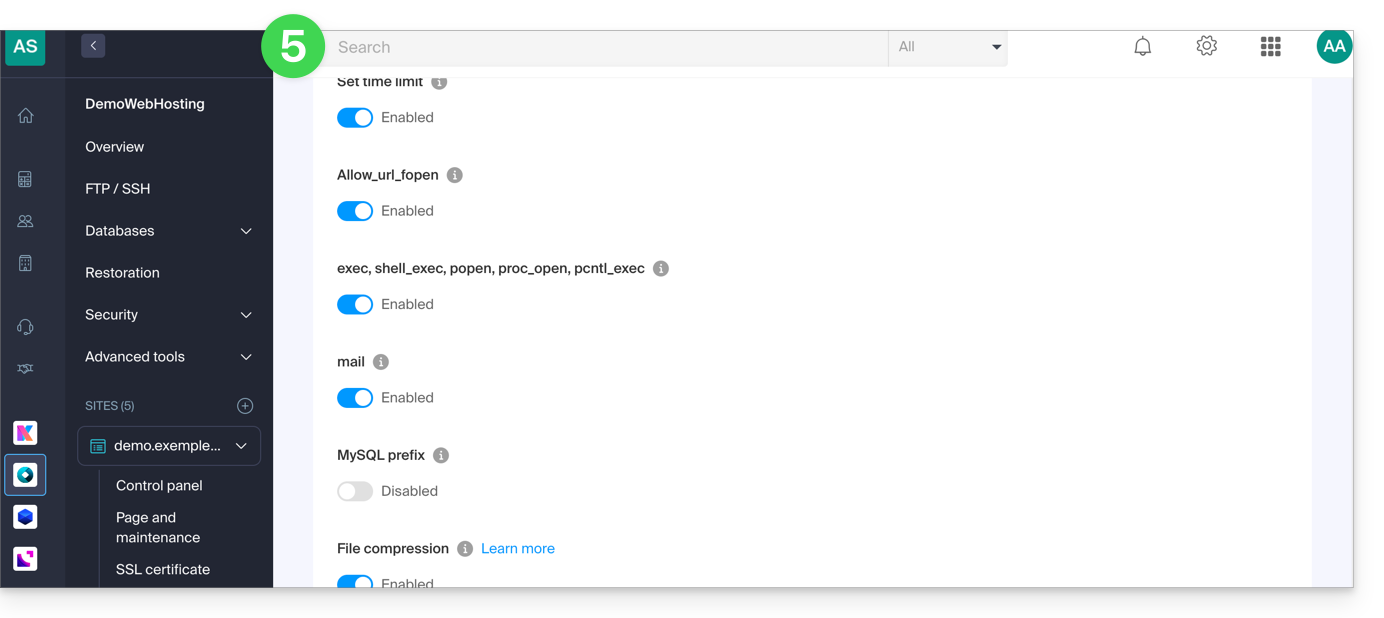
- Click on the Save button at the bottom of the page to validate the changes.
Link to this FAQ:
Has this FAQ been helpful?
This guide explains how to access InnoDB at Infomaniak.
Use the MySQL InnoDB storage engine
As soon as your Infomaniak hosting gives you access to MySQL / MariaDB databases, InnoDB is available at the same time (MyISAM previously).
InnoDB offers advanced features such as ACID transactions, row-level locks, full-text indexes, etc. You can take advantage of these features by using appropriate SQL statements in your queries.
Link to this FAQ:
Has this FAQ been helpful?
This guide explains the principle of URL rewriting (URL Rewriting), an essential technique for SEO and user experience.
Preamble
- Aesthetics and Clarity: transforms a complex URL (
index.php?id=123) into a readable URL (/post-title/). - Referencing (SEO): search engines prioritize URLs containing keywords over technical parameters.
- Security: hides the internal structure of your site and the technologies used (such as
.phpextensions).
URL rewriting example
Consider the URL: article.php?id=25&cat=4. The goal is for it to appear as: /article/25/4/. Here is how to configure your .htaccess file:
# Désactive l'affichage des répertoires et suit les liens symboliques
Options -Indexes +SymLinksIfOwnerMatch
# Active le moteur de réécriture
RewriteEngine on
# Définit la base de réécriture si votre site est dans un sous-dossier (ex: /admin/)
# RewriteBase /admin/
# Règle de réécriture
RewriteRule ^article/([0-9]+)/([0-9]+)/?$ article.php?id=$1&cat=$2 [L,QSA]- [L] (Last): indicates that this is the last rule to apply if the condition is met.
- [QSA] (Query String Append): allows other potential parameters to be preserved at the end of the URL.
Important: implementing these rules does not automatically update your links; you must manually update the internal links in your HTML code or database to use the new format.
Redirect to a main domain (SEO)
To avoid duplicate content, it is imperative to redirect your secondary domains to your main domain in HTTPS.
RewriteEngine On
RewriteCond %{HTTP_HOST} ^domaine-secondaire.xyz [NC,OR]
RewriteCond %{HTTP_HOST} ^www.domaine-secondaire.xyz [NC]
RewriteRule ^(.*)$ https://www.mon-domaine-principal.com/$1 [R=301,L]
The R=301 header tells search engines that the redirect is permanent, thus transferring the SEO "power" to the correct domain.
Link to this FAQ:
Has this FAQ been helpful?
This guide details the errors of type Rejected, too many connections from this host if they occur when visiting a website.
Error origins
429 Too Many Requests
This error occurs when the server is overwhelmed by a large number of requests in a short period of time, which can be due to heavy use of the site or abuse.
503 Service Unavailable
This error can be caused by several factors, including scheduled maintenance work on the server, server overload due to high traffic, or running a script that exceeds the server's resource limits.
Rejected, too many connections from this host
This error occurs when the server rejects connections due to a high number of simultaneous connections from the same IP address. Check the "Access and error logs" on your hosting dashboard to find multiple entries of the form:
[Fri Sep 02 11:40:31] [error] [client 222.111.123.123] Rejected, too many connections from this host. (vhost:domain.xyz uri:/js/modules/blocktopmenu/js/superfish-modified.js current:34 limit:30

[Fri Sep 02 11:40:31] [error] [client 222.111.123.123] Rejected, too many connections from this host. (vhost:domain.xyz uri:/js/modules/blocktopmenu/js/hoverIntent.js current:34 limit:30

[Fri Sep 02 11:40:31] [error] [client 222.111.123.123] Rejected, too many connections from this host. (vhost:domain.xyz uri:/js/modules/productscategory/productscategory.js current:34 limit:30

[Fri Sep 02 11:40:31] [error] [client 222.111.123.123] Rejected, too many connections from this host. (vhost:domain.xyz uri:/modules/feeder/rss.php current:35 limit:30

[Fri Sep 02 11:40:31] [error] [client 222.111.123.123] Rejected, too many connections from this host. (vhost:domain.xyz uri:/js/modules/favoriteproducts/favoriteproducts.js current:34 limit:30
In this example, the IP 222.111.123.123 is executing 30 simultaneous connections on each page, consequently, it is automatically rejected as this may resemble an attack or scan.
Resolution tips
A few tips to resolve these errors:
- Check the scripts that make multiple connections to the server to display data.
- Optimize the affected script(s) so that they require fewer resources.
- Increase the limits of the affected site to allow the script to do everything it needs to do and/or limit the number of simultaneous connections (especially on a Cloud Server where the limits — RAM, execution time, simultaneous connections — can be significantly increased).
- Migrate your hosting to a Cloud Server.
Link to this FAQ:
Has this FAQ been helpful?
This guide explains how to block access to certain directories of a Web Hosting for certain visitors / robots / crawlers by filtering and blocking their IP addresses or hostnames.
Setting up .htaccess rules
Create a .htaccess document at the root of your site and enter the rules intended to block certain IP addresses or bots.
To block visitors based for example on the beginning of their IP address, use the directive "deny from":
Order Deny,Allow
Deny from 123.456.
Allow from all
This means that all requests from an IP address starting with "123.456." will be denied, while all other requests will be allowed. Blocked users will receive an HTTP 403 Forbidden error message.
Block a specific IP address
Order Allow,Deny
Deny from 123.456.789
Allow from all
This means that a single IP address, 123.456.789, is blocked and all other IP addresses can access the site.
Block multiple IP addresses
Order Allow,Deny
Deny from 123.456.789
Deny from 987.654.321
Allow from all
This means that two IP addresses, 123.456.789 and 987.654.321, are blocked and all other IP addresses can access the site.
Block a bot by its user-agent
SetEnvIfNoCase User-Agent "BadBot" BadBot
Order Allow,Deny
Deny from env=BadBot
Allow from all
This means that any bot identified with a user-agent "BadBot" will be blocked and all other users can access the site.
Block access to a specific folder
Order Allow,Deny
Deny from all
This means that all accesses to the folder "/folder" will be blocked, regardless of the IP address or user-agent. An assistant for a similar feature is available in your Infomaniak Manager.
mod_rewrite directives
You can also use the mod_rewrite directive to block certain IP addresses or bots in a .htaccess file.
The mod_rewrite directive can affect the performance of your website if used excessively or incorrectly. It is therefore recommended to be cautious when modifying your .htaccess file.
Here are a few examples:
Block a specific IP address
RewriteEngine on
RewriteCond %{REMOTE_ADDR} ^123\.456\.789\.
RewriteRule ^(.*)$ - [F,L]
This means that a single IP address, 123.456.789, is blocked and all other IP addresses can access the site.
Block multiple IP addresses
RewriteEngine on
RewriteCond %{REMOTE_ADDR} ^123\.456\.789\. [OR]
RewriteCond %{REMOTE_ADDR} ^987\.654\.321\.
RewriteRule ^(.*)$ - [F,L]
This means that two IP addresses, 123.456.789 and 987.654.321, are blocked and all other IP addresses can access the site.
Block a bot by its user-agent
RewriteEngine on
RewriteCond %{HTTP_USER_AGENT} BadBot [NC]
RewriteRule ^(.*)$ - [F,L]
This means that any bot identified with a user-agent "BadBot" will be blocked and all other users can access the site. This can be useful to prevent unwanted robots from accessing certain pages or from consuming resources unnecessarily.
Block access to a specific folder
RewriteEngine on
RewriteRule ^dossier/secret - [F,L]
This means that all accesses to the folder "/folder/secret" will be blocked, regardless of the IP address or user-agent.
Block and redirect elsewhere
RewriteEngine On
RewriteCond %{REMOTE_ADDR} ^123\.456\.789\.
RewriteRule ^(.*)$ http://www.domain.xyz/blocked.html [L,R=301]
This means that all requests from the IP address 123.456.789 will be redirected to the page "blocked.html" on the site "www.domain.xyz". The last part of the line RewriteRule, [L,R=301] indicates that the redirection is permanent (R=301) and that this is the last rule to be applied (L).
You can add multiple conditions RewriteCond to block different IP addresses and redirect to different pages.
Also refer to this other guide.
Link to this FAQ:
Has this FAQ been helpful?
This guide explains how to restore backups of previous versions of your files and other web data from your Infomaniak hostings, and how to set up an effective backup policy if the automatically and freely provided backups no longer meet your availability or security needs.
Web Hostings (Starter, Shared, Cloud Server)
Refer to these guides to restore automatic backups:
- of an entire hosting (FTP + MySQL),
- of specific files on the hosting,
- of specific databases,
- of a Web Application (Wordpress & Apps),
- of Cloud Server SSH crons.
Refer to these guides to backup and restore:
- a hosting with Swiss Backup and Restic (advanced),
- WordPress with Swiss Backup,
- WordPress with an extension.
Also refer to https://faq.infomaniak.com/snapshot.
Messaging
- Restore messages from Infomaniak automatic backups.
- Restore contacts or calendar events.
- Backup the current content of an email account:
- by downloading the current content locally,
- by duplicating all current content to a backup box,
- by copying future emails as they arrive to a backup box.
Domains / DNS Zones
- Restore deleted DNS records from Infomaniak automatic backups.
- Restore an expired domain in redemption period.
Link to this FAQ:
Has this FAQ been helpful?
This guide helps you set up the Access-Control-Allow-Origin header, an HTTP header that specifies which origin (domain, protocol, and port) can access resources on a server. This header is used to control cross-origin (CORS) access from a web application.
List of authorized domains
You can add the origin of a request to the list of authorized domains to access server resources by adding it to the values of the Access-Control-Allow-Origin header.
To authorize, for example, the site https://domain.xyz to access resources with CORS, the header must be as follows:
Access-Control-Allow-Origin: https://domain.xyzYou can set it via the header() function of PHP by referring to this guide in particular.
If you need this header to be applied everywhere, you can use an auto-prepend.
Link to this FAQ:
Has this FAQ been helpful?
This guide helps you understand the different HTTP status codes.
1xx - Information
error 100: Continue
The server has received the request headers and the client may continue to send the request body.
error 101: Switching Protocols
The server agrees to change the communication protocol as requested by the client.
2xx - Success
error 200: Request executed successfully
The request has been successfully processed by the server.
error 201: Document created (reason: new URI)
The request was successful and resulted in the creation of a new resource.
error 202: Request completed asynchronously (TBS)
The request has been accepted but processing is not yet complete.
error 203: Request completed incompletely
The server has successfully processed the request, but the returned information comes from a third-party source.
error 204: No information to return
The request has been successfully processed, but there is no content to return.
error 205: Request completed but form empty
The server has successfully processed the request and asks the client to reset the document that submitted the request.
error 206: Incomplete GET request
The server returns only part of the data, as requested by the client with the Range header.
3xx - Redirections
error 300: The server cannot determine the return code
The request has multiple possible responses, and the server cannot automatically choose one of them.
error 301: Document permanently moved
The requested resource has been permanently moved to a new URL.
error 302: Document temporarily moved
The requested resource is temporarily located at another URL.
error 303: Redirection with new access method
The response to the request can be found under another URL using a GET method.
error 304: The 'If-Modified-Since' field was not modified
The resource has not been modified since the last request. No new data will be returned.
error 305: Redirection to a proxy specified by the header
The requested resource must be accessed through a specified proxy.
error 307: Temporary redirection
The requested resource is temporarily located at another URL, but the client must use the same method to make the next request.
4xx - Client errors
Error 400: Syntax error in the document address
The request is incorrect or malformed.
Error 401: No authorization to access the document
Access to the resource requires authentication.
Error 402: Access to the document subject to payment
This code is reserved for future use regarding online payments. Some services outside of Infomaniak use it in certain cases to indicate a payment problem, but these uses are specific to these platforms — not a global standard.
Error 403: No authorization to access the server
The server understands the request but refuses to authorize it.
Error 404: The requested page does not exist
The server cannot find the requested resource.
Error 405: Form request method not authorized
The method specified in the request is not authorized for the target resource.
Error 406: Request not accepted by the server
The requested resource is not capable of generating acceptable content according to the Accept headers sent in the request.
Error 407: Proxy authorization required
Access to the resource requires authentication by a proxy.
Error 408: Access time to the requested page expired
The server did not receive the complete request within the allotted time.
Error 409: The user must resubmit with more information
The request cannot be processed due to a conflict with the current state of the resource.
Error 410: This resource is no longer available
The requested resource is no longer available and this is permanent.
Error 411: The server refused the request because it has no length
The server refuses to process the request without a valid Content-Length header.
Error 412: The precondition given in the request has failed
One of the conditions specified in the request headers has failed.
Error 413: The request entity was too large
The server refuses to process the request because the entity size is too large.
Error 414: The request URI was too long
The server refuses to process the request because the URI is too long.
Error 415: Unsupported media type
The server refuses to process the request because the format of the request entity is not supported.
5xx - Server errors
Error 500: Internal server error
The server encountered an unexpected condition that prevents it from processing the request.
Error 501: Request made to the server not supported
The server does not support the functionality required to process the request.
Error 502: Bad access gateway
The server, acting as a gateway or proxy, received an invalid response from the upstream server.
Error 503: Service unavailable
The server is not available at the moment (overloaded or undergoing maintenance).
Error 504: Gateway timeout
The server, acting as a gateway or proxy, did not receive a timely response from the upstream server.
Error 505: HTTP version not supported
The server does not support the HTTP protocol version used in the request.
Link to this FAQ:
Has this FAQ been helpful?
This guide concerns the homepage names that can be on your Infomaniak Web Hosting, and which will be prioritized when a visitor accesses your website via its domain name.
Regarding Site Creator, refer to this other guide.
Preamble
- The default homepages on a web server are the first pages that appear when a user accesses a website without specifying a particular file.
- If you simply enter
http://domain.xyzin your browser's address bar, the web server will look for a default homepage to display, for exampleindex.html,index.php,index.htm, or other similar variations.
Priority order of homepages
Here is the priority order of the default pages loaded at Infomaniak:
- index.html
- index.htm
- home.html
- home.htm
- default.html
- default.htm
- index.cgi
- index.php
- index.php5
- index.php4
- index.php3
- default.php
- home.php
- welcome.php
In summary:
- If you have 2 pages at the root of your hosting, thanks to the ranking above, you can see that
index.phpis recognized as a priority overwelcome.php. - It can also be deduced that if you only have
welcome.phpas a page in the root folder, it will be loaded and function as a homepage. - If you have a page
accueil.html, it will not work because this name is not in the list. - When you type
www.domain.xyzin the browser, onlyindex.phpwill be displayed automatically (and to displaywelcome.phpyou will need to type the exact page namewww.domain.xyz/welcome.php).
Customize the default homepage
To set a different default homepage, add DirectoryIndex followed by the appropriate pages in the .htaccess file:
DirectoryIndex accueil.html index.php index.htmlThis means that the web server will first look for a file named home.html. If it does not find home.php, it will look for index.php, then index.html.
Link to this FAQ:
Has this FAQ been helpful?
This guide details the error "Database connection error: could not connect to mysql" that may occur when making changes around an Infomaniak hosting on which the Web app Joomla is installed.
Preamble
- To get the site working again, you need to check and update some information in the Joomla
configuration.phpfile:- The database name — this is often a prefix that has been added before the existing database name and the username (for example
dbnamebefore,abcd_dbnameafter). - The database host server (for example
mysql.domain.xyzbefore,abcd.myd.infomaniak.comafter). - The username that accesses the database (for example
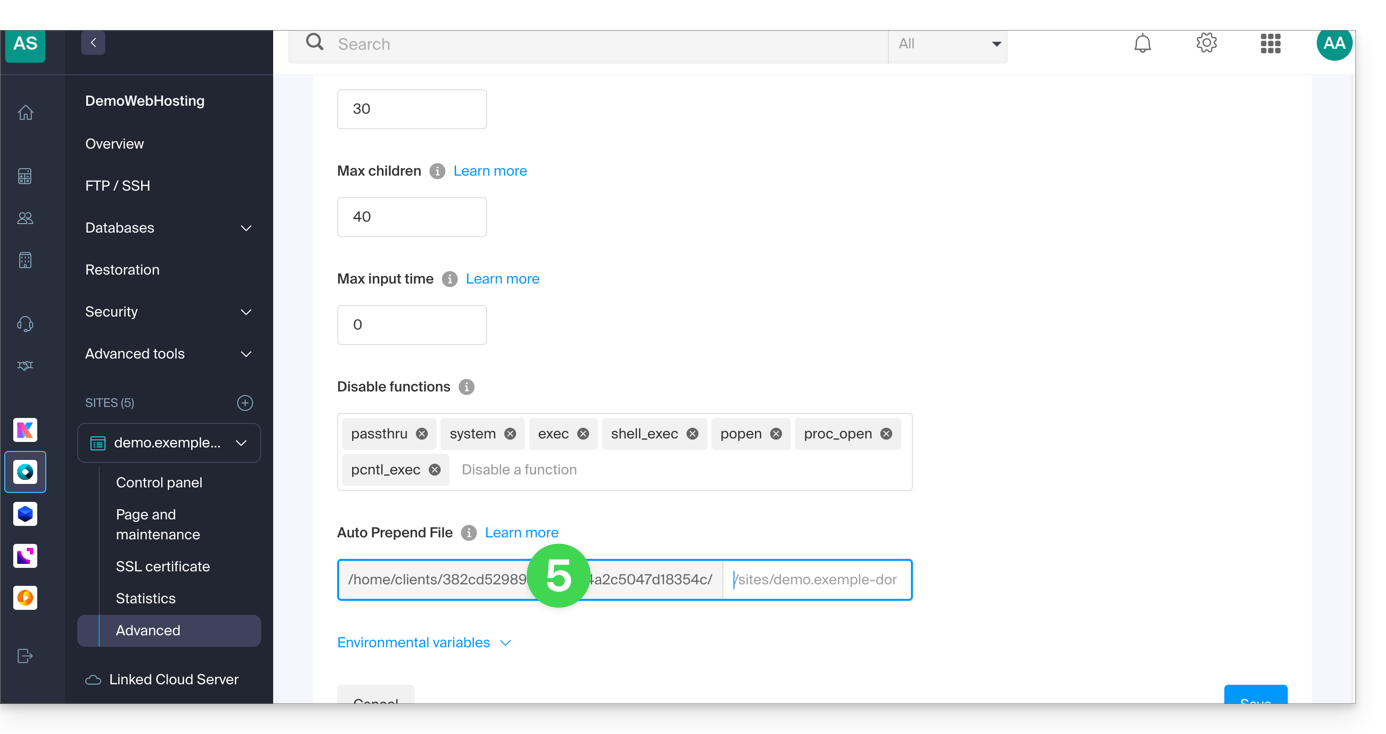
dbuserbefore,abcd_dbuserafter). - The path of two directories
/tmpand/logs.
- The database name — this is often a prefix that has been added before the existing database name and the username (for example
Get the updated information
For points 1, 2 and 3 of the preamble above:
- Click here to access the management of your product on the Infomaniak Manager (need help?).
- Click directly on the name assigned to the product concerned.
- Click on Database in the left sidebar.
- Find and keep your current MySQL information (need help?).
For point 4 of the preamble above:
- Click here to access the management of your site on the Infomaniak Manager (need help?).
- Click directly on the name assigned to the site concerned:
- Click on Manage advanced settings:
- Click on the PHP / Apache tab:
- Copy the path displayed in the first field under Auto Prepend File at the bottom:
Edit the Joomla configuration.php file
Prerequisites
- Create an FTP account (need help?).
- Connect via FTP (need help?).
Then edit the configuration.php file which is in the root folder of your Joomla:
- Replace the old log and tmp paths with the new path:
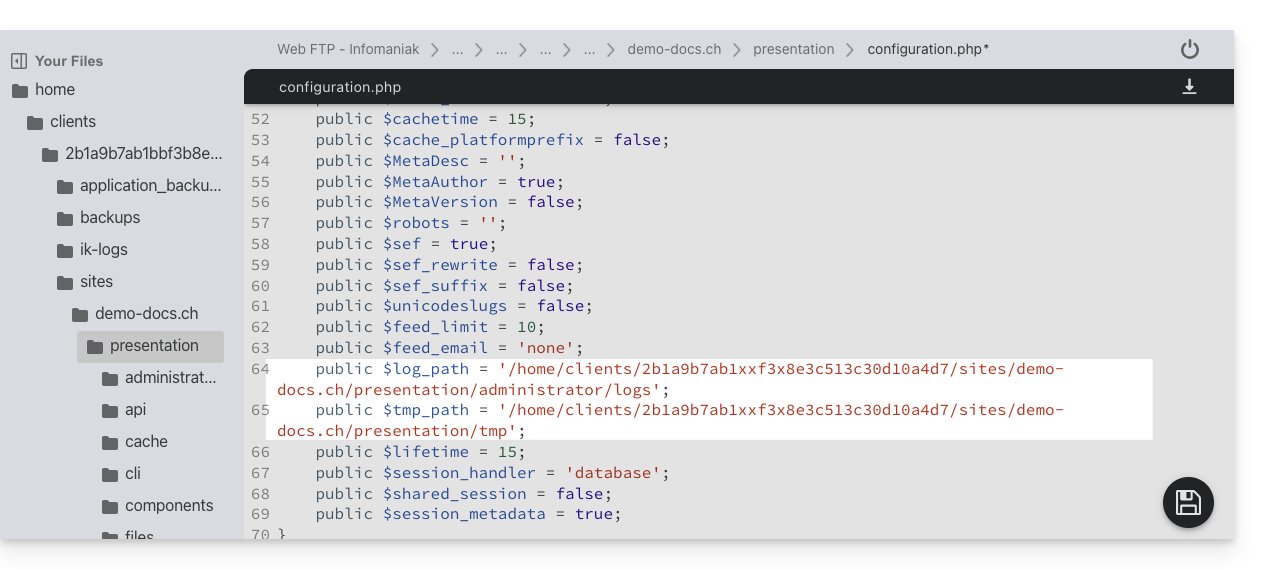
- Find the relevant paragraphs for the rest of the preamble information above:

- Save the file; your Joomla will now connect to the correct database.
Check the changes made
On the Joomla interface, you can check the paths of the /logs and /tmp folders:
- For the
/logsfolder: go to System / Configuration then Logs: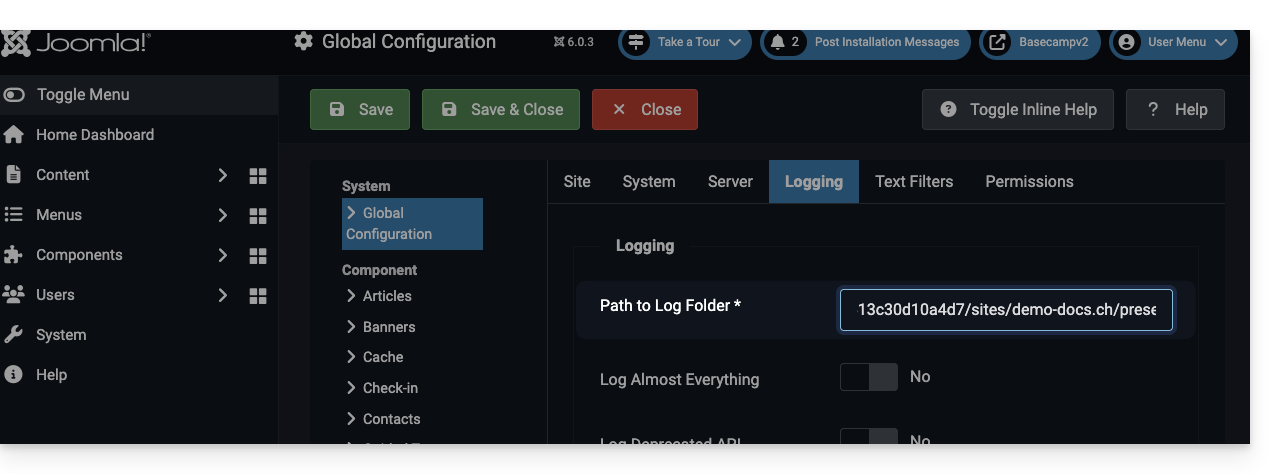
- For the
/tmpfolder: go to System / Configuration then Server: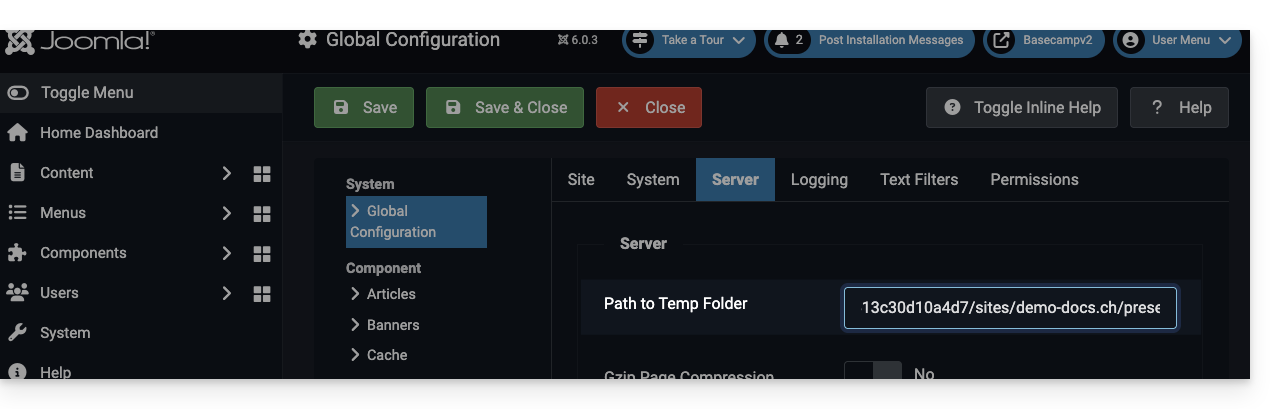
Link to this FAQ:
Has this FAQ been helpful?
This guide concerns IonCube Loader, a PHP module that allows decoding of PHP scripts that have been encoded with IonCube Encoder.
Preamble
- IonCube encoding is used to protect the source code of an application and prevent its modification or illegal distribution.
- By using IonCube Loader, website owners can ensure the security of their code and content while allowing secure and easy distribution of their applications.
Using ionCube Loader
With shared hosting it is no longer offered. You can check this from the dashboard:
- Click here to access the management of your site on the Infomaniak Manager (need help?).
- Click directly on the name assigned to the site concerned:
- Click on Manage advanced settings:
- Click on the PHP Extensions tab.
- Click on ionCube Loader (if present in the list) to see the details:
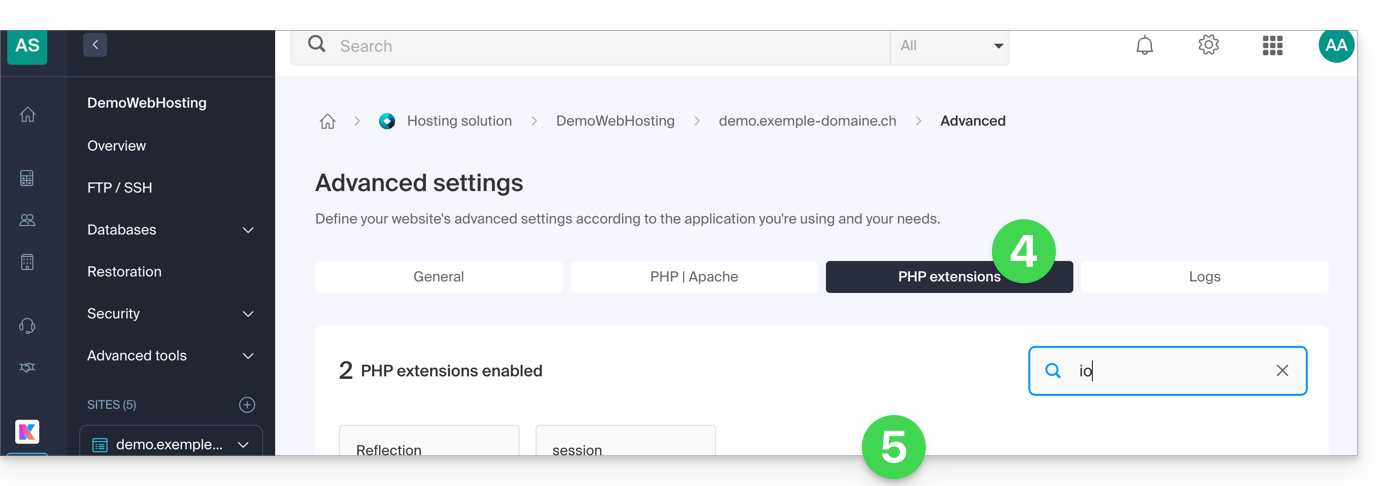
- Here, you will need to consider a Cloud Server.
Link to this FAQ:
Has this FAQ been helpful?
In terms of free software for handling multimedia files, FFmpeg is a powerful and flexible tool. It can be used to convert, edit, and stream videos and audio.
However, using FFmpeg on shared hosting presents certain issues and limitations for both users and hosts.
You should opt for the Cloud Server offer for using FFmpeg.
You can also opt for the Infomaniak VOD/AOD service.
Link to this FAQ:
Has this FAQ been helpful?
This guide explains how to securely and easily transfer files between Web Hosting and/or Cloud Server.
Preamble
- The FXP (File eXchange Protocol) is a method for transferring files directly between two FTP servers without the data passing through the local client.
- Using the FTP PORT and PASV commands, it allows establishing a connection between the two servers for faster and more efficient file transfer, thus saving bandwidth.
- However, this method can present security risks if the connections are not secured by FTPS, and it requires a more complex configuration compared to traditional FTP transfers.
Transferring data between servers
FXP is enabled by default on Cloud Servers and Web Hosting (excluding Starter).
For example, you can use CrossFTP, a multi-platform software that allows FXP (as well as FTP, SFTP, S3, OpenStack Swift…).
Link to this FAQ:
Has this FAQ been helpful?